
We read your photo as:
Explain the components of a TPS, its limitations compared to MIS, and the purpose of a school information system. Also, describe impact and laser printers and identify a key advantage of impact printe
ScanSolve AI Answer
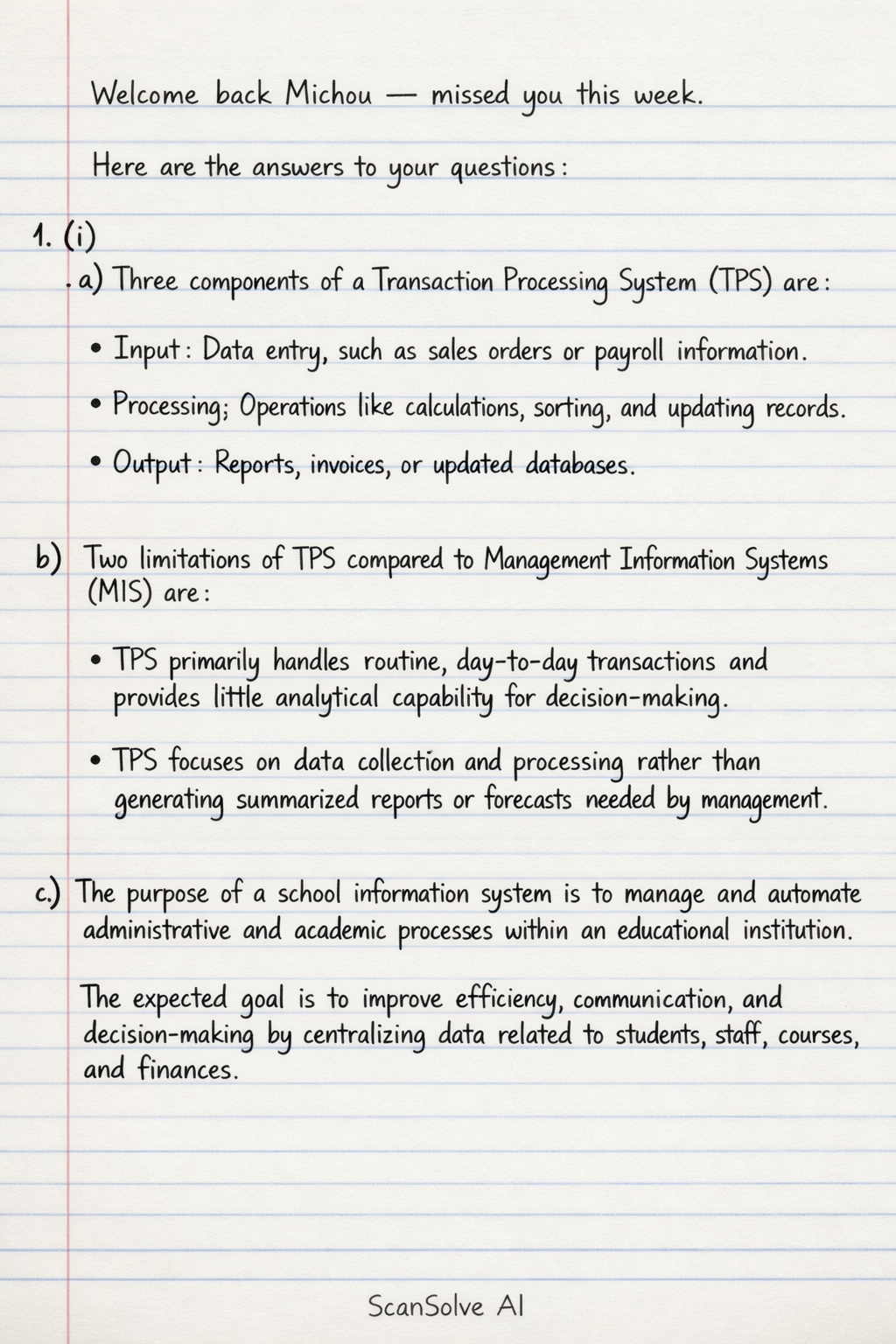
Here are the answers to your questions:
-
(i) a) Three components of a Transaction Processing System (TPS) are:
- Input: Data entry, such as sales orders or payroll information.
- Processing: Operations like calculations, sorting, and updating records.
- Output: Reports, invoices, or updated databases.
b) Two limitations of TPS compared to Management Information Systems (MIS) are:
- TPS primarily handles routine, day-to-day transactions and provides little analytical capability for decision-making.
- TPS focuses on data collection and processing rather than generating summarized reports or forecasts needed by management.
c) The purpose of a school information system is to manage and automate administrative and academic processes within an educational institution. The expected goal is to improve efficiency, communication, and decision-making by centralizing data related to students, staff, courses, and finances.
-
(ii) a)
- Impact Printer:
- They create images by striking an ink ribbon against the paper.
- They are typically noisy during operation.
- Laser Printer:
- They use a laser beam and toner to create images on paper.
- They are known for high-speed and high-quality printing.
b)
- Impact Printer: Can print multi-part forms (carbon copies) due to the physical impact.
- Laser Printer: Produces sharp, high-resolution text and graphics quickly.
c) Another type of printer is an Inkjet printer.
- Impact Printer:
-
(iii) a)
- 1st Generation Computers: Used vacuum tubes as their primary electronic component.
- 3rd Generation Computers: Used integrated circuits (ICs), making them smaller and faster.
b) Two characteristics that determine the power of a laptop computer are:
- Processor Speed (CPU): A faster processor (e.g., higher clock speed, more cores) allows the laptop to execute instructions and perform calculations more quickly, improving overall responsiveness.
- Random Access Memory (RAM): More RAM allows the laptop to run multiple applications simultaneously and handle larger datasets without slowing down, as it provides temporary storage for active programs and data.
Still stuck on this one?
Ask a follow-up, and the answer starts from this question.
More Computer Science Questions
Handwritten Step-by-Step Solution
Get this as a handwritten image on WhatsApp — like a tutor wrote it for you.
Try on WhatsApp