
We read your photo as:
Define TPS, MIS, and Expert System. Explain the term "digital divide".
ScanSolve AI Answer
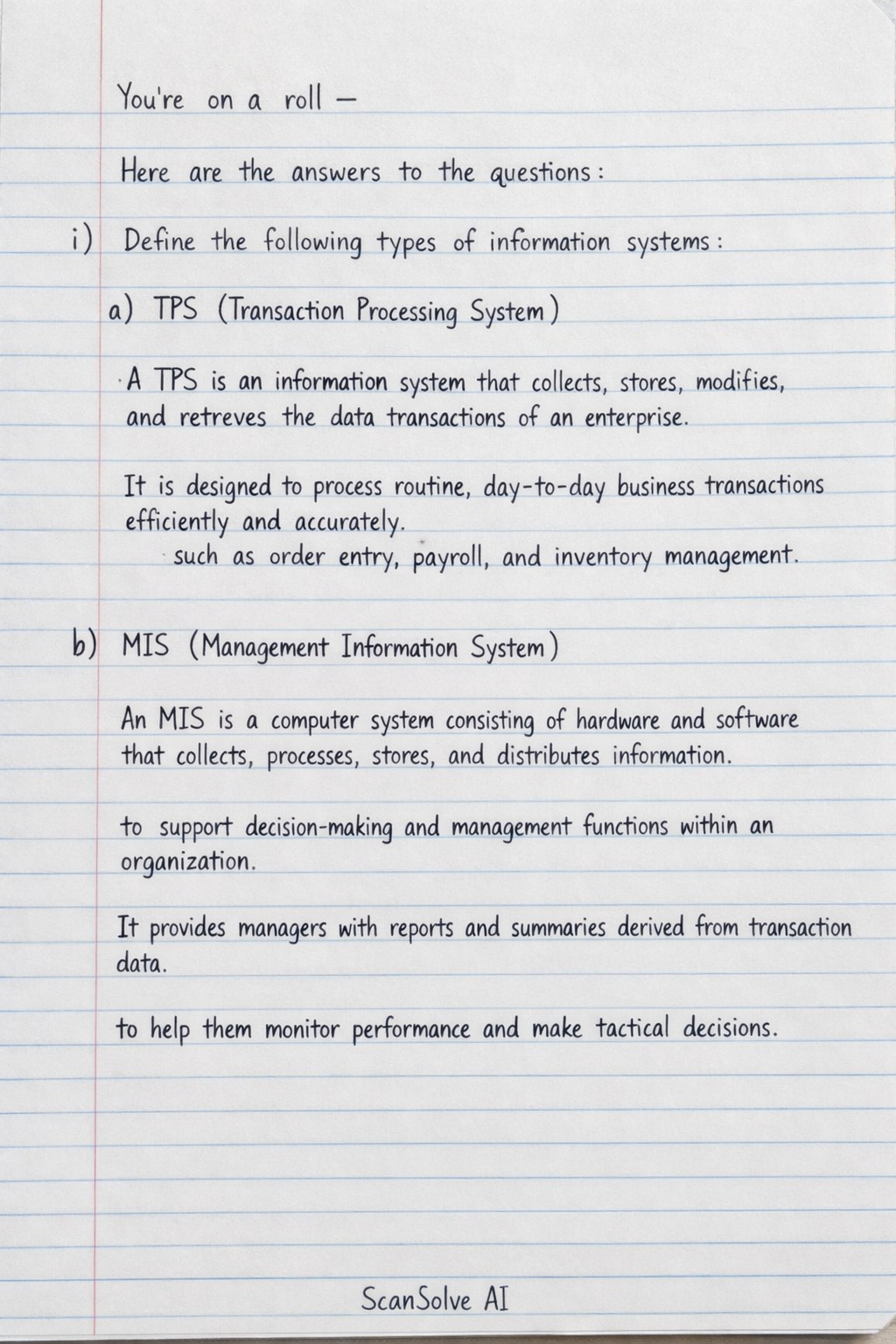
Here are the answers to the questions:
i) Define the following types of information systems.
a) TPS (Transaction Processing System)
A TPS is an information system that collects, stores, modifies, and retrieves the data transactions of an enterprise. It is designed to process routine, day-to-day business transactions efficiently and accurately, such as order entry, payroll, and inventory management.
b) MIS (Management Information System)
An MIS is a computer system consisting of hardware and software that collects, processes, stores, and distributes information to support decision-making and management functions within an organization. It provides managers with reports and summaries derived from transaction data to help them monitor performance and make tactical decisions.
c) Expert system
An expert system is a computer program that simulates the judgment and behavior of a human expert in a specific domain. It uses a knowledge base of facts and rules, along with an inference engine, to solve complex problems and provide advice or recommendations.
ii)
a) Explain the term "digital divide".
The digital divide refers to the gap between individuals, households, businesses, or geographic areas at different socioeconomic levels with regard to both their access to information and communication technologies (ICTs) and their use of the internet for a wide variety of activities.
b) Is digital divide experienced among the students population? Explain your answer.
Yes, the digital divide is experienced among the student population. This is because students from different socioeconomic backgrounds may have varying access to essential digital resources such as personal computers, reliable internet connectivity at home, and digital literacy skills. For example, students from low-income families might lack devices or internet access, putting them at a disadvantage compared to peers who have these resources readily available for online learning and research.
c) Explain two ways digital divide can be reduced in Schools.
- Provide accessible technology and internet: Schools can reduce the digital divide by ensuring all students have access to computers, tablets, or other devices within the school premises, and by offering free, reliable internet access. This could include computer labs, device lending programs, or Wi-Fi hotspots.
- Offer digital literacy training: Schools can implement programs to teach students and even parents essential digital skills, including how to use various software, navigate the internet safely, and critically evaluate online information. This helps bridge the knowledge gap, ensuring all students can effectively utilize available technology.
iii) The Web is one of the services available on the Internet.
a) Differentiate between the Internet and Web.
The Internet is a vast global network of interconnected computer networks that allows computers worldwide to connect and exchange data. It is the underlying infrastructure. The Web (World Wide Web) is a system of interconnected documents and other web resources, accessible via the Internet, that uses HTTP (Hypertext Transfer Protocol) to transmit data. The Web is a service that runs on the Internet, much like email or file transfer.
b) Describe three other services available on the Internet.
- Email (Electronic Mail): A service that allows users to send and receive electronic messages over the Internet. It enables quick and asynchronous communication between individuals or groups, often including attachments like documents or images.
- File Transfer Protocol (FTP): A standard network protocol used for transferring computer files between a client and server on a computer network. It is commonly used for uploading and downloading files, such as website content, to and from web servers.
- Voice over Internet Protocol (VoIP): A technology that allows voice communication and multimedia sessions over Internet Protocol (IP) networks. It enables services like internet telephony, video calls, and conference calls, often at a lower cost than traditional phone services.
c) Describe E-Governance.
E-Governance (Electronic Governance) refers to the application of information and communication technology (ICT) by government agencies to enhance the delivery of government services, improve efficiency, transparency, and accountability, and empower citizens through access to information. It involves using the internet and other digital platforms to interact with citizens, businesses, and other government branches.
Still stuck on this one?
Ask a follow-up, and the answer starts from this question.
More Computer Science Questions
Handwritten Step-by-Step Solution
Get this as a handwritten image on WhatsApp — like a tutor wrote it for you.
Try on WhatsApp