
We read your photo as:
Define and give examples of social media, robotics, and hacking. What factors determine the reliability of an expert system?
ScanSolve AI Answer
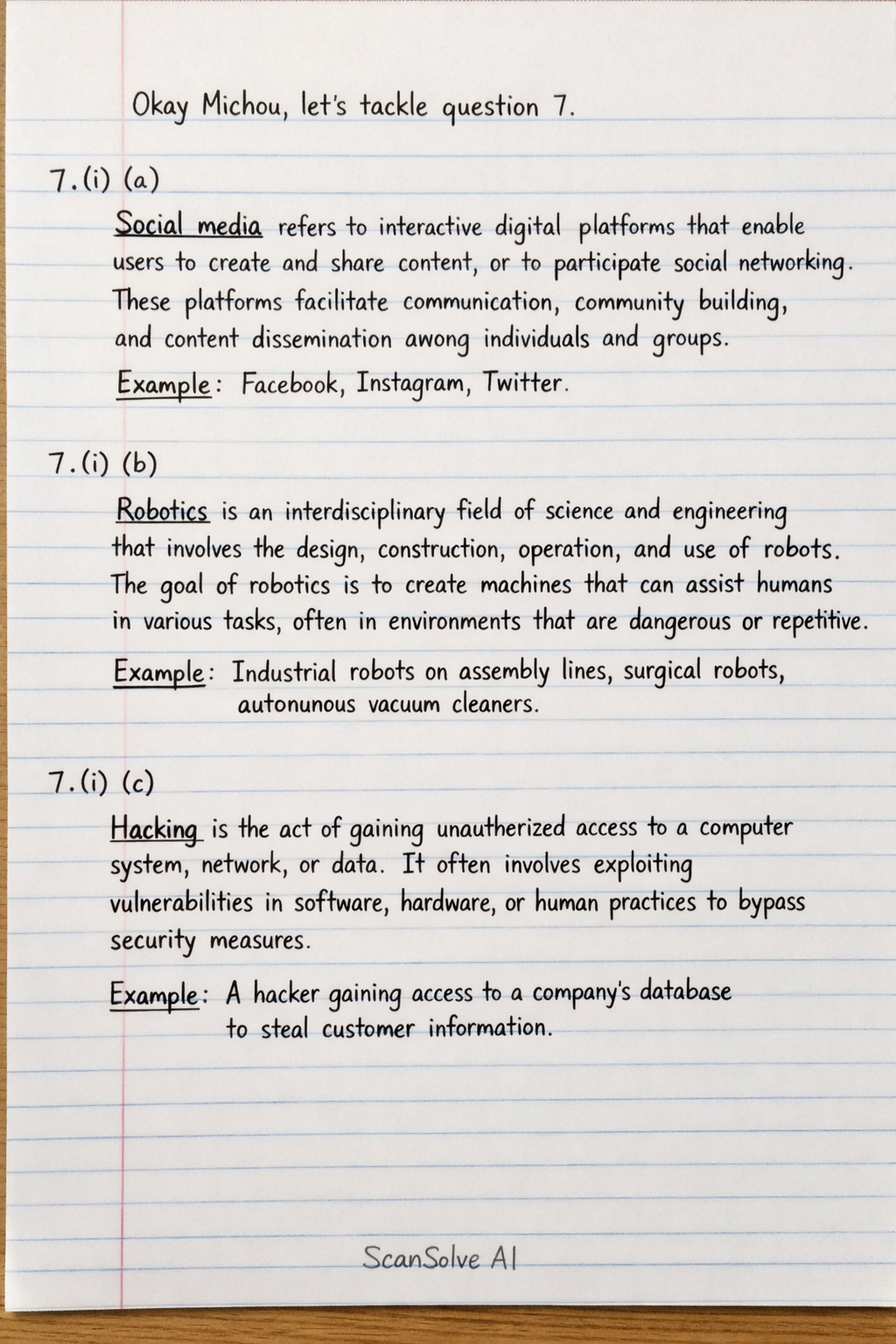
Okay Michou, let's tackle question 7.
7. (i) (a) Social media refers to interactive digital platforms that enable users to create and share content, or to participate in social networking. These platforms facilitate communication, community building, and content dissemination among individuals and groups.
Example: Facebook, Instagram, Twitter.
7. (i) (b) Robotics is an interdisciplinary field of science and engineering that involves the design, construction, operation, and use of robots. The goal of robotics is to create machines that can assist humans in various tasks, often in environments that are dangerous or repetitive.
Example: Industrial robots on assembly lines, surgical robots, autonomous vacuum cleaners.
7. (i) (c) Hacking is the act of gaining unauthorized access to a computer system, network, or data. It often involves exploiting vulnerabilities in software, hardware, or human practices to bypass security measures.
Example: A hacker gaining access to a company's database to steal customer information.
7. (ii) (a) Two factors that determine the reliability of an expert system are:
- Accuracy and Completeness of the Knowledge Base: The system's reliability depends heavily on the quality, accuracy, and comprehensiveness of the rules and facts stored in its knowledge base. Incomplete or incorrect knowledge leads to unreliable outputs.
- Robustness of the Inference Engine: The inference engine's ability to correctly apply the rules, handle uncertainties, and resolve conflicts in the knowledge base directly impacts how reliably the system can derive conclusions.
7. (ii) (b) Two uses of an expert system are:
- Medical Diagnosis: Expert systems can assist doctors in diagnosing diseases by analyzing patient symptoms and medical history against a vast knowledge base of medical conditions.
- Financial Planning: They can provide advice on investments, loan approvals, or tax planning by applying financial rules and market data.
7. (ii) (c) Two limitations of an expert system are:
- Lack of Common Sense: Expert systems operate strictly based on their programmed knowledge and rules, lacking the ability to apply common sense or intuition that human experts possess.
- Difficulty in Acquiring Knowledge: Building the knowledge base is a complex and time-consuming process, as it requires extracting and formalizing expertise from human experts, which can be challenging and expensive.
7. (iii) (a) Simulation involves creating a computer model of a real-world system or process to observe its behavior over time under various conditions without actually building it. It focuses on understanding how a system works.
Prototyping involves building a preliminary working model (a prototype) of a system or product to test concepts, gather feedback, and refine requirements early in the development cycle. It focuses on creating a tangible, albeit incomplete, version of the final product.
7. (iii) (b) The steps used in prototyping typically include:
- Identify Basic Requirements: Gather initial, high-level requirements from users.
- Develop Initial Prototype: Build a quick, rudimentary working model based on these requirements.
- Review and Refine: Present the prototype to users for feedback and identify necessary changes or new requirements.
- Revise and Enhance: Modify the prototype based on feedback, iterating through steps 2 and 3 until the prototype meets user expectations.
7. (iii) (c) One advantage of prototyping is that it reduces development risk and cost by identifying design flaws and requirement misunderstandings early in the project, before significant resources are committed to the final product.
Still stuck on this one?
Ask a follow-up, and the answer starts from this question.
More Computer Science Questions
Handwritten Step-by-Step Solution
Get this as a handwritten image on WhatsApp — like a tutor wrote it for you.
Try on WhatsApp