
We read your photo as:
Explain the fundamental characteristics of an expert system, the definition of an expert system shell, and why it reduces development time.
ScanSolve AI Answer
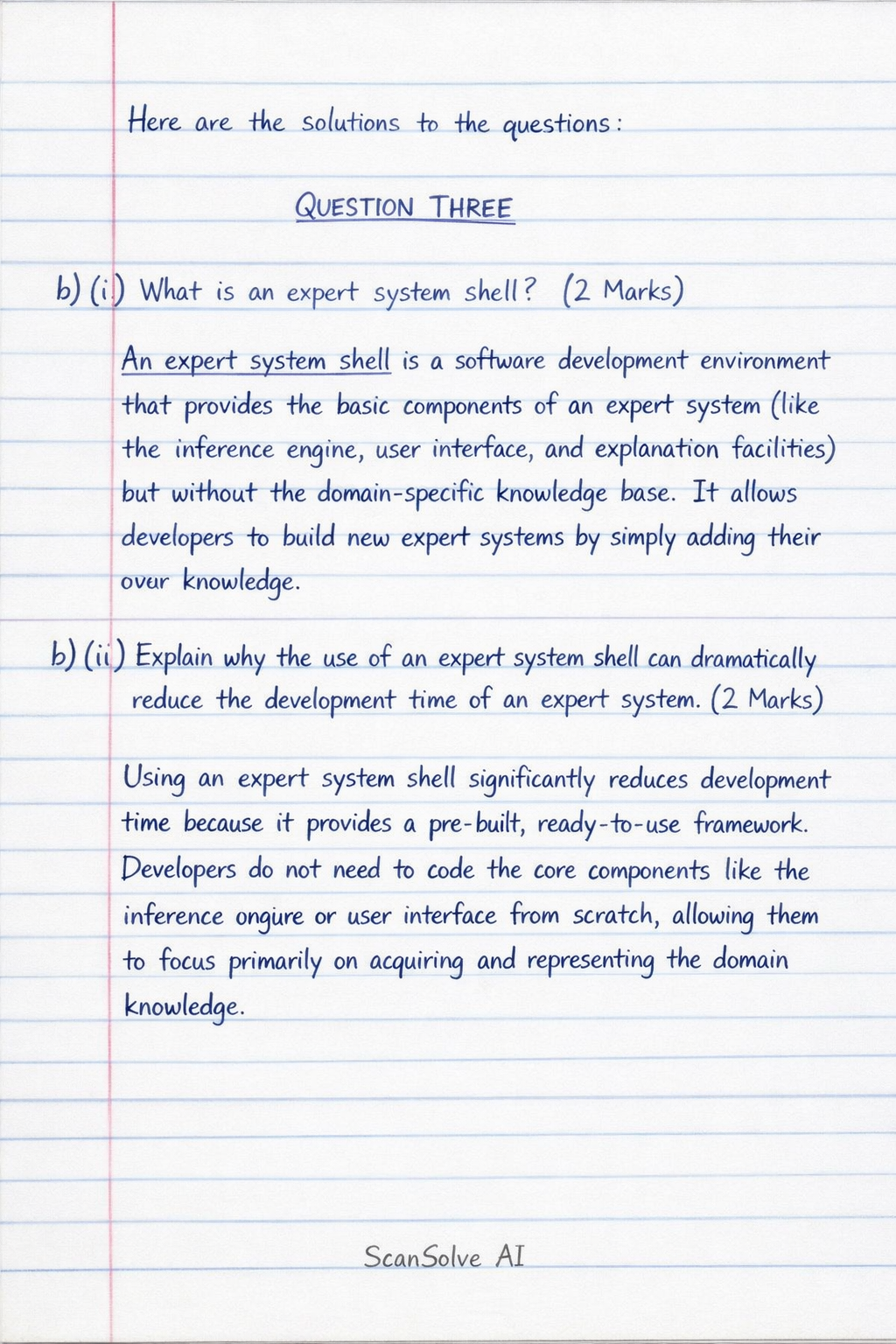
Here are the solutions to the questions:
QUESTION THREE
b) (i) What is an expert system shell? (2 Marks)
An expert system shell is a software development environment that provides the basic components of an expert system (like the inference engine, user interface, and explanation facilities) but without the domain-specific knowledge base. It allows developers to build new expert systems by simply adding their own knowledge.
b) (ii) Explain why the use of an expert system shell can dramatically reduce the development time of an expert system (2 Marks)
Using an expert system shell significantly reduces development time because it provides a pre-built, ready-to-use framework. Developers do not need to code the core components like the inference engine or user interface from scratch, allowing them to focus primarily on acquiring and representing the domain knowledge.
c) List the fundamental characteristics of an expert system (4 Marks)
- High performance: Solves problems at an expert level.
- Adequate response time: Provides solutions within a reasonable timeframe.
- Reliability: Consistently produces correct and dependable results.
- Understandability: Can explain its reasoning process to the user.
- Flexibility: Can be easily modified and updated with new knowledge.
- Symbolic reasoning: Manipulates symbols and uses heuristics.
QUESTION FOUR (15 MARKS)
a) Show in tabular form a comparative analysis of expert system with conventional systems and human expert (4 marks)
| Feature | Expert System | Conventional System | Human Expert |
|---|---|---|---|
| Knowledge | Explicit, symbolic, rule-based | Implicit, procedural, data-based | Tacit, experience-based, intuitive |
| Reasoning | Heuristic, symbolic, inference engine | Algorithmic, deterministic, sequential | Intuitive, adaptive, learning |
| Explanation | Can explain its reasoning | Cannot explain its reasoning | Can explain, but may be subjective |
| Modification | Easy to modify knowledge base | Difficult to modify (requires code changes) | Adapts through learning and experience |
| Error Handling | Handles incomplete/uncertain data | Requires complete and accurate data | Can make errors, but learns from them |
| Performance | Consistent, tireless, can exceed human speed | Consistent, but limited by programmed logic | Variable, can be affected by fatigue/emotion |
b) (i) Discuss forward chaining and backward chaining inference techniques (3 marks)
- Forward Chaining: This is a data-driven approach. The inference engine starts with known facts and rules, then repeatedly applies the rules to infer new facts until a goal is reached or no more rules can be applied. It works from "facts to conclusions."
- Backward Chaining: This is a goal-driven approach. The inference engine starts with a hypothesis (a potential conclusion) and works backward to find facts that support it. It tries to prove the hypothesis by finding rules whose conclusions match the hypothesis and then trying to prove the premises of those rules. It works from "conclusions to facts."
b) (ii) Show with neat diagram the Inference engine cycles via match-free procedure (3 marks)
The inference engine cycle typically involves three main steps:
Still stuck on this one?
Ask a follow-up, and the answer starts from this question.
More Computer Science Questions
Handwritten Step-by-Step Solution
Get this as a handwritten image on WhatsApp — like a tutor wrote it for you.
Try on WhatsApp