
We read your photo as:
What is an expert system and define AI, Disabilities, and JAWS? Explain the data processing cycle and its components.
ScanSolve AI Answer
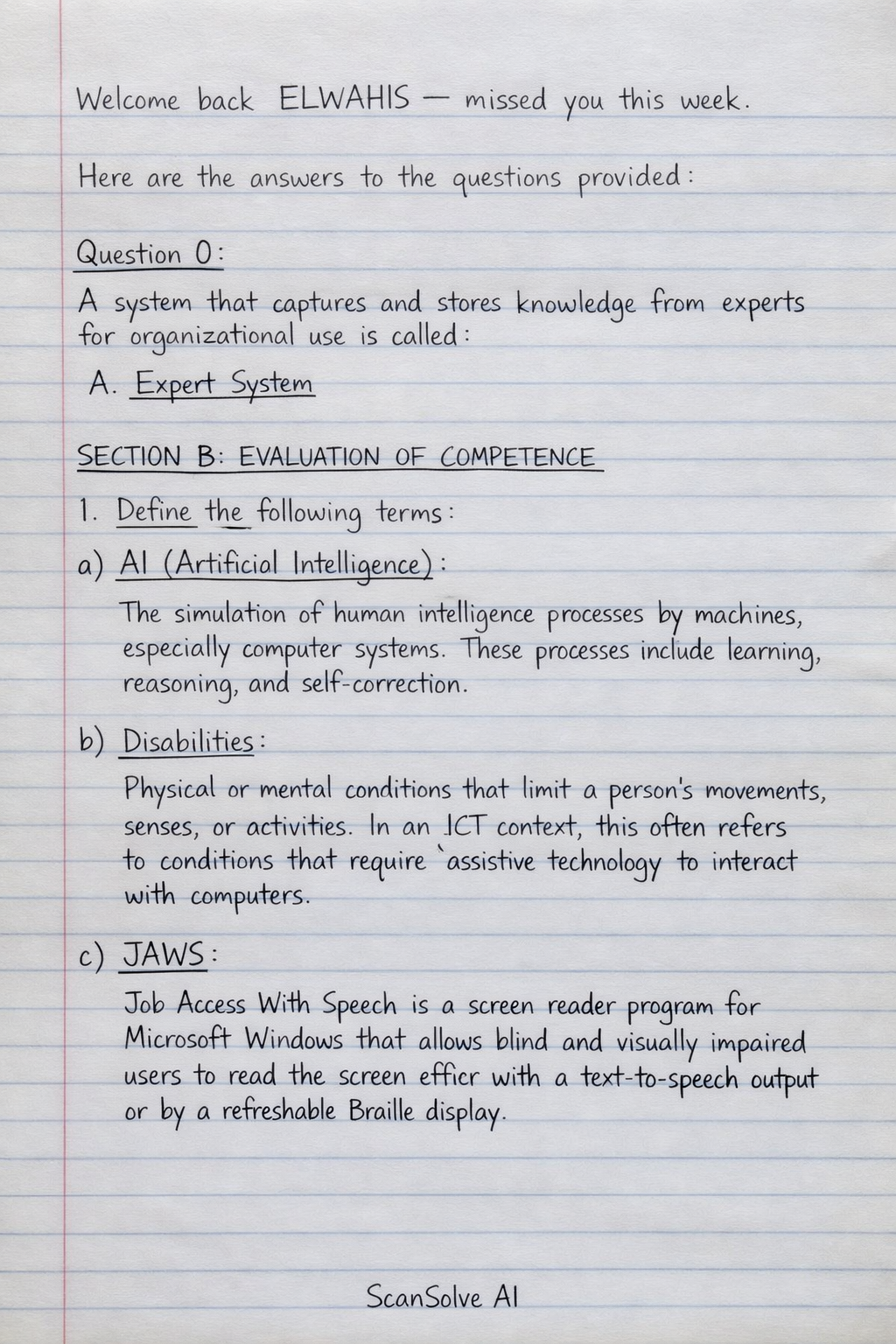
Here are the answers to the questions provided:
Question 0:
A system that captures and stores knowledge from experts for organizational use is called:
A. Expert System
SECTION B: EVALUATION OF COMPETENCE
1. Define the following terms:
a) AI (Artificial Intelligence): The simulation of human intelligence processes by machines, especially computer systems. These processes include learning, reasoning, and self-correction.
b) Disabilities: Physical or mental conditions that limit a person's movements, senses, or activities. In an ICT context, this often refers to conditions that require assistive technology to interact with computers.
c) JAWS: Job Access With Speech is a screen reader program for Microsoft Windows that allows blind and visually impaired users to read the screen either with a text-to-speech output or by a refreshable Braille display.
2. a) What do you mean by data processing cycle?
The data processing cycle is a series of steps that raw data goes through to be converted into meaningful information. It typically involves input, processing, output, and storage.
2. b) State the components of data processing cycle with two devices in each case.
- Input: Devices used to enter raw data into the system.
- Examples: Keyboard, Mouse
- Processing: The manipulation and transformation of data into information.
- Examples: Central Processing Unit (CPU), Graphics Processing Unit (GPU)
- Output: Devices used to display or present the processed information to the user.
- Examples: Monitor, Printer
- Storage: Devices used to save data and information for future use.
- Examples: Hard Disk Drive (HDD), Solid State Drive (SSD)
2. c) Describe any four components of an information system.
- Hardware: The physical components of an information system, such as computers, servers, and peripheral devices.
- Software: The programs and applications that control the hardware and process data, including operating systems and application software.
- Data: The raw facts, figures, and statistics that are collected, processed, and stored by the system.
- People: The users, operators, and developers who interact with and manage the information system.
- Procedures: The rules, guidelines, and instructions that govern how the information system is used and operated.
3. a) Distinguish between management and decision support system.
- Management Information System (MIS): Provides routine reports and summaries to managers to help them monitor and control operations, focusing on structured decisions and historical data.
- Decision Support System (DSS): Helps managers make non-routine, semi-structured, or unstructured decisions by providing tools for analysis, modeling, and "what-if" scenarios, often using data from MIS and external sources.
3. b) On your way to school, you saw someone by the road side begging because he had an accident and lost his limbs. As an ICT student what advice can you give that can enable this man regain his job.
As an ICT student, I would advise him to:
- Explore assistive technologies such as voice recognition software, specialized keyboards, or screen readers to enable him to operate a computer despite his physical limitations.
- Seek retraining in ICT skills that can be performed remotely or with adaptive tools, such as data entry, web design, or online customer support, which can open up new job opportunities.
Section Two: (20 Marks)
Question 1:
The questions 1-10 for the True/False section are not visible in the image provided. Please send the questions for this section.
Still stuck on this one?
Ask a follow-up, and the answer starts from this question.
More Computer Science Questions
Handwritten Step-by-Step Solution
Get this as a handwritten image on WhatsApp — like a tutor wrote it for you.
Try on WhatsApp