
We read your photo as:
Explain data security, its threats and countermeasures, and the Data Protection Act. Also, define Artificial Intelligence.
ScanSolve AI Answer
Question 2 (i)
a) Data security refers to the protective measures applied to prevent unauthorized access, corruption, or theft of data throughout its lifecycle. It ensures the confidentiality, integrity, and availability of information.
b)
Threats to data safety:
- Malware: Malicious software like viruses or ransomware can infect systems, corrupt data, or steal sensitive information.
- Phishing: Deceptive attempts to trick individuals into revealing sensitive data, such as usernames, passwords, and credit card details, often through fake emails or websites.
Methods to combat these threats:
- Antivirus software: Programs designed to detect, prevent, and remove malicious software from computer systems.
- Firewalls: Network security systems that monitor and control incoming and outgoing network traffic based on predetermined security rules, blocking unauthorized access.
c) The Data Protection Act is a law designed to protect personal data stored on computers or in organized paper filing systems. It sets out principles for how personal information should be handled, ensuring it is used fairly, lawfully, and securely.
Question 2 (ii)
a) Artificial Intelligence (AI) is the simulation of human intelligence processes by machines, especially computer systems. These processes include learning, reasoning, problem-solving, perception, and language understanding.
b)
Two areas where AI is being applied:
- Healthcare: AI is used in medical imaging analysis for disease detection, drug discovery, and personalized treatment plans.
- Autonomous vehicles: AI powers self-driving cars, enabling them to perceive their environment, navigate, and make driving decisions without human intervention.
c) One way to use artificial intelligence in studies out of school is by using AI-powered language translation tools to understand academic papers or resources written in foreign languages, expanding access to information.
Question 2 (iii)
a) A file extension is a suffix at the end of a computer file name, typically three or four characters long, separated from the base file name by a dot. It indicates the file format and tells the operating system which application can open or run the file.
b)
| File type | Example of file extension |
|---|---|
| Audio | .mp3 |
| Video | .mp4 |
| Spreadsheet | .xlsx |
| Picture | .jpg |
| Document | .docx |
| Hypermedia | .html |
Question 2 (iv)
Robotics is the branch of engineering and computer science that deals with the design, construction, operation, and application of robots.
One application of a robot in an industry is assembly line manufacturing, where robots perform repetitive tasks like welding, painting, or picking and placing components with high precision and speed.
Question 2 (v)
- 2nd generation computers: Used transistors as their main electronic component, making them smaller, faster, and more energy-efficient than first-generation computers.
- 5th generation computers: Characterized by artificial intelligence and parallel processing, aiming to create machines that can understand natural language and solve complex problems.
Still stuck on this one?
Ask a follow-up, and the answer starts from this question.
More Computer Science Questions
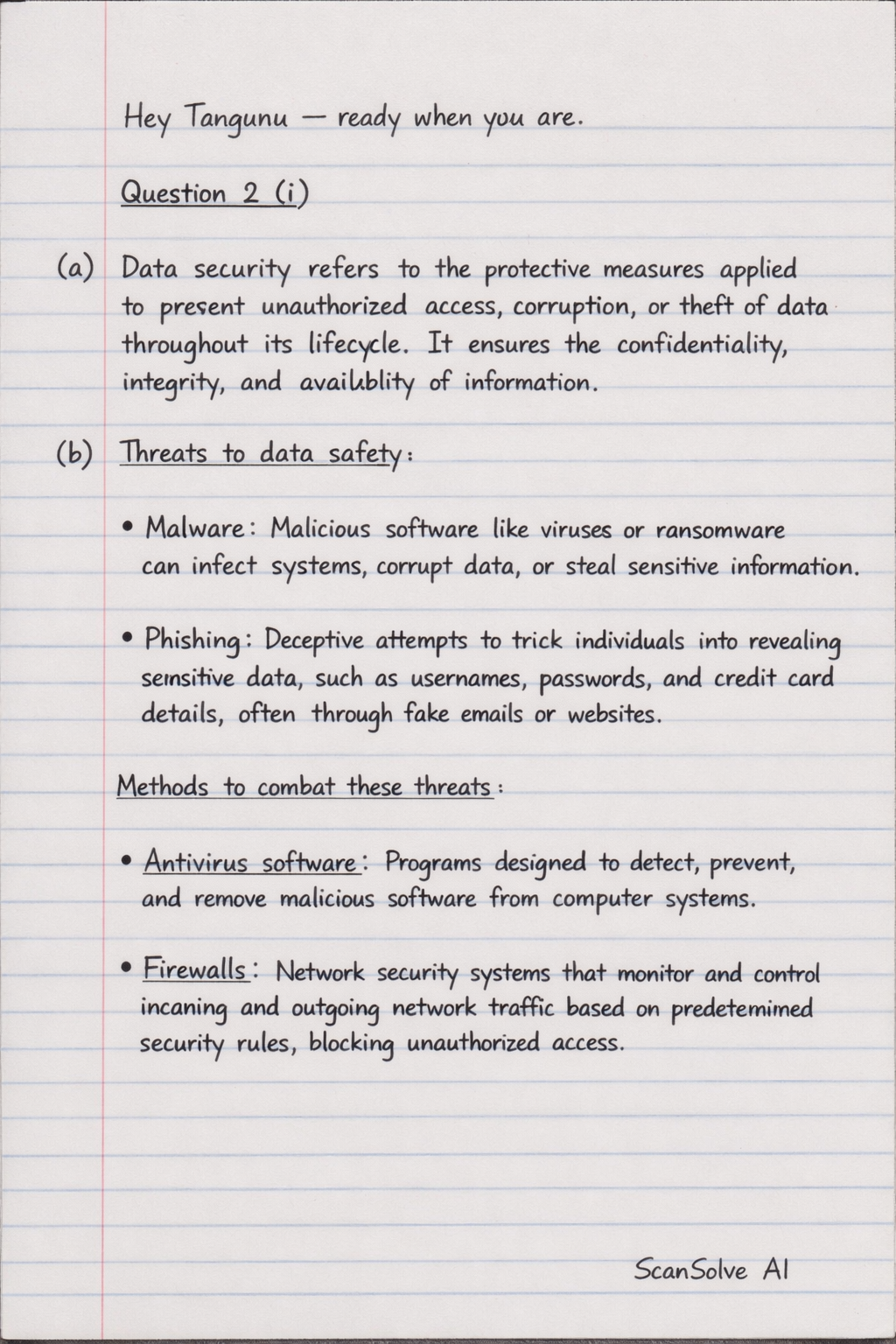
Handwritten Step-by-Step Solution
Get this as a handwritten image on WhatsApp — like a tutor wrote it for you.
Try on WhatsApp