
![Define the convolution sum and determine the non-zero ranges for the signals involved in the convolution of x[n] and h[n].](/_next/image?url=https%3A%2F%2Fohijasnjvprzodcmxltt.supabase.co%2Fstorage%2Fv1%2Fobject%2Fpublic%2Fwhatsapp-images%2F1775736798339-b17ed89b97891547.png&w=3840&q=75)
This computer science problem involves algorithmic thinking and programming concepts. The solution below explains the approach, logic, and implementation step by step.
ScanSolve AI Answer
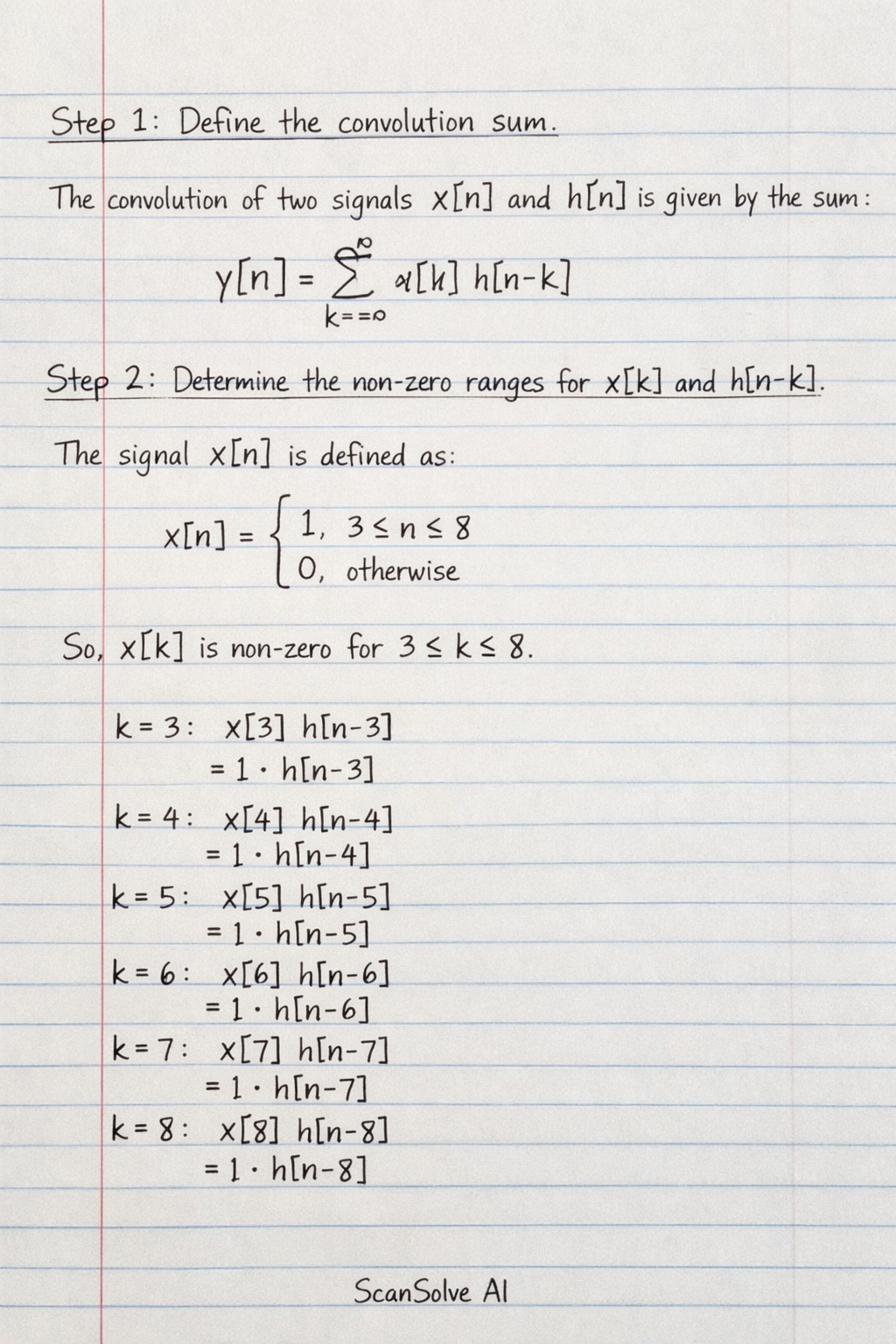
Step 1: Define the convolution sum. The convolution of two discrete-time signals x[n] and h[n] is given by the sum: y[n] = _k=-^ x[k] h[n-k] Step 2: Determine the non-zero ranges for x[k] and h[n-k]. The signal x[n] is defined as: x[n] = 1, & 3 n 8 \\ 0, & otherwise So, x[k] is non-zero for 3 k 8.