
We read your photo as:
| Decimal | Binary | Octal | Hexadecimal |
ScanSolve AI Answer
Step-by-step solution
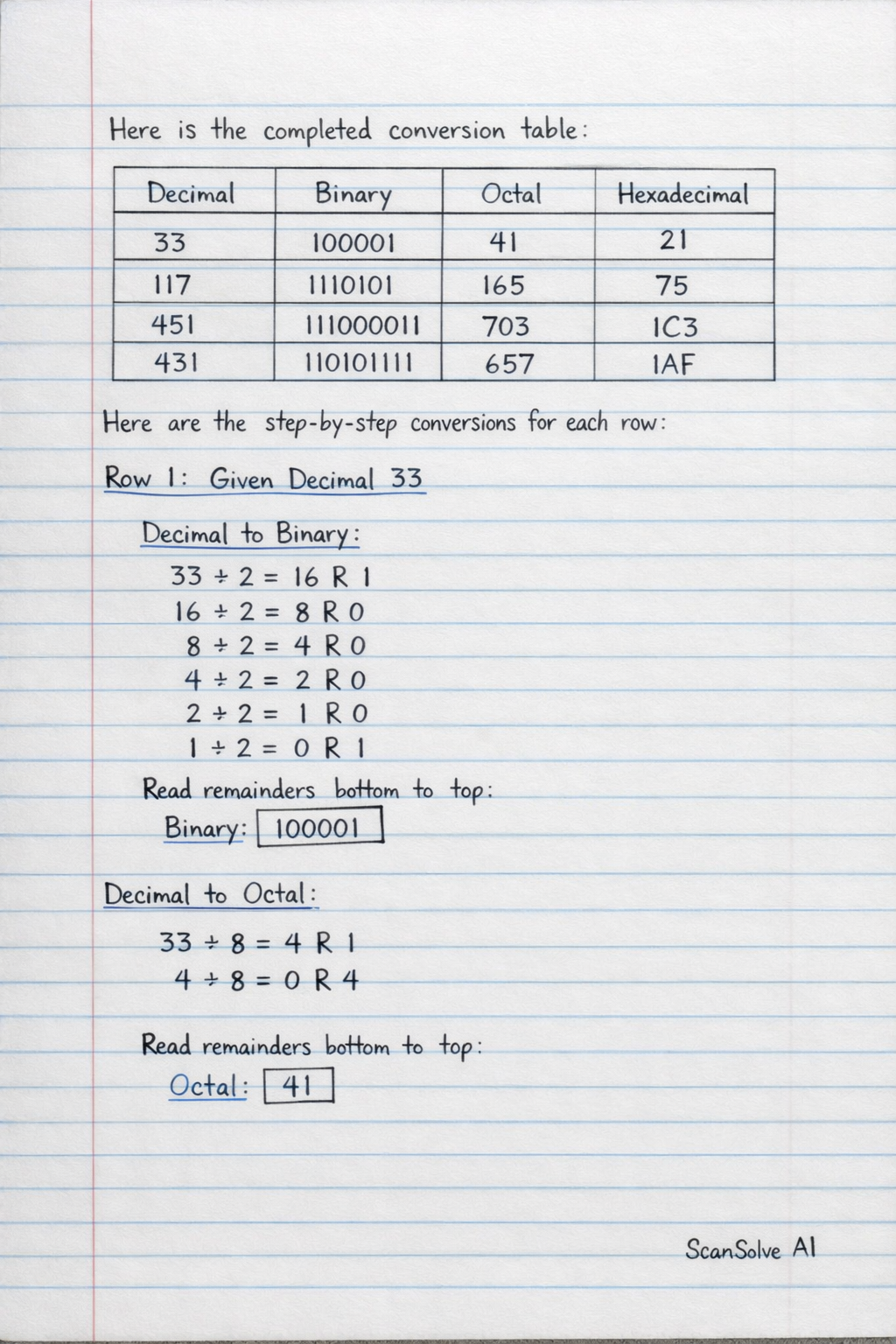
26 stepsHere is the completed conversion table:
| Decimal | Binary | Octal | Hexadecimal |
|---|---|---|---|
| 33 | 100001 | 41 | 21 |
| 117 | 1110101 | 165 | 75 |
| 451 | 111000011 | 703 | 1C3 |
| 431 | 110101111 | 657 | 1AF |
Here are the step-by-step conversions for each row:
Row 1: Given Decimal 33
- Decimal to Binary:
Divide 33 by 2 repeatedly and record the remainders.
$$ 33 \div 2 = 16 \text{ R } 1 $$ $$ 16 \div 2 = 8 \text{ R } 0 $$ $$ 8 \div 2 = 4 \text{ R } 0 $$ $$ 4 \div 2 = 2 \text{ R } 0 $$ $$ 2 \div 2 = 1 \text{ R } 0 $$ $$ 1 \div 2 = 0 \text{ R } 1 $$Read the remainders from bottom to top.
Binary: $\boxed{\text{100001}}$- Decimal to Octal:
Divide 33 by 8 repeatedly and record the remainders.
$$ 33 \div 8 = 4 \text{ R } 1 $$ $$ 4 \div 8 = 0 \text{ R } 4 $$Read the remainders from bottom to top.
Octal: $\boxed{\text{41}}$- Decimal to Hexadecimal:
Divide 33 by 16 repeatedly and record the remainders.
$$ 33 \div 16 = 2 \text{ R } 1 $$ $$ 2 \div 16 = 0 \text{ R } 2 $$Read the remainders from bottom to top.
Hexadecimal: $\boxed{\text{21}}$Row 2: Given Binary 1110101
- Binary to Decimal:
Assign powers of 2 to each binary digit from right to left, starting with .
$$ 1 \cdot 2^6 + 1 \cdot 2^5 + 1 \cdot 2^4 + 0 \cdot 2^3 + 1 \cdot 2^2 + 0 \cdot 2^1 + 1 \cdot 2^0 $$Calculate the sum.
$$ 64 + 32 + 16 + 0 + 4 + 0 + 1 = 117 $$ Decimal: $\boxed{\text{117}}$- Binary to Octal:
Group the binary digits into sets of three from right to left.
Add leading zeros if necessary.
Convert each group of three binary digits to its octal equivalent.
$$ 001_2 = 1_8 $$ $$ 110_2 = 6_8 $$ $$ 101_2 = 5_8 $$ Octal: $\boxed{\text{165}}$- Binary to Hexadecimal:
Group the binary digits into sets of four from right to left.
Add leading zeros if necessary.
Convert each group of four binary digits to its hexadecimal equivalent.
$$ 0111_2 = 7_{16} $$ $$ 0101_2 = 5_{16} $$ Hexadecimal: $\boxed{\text{75}}$Row 3: Given Octal 703
- Octal to Decimal:
Assign powers of 8 to each octal digit from right to left, starting with .
$$ 7 \cdot 8^2 + 0 \cdot 8^1 + 3 \cdot 8^0 $$Calculate the sum.
$$ 7 \cdot 64 + 0 \cdot 8 + 3 \cdot 1 = 448 + 0 + 3 = 451 $$ Decimal: $\boxed{\text{451}}$- Octal to Binary:
Convert each octal digit to its 3-bit binary equivalent.
$$ 7_8 = 111_2 $$ $$ 0_8 = 000_2 $$ $$ 3_8 = 011_2 $$Combine the binary groups.
Binary: $\boxed{\text{111000011}}$- Octal to Hexadecimal:
Convert Octal to Binary (as above).
$$ 703_8 = 111000011_2 $$Group the binary digits into sets of four from right to left.
Add leading zeros if necessary.
Convert each group of four binary digits to its hexadecimal equivalent.
$$ 0001_2 = 1_{16} $$ $$ 1100_2 = C_{16} $$ $$ 0011_2 = 3_{16} $$ Hexadecimal: $\boxed{\text{1C3}}$Row 4: Given Hexadecimal 1AF
- Hexadecimal to Decimal:
Assign powers of 16 to each hexadecimal digit from right to left, starting with .
(Note: A=10, F=15)
Calculate the sum.
$$ 1 \cdot 256 + 10 \cdot 16 + 15 \cdot 1 = 256 + 160 + 15 = 431 $$ Decimal: $\boxed{\text{431}}$- Hexadecimal to Binary:
Convert each hexadecimal digit to its 4-bit binary equivalent.
$$ 1_{16} = 0001_2 $$ $$ A_{16} = 1010_2 $$ $$ F_{16} = 1111_2 $$Combine the binary groups.
Leading zeros can be omitted.
Binary:- Hexadecimal to Octal:
Convert Hexadecimal to Binary (as above).
$$ 1AF_{16} = 000110101111_2 $$Group the binary digits into sets of three from right to left.
Add leading zeros if necessary.
Convert each group of three binary digits to its octal equivalent.
$$
000_2 = 0_8
$$
$$
110_2 = 6_8
$$
$$
101_2 = 5_8
$$
$$
111_2 = 7_8
$$
Octal: $\boxed{\text{657}}$
Still stuck on this one?
Ask a follow-up, and the answer starts from this question.
More Computer Science Questions
Handwritten Step-by-Step Solution
Get this as a handwritten image on WhatsApp — like a tutor wrote it for you.
Try on WhatsApp