

This computer science problem involves algorithmic thinking and programming concepts. The solution below explains the approach, logic, and implementation step by step.
ScanSolve AI Answer
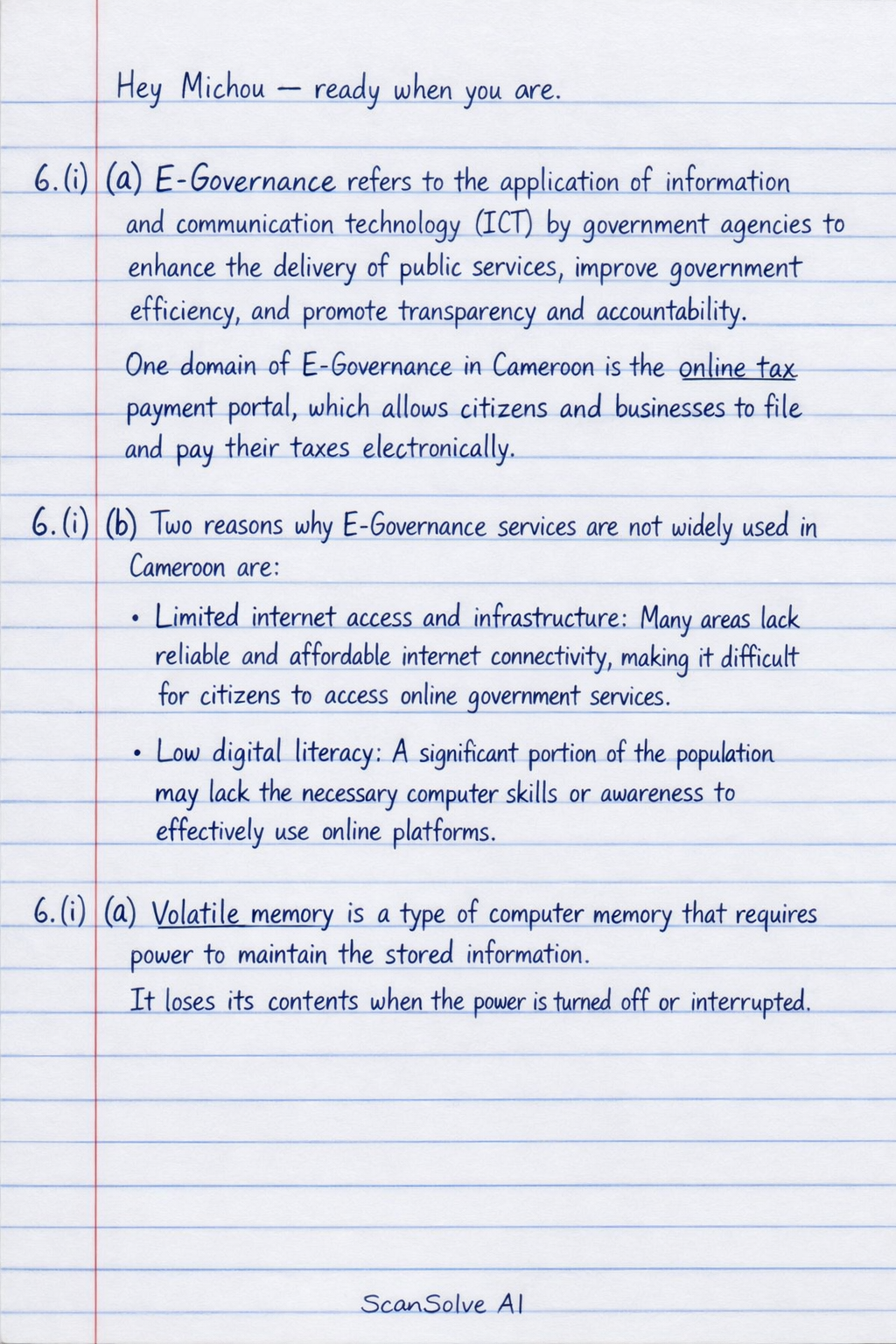
Hey Michou — ready when you are. 6. (i) (a) E-Governance refers to the application of information and communication technology (ICT) by government agencies to enhance the delivery of public services, improve government efficiency, and promote transparency and accountability. One domain of E-Governance in Cameroon is the online tax payment portal, which allows citizens and businesses to file and pay their taxes electronically. 6. (i) (b) Two reasons why E-Governance services are not widely used in Cameroon are: • Limited internet access and infrastructure: Many areas lack reliable and affordable internet connectivity, making it difficult for citizens to access online government services. • Low digital literacy: A significant portion of the population may lack the necessary computer skills or awareness to effectively use online platforms. 6. (ii) (a) Volatile memory is a type of computer memory that requires power to maintain the stored information. It loses its contents when the power is turned off or interrupted. 6. (ii) (b) Grouping the memories: • Volatile memories: Registers, RAM • Non-volatile memories: ROM, EPROM 6. (ii) (c) Location of each memory in a PC: • ROM (Read-Only Memory): Typically found on the motherboard as a BIOS chip. • Registers: Located directly within the Central Processing Unit (CPU). • RAM (Random Access Memory): Installed in dedicated RAM slots on the motherboard. • EPROM (Erasable Programmable Read-Only Memory): Can be found on older motherboards as a BIOS chip or in specialized embedded systems. 6. (iii) (a) Three components of an information system are: • Hardware: The physical components of the system, such as computers, servers, storage devices, and network equipment. • Software: The programs and applications that control the hardware and process data, including operating systems, database management systems, and application programs. • Data: The raw facts, figures, and text that are input into the system, processed, and stored to generate meaningful information. 6. (iii) (b) Two factors that determine the reliability of an information system are: • Hardware Quality and Redundancy: High-quality, robust hardware with built-in redundancy (e.g., redundant power supplies, RAID storage) ensures that the system can continue operating even if a component fails. • Software Design and Testing: Well-designed software with minimal bugs, thorough testing, and robust error handling mechanisms contributes significantly to system stability and reliability. 6. (iii) (c) One advantage of an expert system is that it can preserve and replicate the knowledge of human experts, making specialized expertise available consistently and widely, even when the human expert is not present. What's next?