
We read your photo as:
Draw and label parts of a computer, define data, information, and computer, and state five characteristics of a computer.
ScanSolve AI Answer
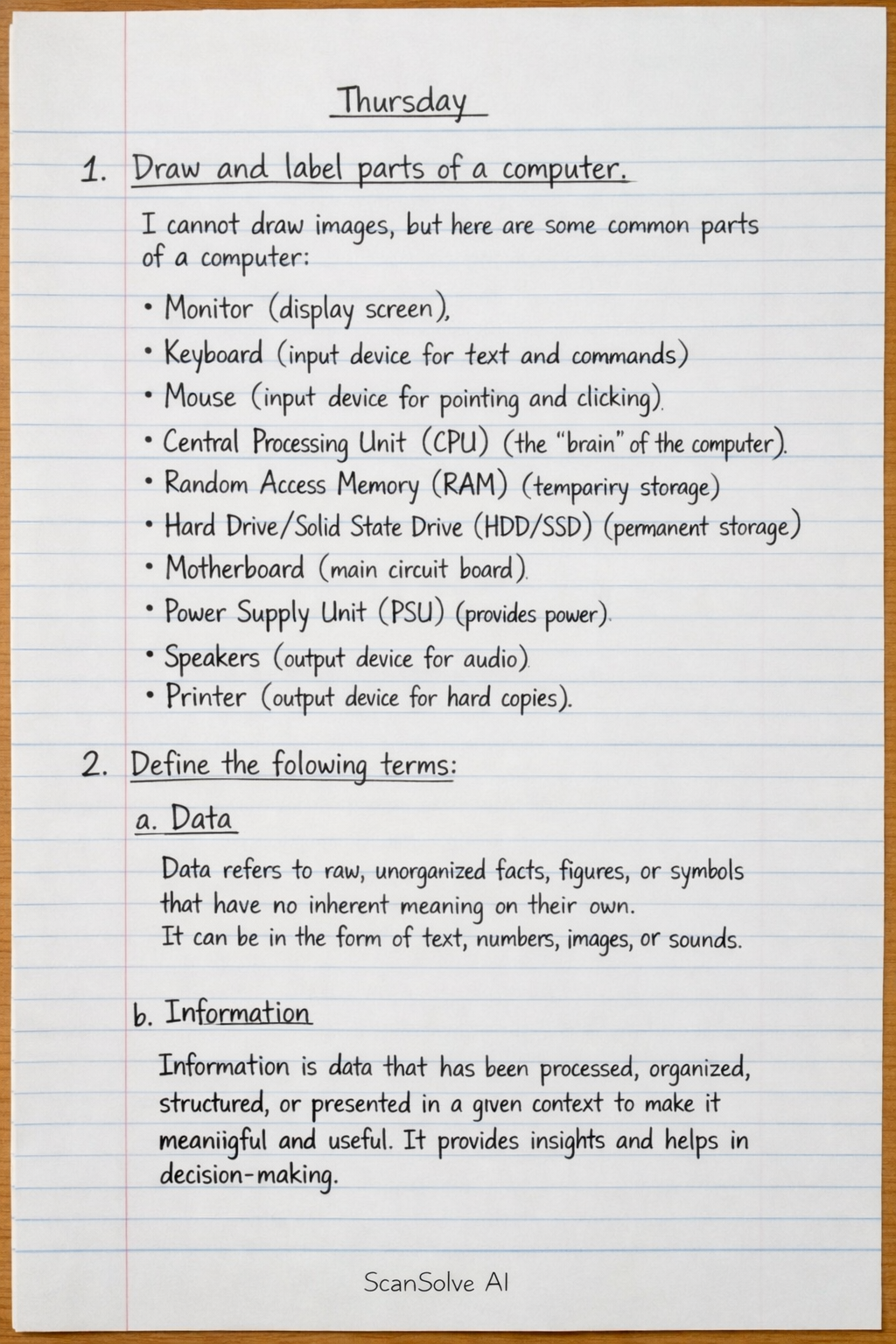
Thursday
1. Draw and label parts of a computer
I cannot draw images, but here are some common parts of a computer:
- Monitor (display screen)
- Keyboard (input device for text and commands)
- Mouse (input device for pointing and clicking)
- Central Processing Unit (CPU) (the "brain" of the computer)
- Random Access Memory (RAM) (temporary storage)
- Hard Drive/Solid State Drive (HDD/SSD) (permanent storage)
- Motherboard (main circuit board)
- Power Supply Unit (PSU) (provides power)
- Speakers (output device for audio)
- Printer (output device for hard copies)
2. Define the following terms:
-
a. Data Data refers to raw, unorganized facts, figures, or symbols that have no inherent meaning on their own. It can be in the form of text, numbers, images, or sounds.
-
b. Information Information is data that has been processed, organized, structured, or presented in a given context to make it meaningful and useful. It provides insights and helps in decision-making.
-
c. Computer A computer is an electronic device that can store, retrieve, and process data according to a set of instructions (programs). It is capable of performing various tasks, from simple calculations to complex operations.
3. State five characteristics of a computer
Here are five characteristics of a computer:
- a. Speed: Computers can process data and perform calculations at extremely high speeds.
- b. Accuracy: They perform tasks with high precision and consistency, minimizing errors.
- c. Diligence: Computers can perform repetitive tasks tirelessly without loss of concentration or accuracy.
- d. Versatility: They can perform a wide range of tasks, from complex scientific calculations to simple word processing.
- e. Storage Capacity: Computers can store vast amounts of data and information for future use.
4. Classify computers based on functionality
Computers can be classified based on functionality as:
- a. Analog Computers: Process continuous data, often used for specific scientific or engineering tasks.
- b. Digital Computers: Process discrete data (binary digits), used for most general-purpose computing.
- c. Hybrid Computers: Combine features of both analog and digital computers, used in specialized applications like medical equipment.
5. Name two types of computers classified based on purpose
Two types of computers classified based on purpose are:
- a. General-purpose computers: Designed to perform a wide variety of tasks and run different applications (e.g., personal computers, smartphones).
- b. Special-purpose computers: Designed to perform a specific task or set of tasks very efficiently (e.g., ATMs, embedded systems in cars).
Friday
1. Classify computers based on size
Computers can be classified based on size as:
- a. Supercomputers: The largest and fastest computers, used for highly intensive computational tasks.
- b. Mainframe computers: Large, powerful computers used by large organizations for critical applications and bulk data processing.
- c. Minicomputers (Midrange servers): Smaller than mainframes but more powerful than microcomputers, often used by medium-sized businesses.
- d. Microcomputers (Personal computers): Small, single-user computers designed for individual use (e.g., desktops, laptops, tablets).
- e. Wearable computers: Tiny electronic devices worn on the body (e.g., smartwatches, fitness trackers).
WEEK 2 Monday
1. State importance of drawing as a means of communication
Drawing is a powerful means of communication because it allows for the visual representation of ideas, concepts, and objects that might be difficult to explain with words alone. It transcends language barriers, enabling clear and concise conveyance of information, designs, and emotions across different cultures and contexts.
2. Define:
-
a. Artistic drawing Artistic drawing is a form of visual art that focuses on expressing emotions, ideas, and aesthetics through creative and often subjective interpretations. It emphasizes personal style, imagination, and visual storytelling rather than strict accuracy or technical specifications.
-
b. Technical drawing Technical drawing is a precise and standardized form of drawing used to convey detailed information about how an object is to be constructed or functions. It adheres to specific rules, symbols, and conventions to ensure clarity, accuracy, and unambiguous communication in fields like engineering and architecture.
3. State the difference between artistic drawing and technical drawing
The main differences between artistic drawing and technical drawing are:
- a. Purpose: Artistic drawing aims for aesthetic expression and conveying emotion, while technical drawing aims for precise communication of functional and structural details.
- b. Accuracy and Conventions: Artistic drawing allows for creative interpretation and less strict adherence to reality, whereas technical drawing demands high accuracy, standardized symbols, and specific conventions.
- c. Audience: Artistic drawings are often for general appreciation, while technical drawings are for professionals (engineers, manufacturers) who need exact specifications.
4. Write letters A-Z using uppercase
A B C D E F G H I J K L M N O P Q R S T U V W X Y Z
5. Write letters A-Z using lowercase
a b c d e f g h i j k l m n o p q r s t u v w x y z
Still stuck on this one?
Ask a follow-up, and the answer starts from this question.
More Computer Science Questions
Handwritten Step-by-Step Solution
Get this as a handwritten image on WhatsApp — like a tutor wrote it for you.
Try on WhatsApp