
We read your photo as:
Identify key figures in computer history and describe the five generations of computers.
Computer Science
ScanSolve AI Answer
Here's the solution to the activities:
Activity 1.1 Historical Development of Computers
Here are 4 major figures who contributed to the development of computers and their approximate years of significant contribution:
- Charles Babbage (1820s-1830s): Known as the "Father of the Computer" for conceiving the Difference Engine and the Analytical Engine, which laid the theoretical groundwork for modern computers.
- Ada Lovelace (1840s): Often regarded as the first computer programmer for her work on Babbage's Analytical Engine, where she wrote what is considered the first algorithm intended to be carried out by a machine.
- Alan Turing (1930s-1940s): Developed the concept of the Turing machine, a theoretical model of computation, and played a pivotal role in breaking the Enigma code during World War II with the Bombe machine.
- John von Neumann (1940s): Proposed the von Neumann architecture, a design model for stored-program computers that is still fundamental to most modern computers.
Activity 1.2 Generation of Computers
Here is a table summarizing the five generations of computers:
| Generation | Technology | Storage Medium | Language | Example |
|---|---|---|---|---|
| First (1940s-1950s) | Vacuum Tubes | Magnetic Drums, Magnetic Tapes | Machine Language | ENIAC, UNIVAC I |
| Second (1950s-1960s) | Transistors | Magnetic Cores, Magnetic Disks | Assembly Language, FORTRAN, COBOL | IBM 7090, CDC 1604 |
| Third (1960s-1970s) | Integrated Circuits (ICs) | Magnetic Disks, Semiconductor Memory | High-Level Languages (BASIC, Pascal) | IBM System/360, PDP-8 |
| Fourth (1970s-Present) | Microprocessors (VLSI) | Hard Disks, Floppy Disks, Optical Disks, Flash | High-Level Languages (C++, Java, Python) | Personal Computers (IBM PC, Apple Mac) |
| Fifth (Present & Beyond) | Artificial Intelligence, Parallel Processing | Advanced storage, Cloud Storage | AI Languages (Prolog, LISP), Natural Language | Robotics, Expert Systems, Voice Recognition |
Was this helpful?
Still stuck on this one?
Ask a follow-up, and the answer starts from this question.
Got a different question?Ask your own question
More Computer Science Questions
QWrite the generation of the computer, their years, their future, their example, and technologies of…QComputer Generations, Main Technology, and Example ComputersQb. Explain various generation of the computer with their main components.QDescribe the main technological advancements that characterized the first three generations of…QProvide an essay (3+ pages) on the evolution of computer systems, detailing key people, dates…
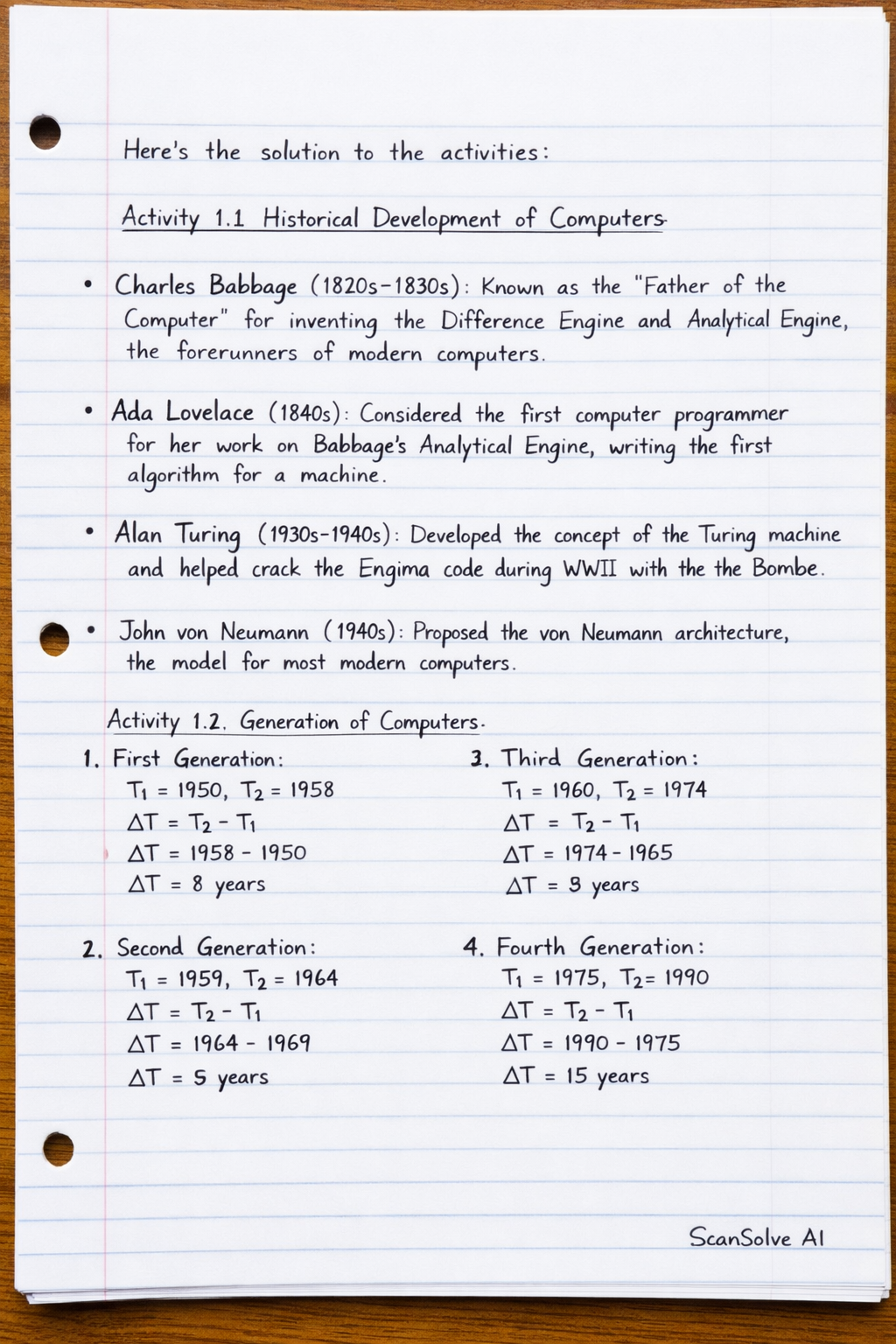
Handwritten Step-by-Step Solution
Get this as a handwritten image on WhatsApp — like a tutor wrote it for you.
Try on WhatsApp