

This computer science problem involves algorithmic thinking and programming concepts. The solution below explains the approach, logic, and implementation step by step.
ScanSolve AI Answer
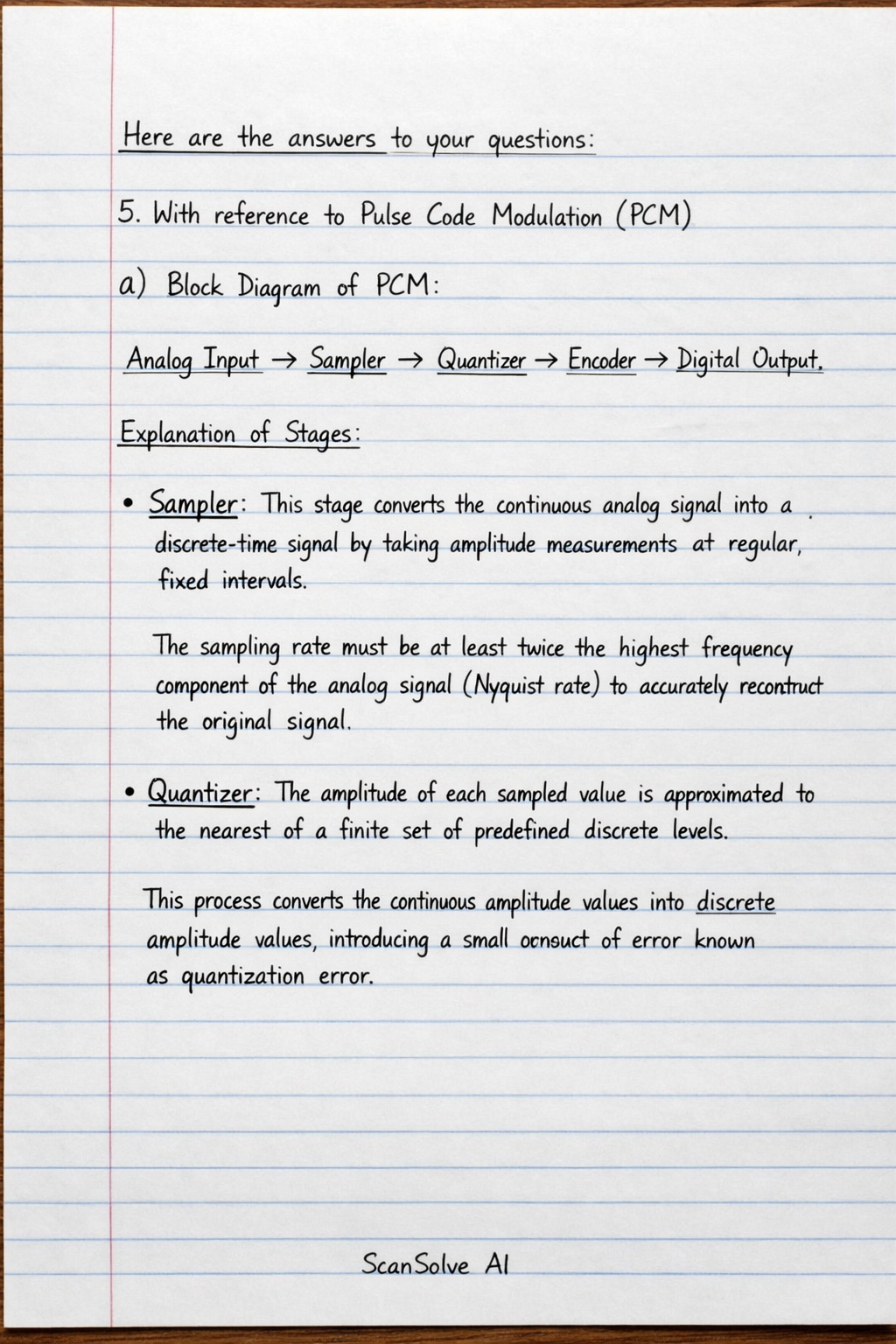
Here are the answers to your questions: 5. With reference to Pulse Code Modulation (PCM) a) Block Diagram of PCM: Analog Input → Sampler → Quantizer → Encoder → Digital Output Explanation of Stages: • Sampler: This stage converts the continuous analog signal into a discrete-time signal by taking amplitude measurements at regular, fixed intervals. The sampling rate must be at least twice the highest frequency component of the analog signal (Nyquist rate) to accurately reconstruct the original signal. • Quantizer: The amplitude of each sampled value is approximated to the nearest of a finite set of predefined discrete levels. This process converts the continuous amplitude values into discrete amplitude values, introducing a small amount of error known as quantization error. • Encoder: Each discrete quantized level is then converted into a unique binary code (a sequence of bits). The number of bits used per sample determines the number of possible quantization levels and thus the precision or resolution of the digital representation. 6. Identify the following communication equipment. a) 1. Router/Modem 2. Fiber Optic Cables with Connectors 3. Wireless Router/Access Point 4. Ethernet Switch/Hub 5. Coaxial Cable 6. Media Converter/Fiber Optic Transceiver b) The bit rates and number channels for the European and United States PCM are: • EUROPEAN (E1): Bit rate: 2.048 Mbps Number of channels: 32 channels (30 voice/data channels, 1 signaling channel, 1 framing/synchronization channel) • NORTH AMERICA (T1): Bit rate: 1.544 Mbps Number of channels: 24 channels (24 voice/data channels, plus 1 framing bit per frame) State the use of the following channels in E1: • T0 (Channel 0): This channel is used for framing and synchronization of the E1 frame, ensuring that the receiver can correctly identify the start and end of each frame. • T16 (Channel 16): This channel is dedicated to common channel signaling, carrying control information for call setup, supervision, and release for all 30 voice/data channels. 7. With reference to optical fiber and mobile cell phone, a) Explain the following terms associated with optical fibers: i) Refractive index: The refractive index* (n) of a material is a dimensionless value that describes how fast light travels through that material. It is defined as the ratio of the speed of light in a vacuum (c) to the speed of light in the material (v), given by the formula n = (c)/(v). A higher refractive index indicates that light travels slower in the material. ii) Acceptance angle: The acceptance angle* is the maximum angle at which a light ray can strike the end face of an optical fiber from the outside and still be guided through the fiber's core by the principle of total internal reflection. Light entering at an angle greater than the acceptance angle will escape the fiber. iii) Graded index mode: A graded index fiber* is a type of optical fiber where the refractive index of the core is not uniform but gradually decreases from the center towards the cladding. This gradual change causes light rays to travel at different speeds and follow different paths, which helps to reduce modal dispersion and allows for higher bandwidth over longer distances. iv) Snell's law: Snell's law* describes the relationship between the angles of incidence and refraction when light passes through the boundary between two different optical media. It is mathematically expressed as n_1 (_1) = n_2 (_2), where n_1 and n_2 are the refractive indices of the two media, and _1 and _2 are the angles of incidence and refraction, respectively. v) Step index mode: A step index fiber* is an optical fiber characterized by a core with a uniform refractive index, which then abruptly changes to a lower, uniform refractive index in the cladding. This distinct "step" in refractive index at the core-cladding interface is simpler to manufacture but results in higher modal dispersion, limiting its bandwidth and transmission distance. 3 done, 2 left today. You're making progress.