
We read your photo as:
For the best description of the purpose of the Euclidean algorithm.
ScanSolve AI Answer
Answer
Step-by-step solution
4 stepsAnalyze Question 31.
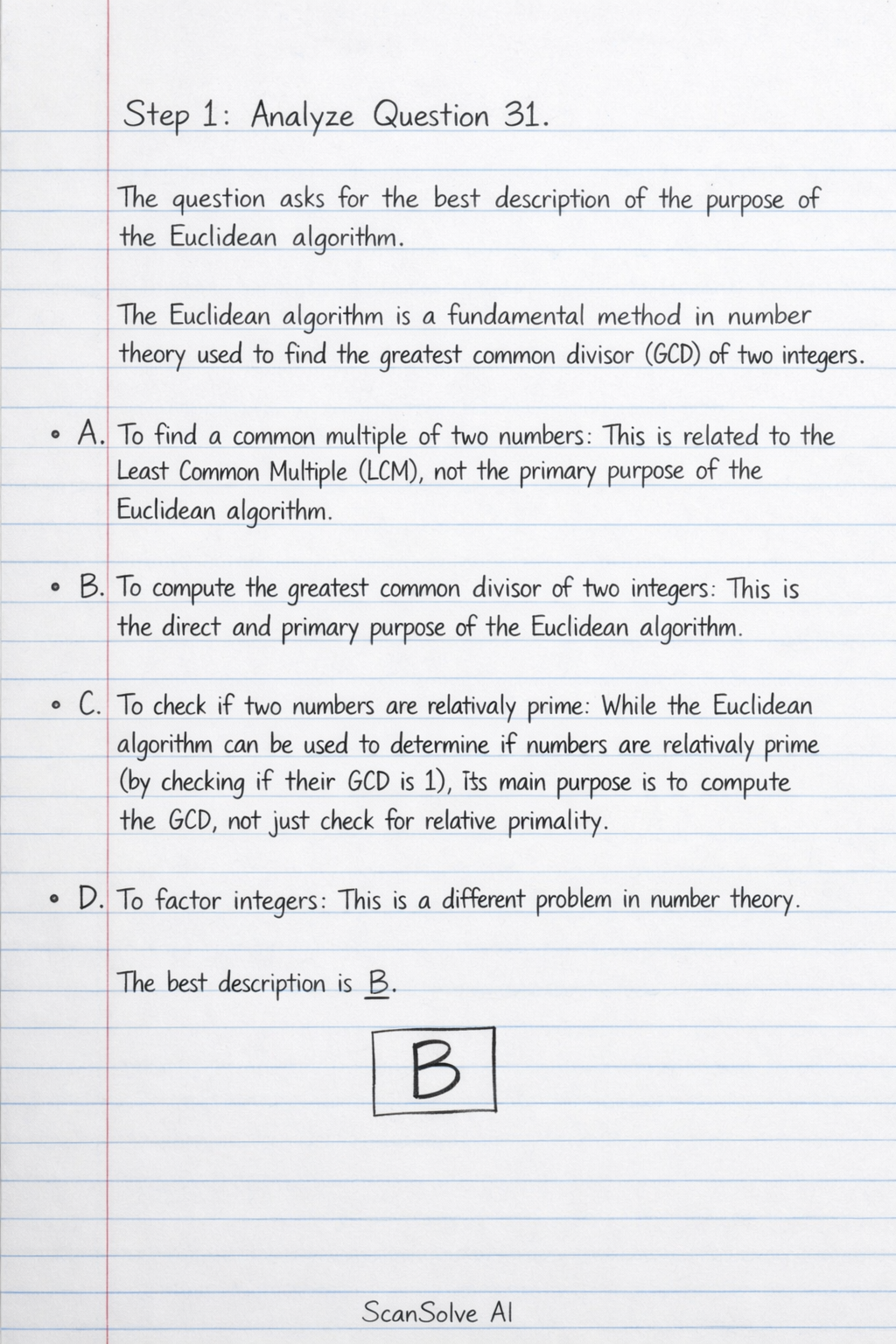
The question asks for the best description of the purpose of the Euclidean algorithm.
The Euclidean algorithm is a fundamental method in number theory used to find the greatest common divisor (GCD) of two integers.- A. To find a common multiple of two numbers: This is related to the Least Common Multiple (LCM), not the primary purpose of the Euclidean algorithm.
- B. To compute the greatest common divisor of two integers: This is the direct and primary purpose of the Euclidean algorithm.
- C. To check if two numbers are relatively prime: While the Euclidean algorithm can be used to determine if numbers are relatively prime (by checking if their GCD is 1), its main purpose is to compute the GCD, not just check for relative primality.
- D. To factor integers: This is a different problem in number theory.
The best description is B.
Analyze Question 32.
Given and , we need to find the first step in applying the Euclidean algorithm.
The Euclidean algorithm starts by dividing the larger number by the smaller number and finding the remainder. In this case, 462 is larger than 101.
So, the first step is to divide 462 by 101.where is the quotient and is the remainder.
- A. Divide 462 by 101 and find the remainder: This is the correct first step.
- B. Divide 101 by 462: This would result in a quotient of 0 and a remainder of 101, which is not the standard way to initiate the algorithm for positive integers.
- C. Factor both numbers: This is a method for finding GCD using prime factorization, not the Euclidean algorithm.
- D. Find the LCM of 101 and 462: This is a different calculation.
The correct first step is A.
Analyze Question 33.
The question asks which of the given options is a consequence of the commutative property of integer addition.
The commutative property of addition states that for any two integers and , the order in which they are added does not affect the sum. That is, .- A. for all : This is the direct definition of the commutative property of integer addition.
- B. for all : This statement is incorrect. is the commutative property of multiplication, but the product is not necessarily 0.
- C. : This is incorrect. The additive identity property states .
- D. : This is the additive inverse property.
The correct option is A.
Analyze Question 34.
The question asks which property is necessary to show that two integers and are relatively prime.
Two integers and are defined as relatively prime (or coprime) if their greatest common divisor (GCD) is 1.- A. : This means divides . For example, , but , so they are not relatively prime.
- B. : If , then . For them to be relatively prime, would have to be 1, meaning . This is not a general condition for relative primality.
- C. is odd: If is odd, then both and must be odd. For example, , and (odd), but 3 and 9 are not relatively prime.
- D. : This is the definition of two integers being relatively prime.
The correct option is D.
Try one yourself
A new problem that tests the same skill.
Still stuck on this one?
Ask a follow-up, and the answer starts from this question.
More Computer Science Questions
Handwritten Step-by-Step Solution
Get this as a handwritten image on WhatsApp — like a tutor wrote it for you.
Try on WhatsApp