
We read your photo as:
Given a sequence of numbers, what is the rule to calculate R based on the examples provided?
ScanSolve AI Answer
Answer
Step-by-step solution
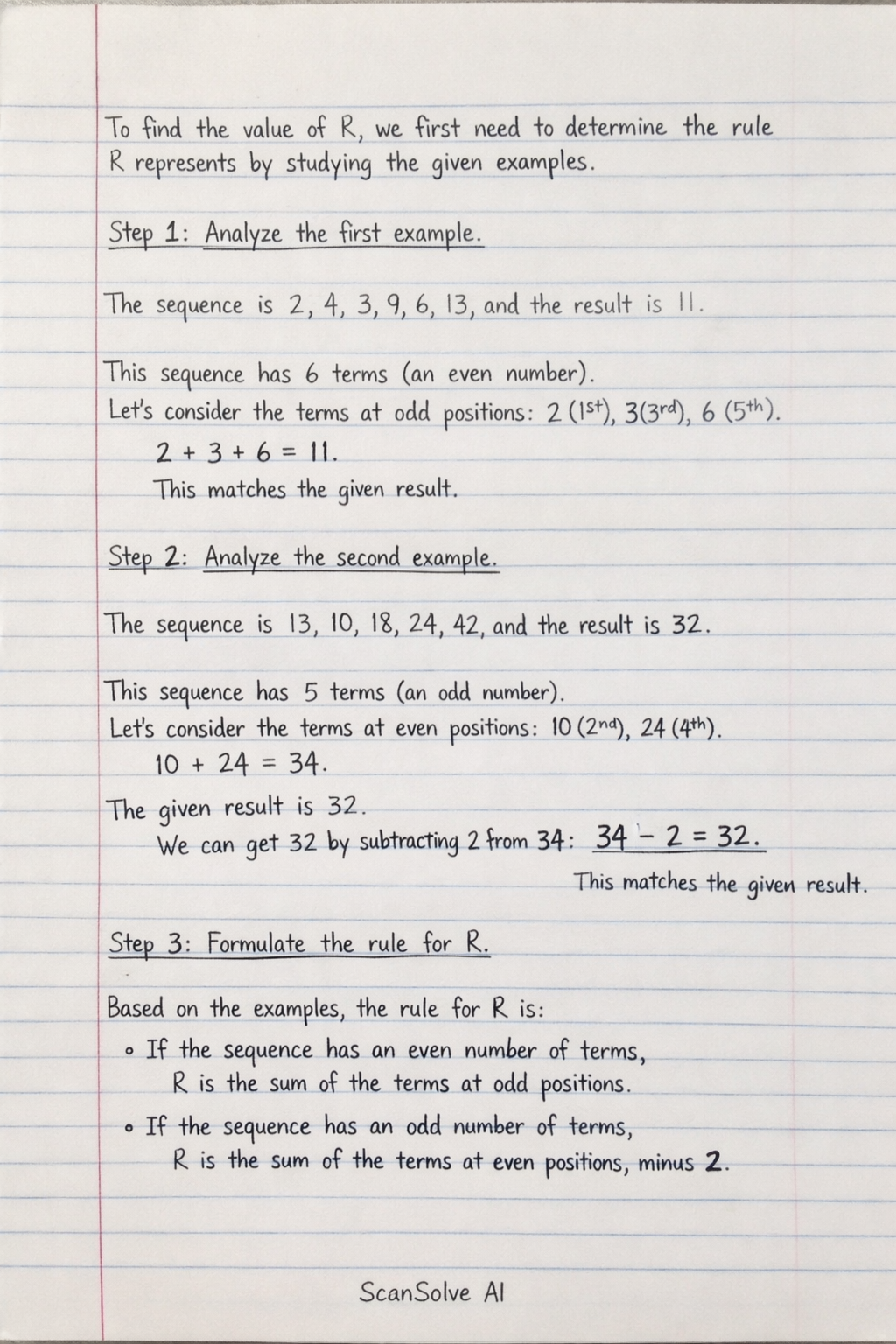
5 stepsTo find the value of R, we first need to determine the rule R represents by studying the given examples.
Analyze the first example.
The sequence is , and the result is 11.
This sequence has 6 terms (an even number).
Let's consider the terms at odd positions: 2 (1st), 3 (3rd), 6 (5th).
Summing these terms: . This matches the given result.Analyze the second example.
The sequence is , and the result is 32.
This sequence has 5 terms (an odd number).
Let's consider the terms at even positions: 10 (2nd), 24 (4th).
Summing these terms: .
The given result is 32. We can get 32 by subtracting 2 from 34: . This matches the given result.Formulate the rule for R.
Based on the examples, the rule for R is:
- If the sequence has an even number of terms, R is the sum of the terms at odd positions.
- If the sequence has an odd number of terms, R is the sum of the terms at even positions, minus 2.
Apply the rule to .
The sequence is .
The number of terms is 4 (an even number).
According to the rule for an even number of terms, R is the sum of the terms at odd positions.
The terms at odd positions are 1 (1st) and 8 (3rd).The value of R for is .
Apply the rule to .
The sequence is .
The number of terms is 4 (an even number).
According to the rule for an even number of terms, R is the sum of the terms at odd positions.
The terms at odd positions are 3 (1st) and 6 (3rd).The value of R for is .
Try one yourself
A new problem that tests the same skill.
Still stuck on this one?
Ask a follow-up, and the answer starts from this question.
More Computer Science Questions
Handwritten Step-by-Step Solution
Get this as a handwritten image on WhatsApp — like a tutor wrote it for you.
Try on WhatsApp