

This computer science problem involves algorithmic thinking and programming concepts. The solution below explains the approach, logic, and implementation step by step.
ScanSolve AI Answer
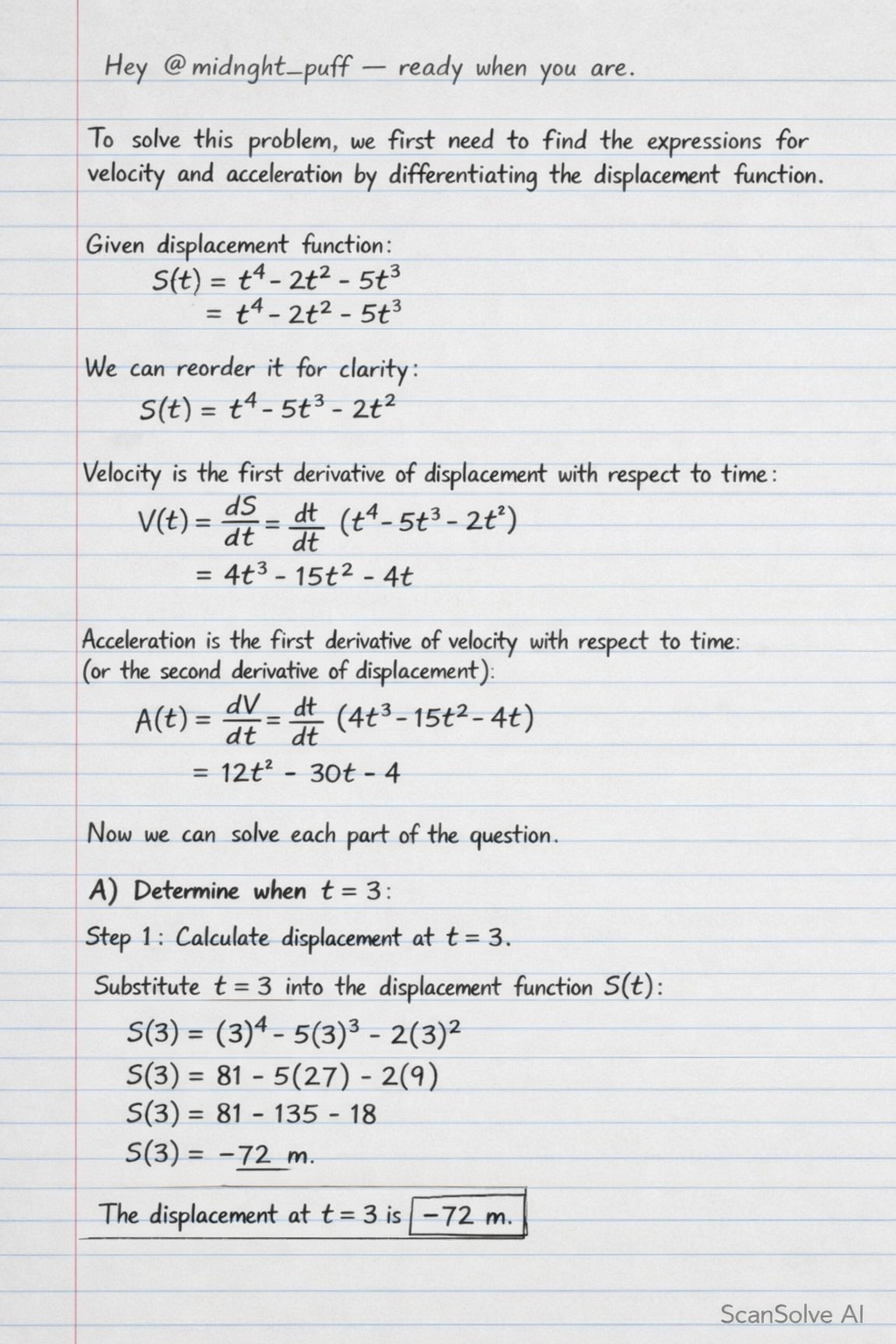
To solve this problem, we first need to find the expressions for velocity and acceleration by differentiating the displacement function. Given displacement function: S(t) = t^4 - 2t^2 - 5t^3 We can reorder it for clarity: S(t) = t^4 - 5t^3 - 2t^2 Velocity is the first derivative of displacement with respect to time: V(t) = (dS)/(dt) = (d)/(dt)(t^4 - 5t^3 - 2t^2) = 4t^3 - 15t^2 - 4t Acceleration is the first derivative of velocity with respect to time (or the second derivative of displacement): A(t) = (dV)/(dt) = (d)/(dt)(4t^3 - 15t^2 - 4t) = 12t^2 - 30t - 4 Now we can solve each part of the question. A) Determine when t=3: Step 1: Calculate displacement at t=3. Substitute t=3 into the displacement function S(t). S(3) = (3)^4 - 5(3)^3 - 2(3)^2 S(3) = 81 - 5(27) - 2(9) S(3) = 81 - 135 - 18 S(3) = -72 m The displacement at t=3 is -72 m. Step 2: Calculate velocity at t=3. Substitute t=3 into the velocity function V(t). V(3) = 4(3)^3 - 15(3)^2 - 4(3) V(3) = 4(27) - 15(9) - 12 V(3) = 108 - 135 - 12 V(3) = -39 m/s The velocity at t=3 is -39 m/s. Step 3: Calculate acceleration at t=3. Substitute t=3 into the acceleration function A(t). A(3) = 12(3)^2 - 30(3) - 4 A(3) = 12(9) - 90 - 4 A(3) = 108 - 90 - 4 A(3) = 14 m/s^2 The acceleration at t=3 is 14 m/s^2. B) Time when velocity is 0: Step 4: Set the velocity function V(t) to 0 and solve for t. V(t) = 4t^3 - 15t^2 - 4t = 0 Factor out t: t(4t^2 - 15t - 4) = 0 This gives two possibilities: t=0 or 4t^2 - 15t - 4 = 0. Solve the quadratic equation 4t^2 - 15t - 4 = 0. We can factor it: (4t+1)(t-4) = 0 This yields two more solutions: 4t+1 = 0 t = -(1)/(4) s t-4 = 0 t = 4 s Since time cannot be negative in this physical context, the times when velocity is 0 are t=0 s and t=4 s. The times when velocity is 0 are 0 s and 4 s. C) Acceleration at t=2: Step 5: Calculate acceleration at t=2. Substitute t=2 into the acceleration function A(t). A(2) = 12(2)^2 - 30(2) - 4 A(2) = 12(4) - 60 - 4 A(2) = 48 - 60 - 4 A(2) = -16 m/s^2 The acceleration at t=2 is -16 m/s^2.