

This computer science problem involves algorithmic thinking and programming concepts. The solution below explains the approach, logic, and implementation step by step.
ScanSolve AI Answer
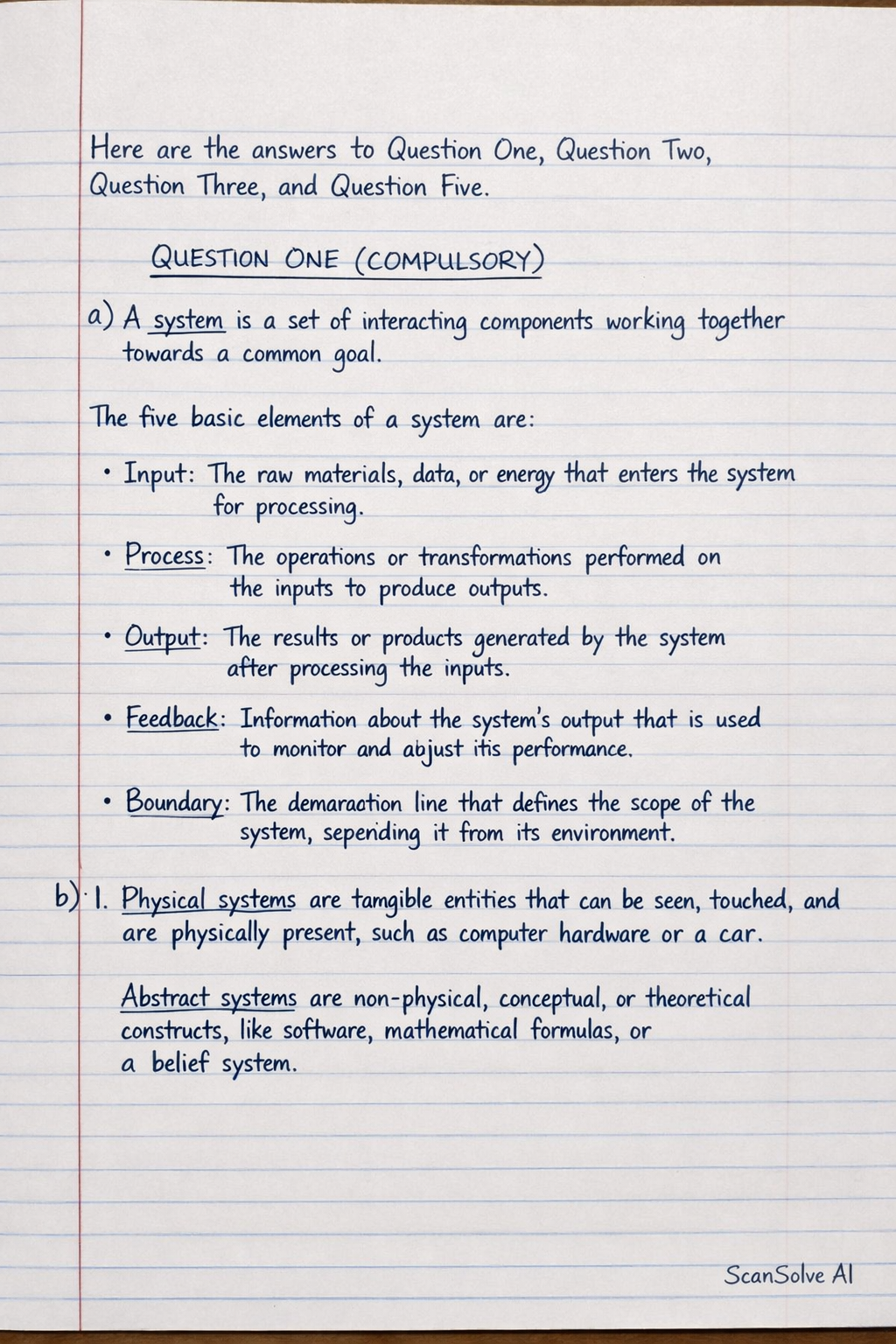
Here are the answers to Question One, Question Two, Question Three, and Question Five. QUESTION ONE (COMPULSORY) a) A system is a set of interacting components working together towards a common goal. The five basic elements of a system are: Input*: The raw materials, data, or energy that enters the system for processing. Process*: The operations or transformations performed on the inputs to produce outputs. Output*: The results or products generated by the system after processing the inputs. Feedback*: Information about the system's output that is used to monitor and adjust its performance. Boundary*: The demarcation line that defines the scope of the system, separating it from its environment. b) i. Physical systems are tangible entities that can be seen, touched, and are physically present, such as computer hardware or a car. Abstract systems are non-physical, conceptual, or theoretical constructs, like software, mathematical formulas, or a belief system. ii. Open systems interact with their environment, exchanging inputs and outputs, and are influenced by external factors, such as a living organism or a business organization. Closed systems are self-contained and do not interact with their environment, meaning they do not exchange matter, energy, or information with their surroundings. Truly closed systems are rare in reality. c) Let's compare the Waterfall Model and the Agile Model. i. Features: Waterfall Model: A linear, sequential approach where each phase (requirements, design, implementation, testing, deployment, maintenance) must be completed before the next begins. It is document-driven and rigid. Agile Model: An iterative and incremental approach that emphasizes flexibility, collaboration, and customer feedback. Development occurs in short cycles called sprints, delivering working software frequently. ii. Advantages and Disadvantages: Waterfall Model: Advantages*: Simple to understand and use, good for projects with well-defined and stable requirements, easy to manage due to its rigid structure. Disadvantages*: Inflexible to changes, testing occurs late in the cycle, high risk if requirements are initially unclear, difficult to go back to previous phases. Agile Model: Advantages*: Flexible and adaptable to changing requirements, continuous customer involvement, early and continuous delivery of working software, promotes collaboration. Disadvantages*: Requires active customer involvement, less predictable in terms of final cost and time, can be difficult to manage without experienced teams. iii. Suitable Application Areas: Waterfall Model: Best suited for projects with clear, stable, and well-understood requirements, often in domains with strict regulations or where quality is paramount and changes are costly (e.g., embedded systems, defense projects). Agile Model: Ideal for projects with evolving or unclear requirements, where rapid delivery and customer feedback are crucial, such as web development, mobile applications, or research and development projects. QUESTION TWO (15 Marks) a) The System Development Life Cycle (SDLC) is a structured framework that outlines the stages involved in developing, deploying, and maintaining an information system, from its initial conception to its eventual retirement. b) The objectives of SDLC include: To produce a high-quality system that meets or exceeds customer expectations and requirements. To ensure the system is completed within the allocated budget and timeframe. To provide a clear framework for project planning, control, and management, reducing risks. To enhance the efficiency and effectiveness of the system development process. To minimize errors and defects by incorporating testing and review processes at various stages. c) The seven common phases of SDLC are: 1. Planning: This initial phase involves defining the project scope, objectives, resources, and feasibility. It identifies the problem or opportunity and determines if a new system is viable. 2. Requirements Analysis: In this phase, system analysts gather, document, and analyze the functional and non-functional requirements from stakeholders to understand what the system needs to do. 3. Design: This phase translates the requirements into a detailed system architecture. It involves designing the system's components, interfaces, databases, and overall structure. 4. Implementation (Coding): Developers write the actual code for the system based on the design specifications. This phase involves programming, unit testing, and integration of different modules. 5. Testing: The system is rigorously tested to identify and fix defects, ensuring it meets all specified requirements and functions correctly. This includes unit, integration, system, and user acceptance testing. 6. Deployment: The completed and tested system is installed and made operational in the user's environment. This may involve data migration, user training, and system configuration. 7. Maintenance: After deployment, this ongoing phase involves monitoring the system, fixing bugs, applying updates, enhancing features, and ensuring the system continues to meet evolving business needs. QUESTION THREE (15 Marks) a) System Analysis is the process of studying a business problem or opportunity to determine how an information system can be used to solve the problem or exploit the opportunity. It involves understanding user needs, defining system requirements, and evaluating potential solutions. b) The objectives of System Analysis are: To thoroughly understand the existing system, identifying its strengths, weaknesses, and areas for improvement. To accurately gather, analyze, and document the functional and non-functional requirements for a new or modified system. To define the scope, boundaries, and objectives of the proposed system clearly. To identify and evaluate various alternative solutions, considering their feasibility, costs, and benefits. To bridge the communication gap between business users and technical developers by translating business needs into technical specifications. c) The role of a System Analyst is to act as a liaison between business stakeholders and the technical development team. They analyze business problems, gather and document user requirements, design system specifications, and ensure that the developed system effectively addresses the organization's needs and objectives. Four qualities of a good System Analyst are: 1. Analytical Skills: Ability to break down complex problems, identify root causes, and logically structure solutions. 2. Communication Skills: Excellent verbal and written communication to effectively interact with diverse stakeholders and clearly document requirements. 3. Problem-Solving Skills: Capacity to identify issues, evaluate alternatives, and devise practical and efficient solutions. 4. Technical Knowledge: A solid understanding of information technology, system development methodologies, and database concepts to facilitate effective design and implementation. QUESTION FIVE (15 Marks) a) An Entity-Relationship Diagram (ERD) is a visual representation of the structure of a database, illustrating how different entities (real-world objects or concepts) are related to each other. It helps in designing and understanding the logical structure of a database. b) The following are key ERD components: Entity*: An entity represents a real-world object or concept about which data is stored. It is distinguishable from other objects and can be a person, place, event, or concept (e.g., Student, Course, Department). In an ERD, entities are typically represented by rectangles. Attribute*: An attribute is a property or characteristic that describes an entity. It provides specific details about an entity (e.g., for a "Student" entity, attributes might include Student ID, Name, Date of Birth). Attributes are usually represented by ovals connected to their respective entities. Relationship: A relationship describes an association or interaction between two or more entities. It shows how entities are connected or linked to each other (e.g., a "Student" enrolls in* a "Course"). Relationships are typically represented by diamond shapes connecting the related entities. c) The following are common relationship types in ERDs: i. One-to-One (1:1): This relationship type exists when an instance of entity A is associated with at most one instance of entity B, and an instance of entity B is associated with at most one instance of entity A. Example: A Person has one Passport, and a Passport belongs to one Person*. ii. One-to-Many (1:M): In this relationship, an instance of entity A can be associated with one or more instances of entity B, but an instance of entity B is associated with at most one instance of entity A. Example: A Department has many Employees, but an Employee belongs to only one Department*. iii. Many-to-Many (M:N): This relationship type occurs when an instance of entity A can be associated with one or more instances of entity B, and an instance of entity B can be associated with one or more instances of entity A. Example: A Student can enroll in many Courses, and a Course can have many Students*.