
We read your photo as:
Differentiate between data and information, state four benefits of computerized systems in a hospital, and outline four activities in the system analysis stage of SDLC.
Computer Science
ScanSolve AI Answer
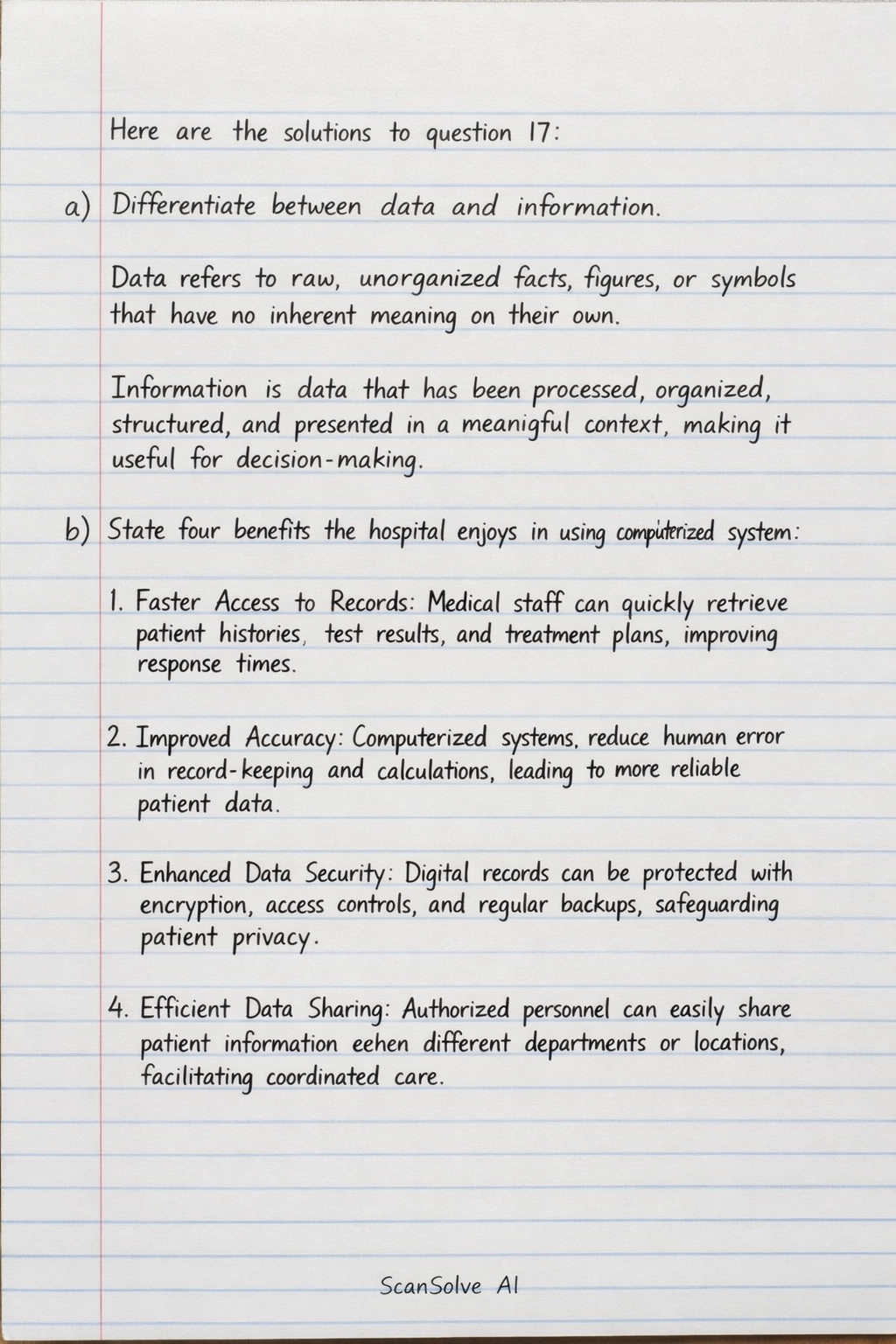
Here are the solutions to question 17:
a) Differentiate between data and information.
- Data refers to raw, unorganized facts, figures, or symbols that have no inherent meaning on their own.
- Information is data that has been processed, organized, structured, and presented in a meaningful context, making it useful for decision-making.
b) State four benefits the hospital enjoys in using computerized system.
- Faster Access to Records: Medical staff can quickly retrieve patient histories, test results, and treatment plans, improving response times.
- Improved Accuracy: Computerized systems reduce human error in record-keeping and calculations, leading to more reliable patient data.
- Enhanced Data Security: Digital records can be protected with encryption, access controls, and regular backups, safeguarding patient privacy.
- Efficient Data Sharing: Authorized personnel can easily share patient information across different departments or locations, facilitating coordinated care.
c) Outline four activities carried out during the system analysis stage of SDLC.
- Feasibility Study: Assessing the practicality and viability of the proposed system in terms of technical, economic, operational, legal, and schedule aspects.
- Requirements Gathering: Collecting detailed information from users and stakeholders about what the new system needs to do, often through interviews, surveys, and observation.
- Requirements Analysis: Examining the gathered requirements to identify inconsistencies, ambiguities, and completeness, and then documenting them clearly.
- System Modeling: Creating logical models, such as data flow diagrams (DFDs) or entity-relationship diagrams (ERDs), to visually represent the system's processes, data, and relationships.
d) State three methods of system conversion.
- Direct Conversion (Plunge Conversion): The old system is immediately stopped, and the new system is started.
- Parallel Conversion: Both the old and new systems run simultaneously for a period until the new system is proven reliable.
- Phased Conversion: The new system is implemented in stages or modules over time, gradually replacing parts of the old system.
Was this helpful?
Still stuck on this one?
Ask a follow-up, and the answer starts from this question.
Got a different question?Ask your own question
More Computer Science Questions
QDefine a system and explain the five basic elements of a system. Differentiate between the following…QThe table below shows the activities carried out during system development. Identify the phase or…QDescribe health information system components giving practical examples.QDiscuss the various steps you would undertake in setting up an Electronic Health Information System…QCan you summarize the key components and types of information systems based on my notes?
Handwritten Step-by-Step Solution
Get this as a handwritten image on WhatsApp — like a tutor wrote it for you.
Try on WhatsApp