
We read your photo as:
& (ii) The activity list and their durations are required to draw the network diagram and determine the critical path and project duration. Please provide this information.
ScanSolve AI Answer
Here are the answers to the questions:
1.
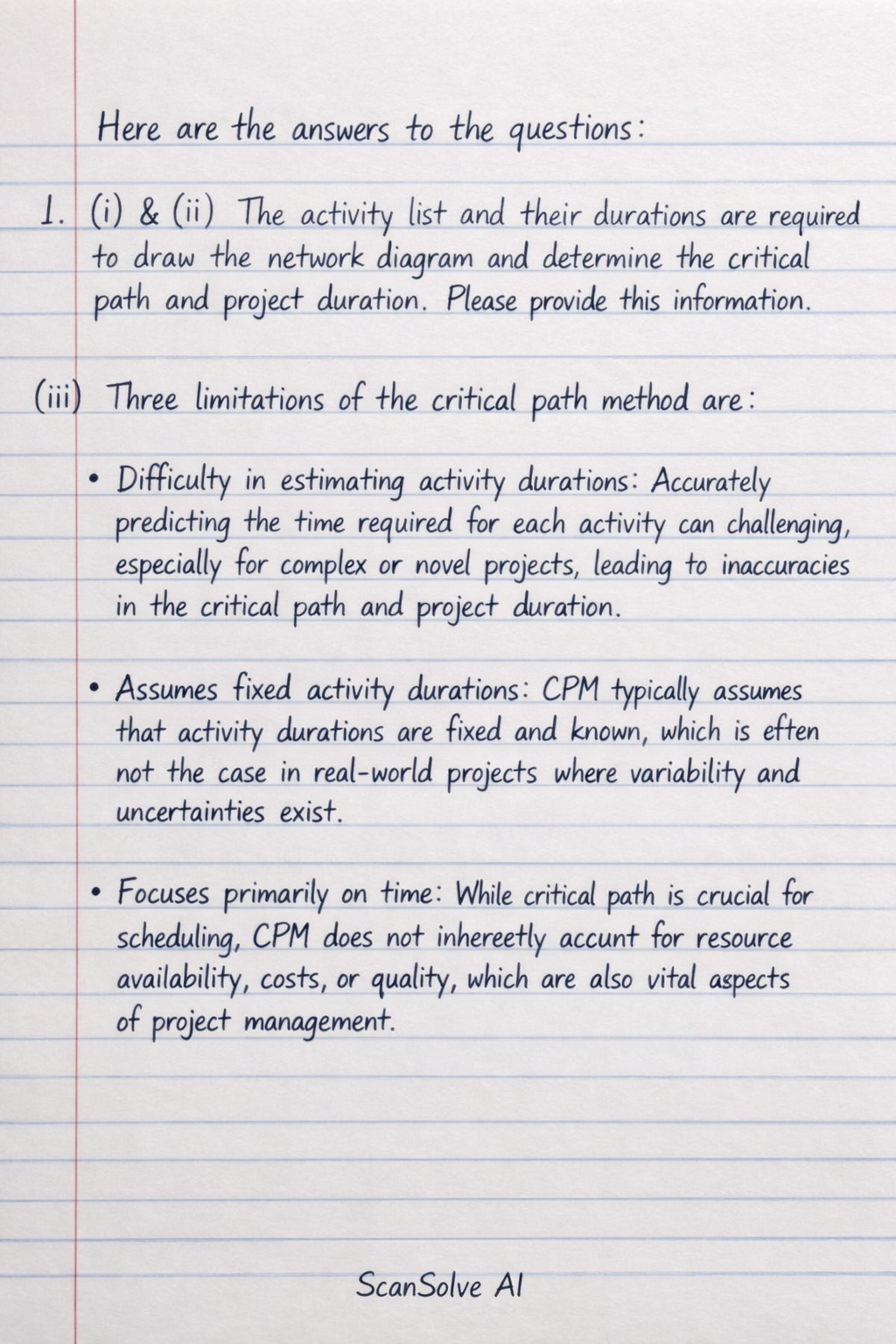
(i) & (ii) The activity list and their durations are required to draw the network diagram and determine the critical path and project duration. Please provide this information.
(iii) Three limitations of the critical path method are:
- Difficulty in estimating activity durations: Accurately predicting the time required for each activity can be challenging, especially for complex or novel projects, leading to inaccuracies in the critical path and project duration.
- Assumes fixed activity durations: CPM typically assumes that activity durations are fixed and known, which is often not the case in real-world projects where variability and uncertainties exist.
- Focuses primarily on time: While critical path is crucial for scheduling, CPM does not inherently account for resource availability, costs, or quality, which are also vital aspects of project management.
2. Three characteristics of a package deal contract are:
- Single point of responsibility: The contractor is responsible for both the design and construction of the project, providing a single point of contact for the client.
- Fixed price or lump sum: The contract typically involves a single, agreed-upon price for the entire scope of work, including design, procurement, and construction, offering cost certainty to the client.
- Reduced client involvement: The client has less direct involvement in the day-to-day design and construction decisions, as these are managed by the contractor, allowing the client to focus on their core business.
3. Three criteria that may be used to evaluate a contractor are:
- Financial stability: Assessing the contractor's financial health, including their balance sheet, cash flow, and creditworthiness, to ensure they have the resources to complete the project.
- Experience and track record: Evaluating the contractor's past projects, relevant experience, and references to gauge their capability and success in similar undertakings.
- Technical capability and resources: Examining the contractor's technical expertise, availability of skilled personnel, equipment, and management systems to ensure they can meet the project's technical requirements.
4. Four reasons that may make an organization obtain quotations for material prices regularly are:
- Cost control: Regular quotations help organizations identify the most competitive prices, enabling them to control material costs and improve project profitability.
- Market intelligence: Obtaining frequent quotes provides insights into market trends, price fluctuations, and the availability of materials, aiding in better procurement decisions.
- Supplier diversification: Regular engagement with multiple suppliers through quotations helps in building a diverse supplier base, reducing reliance on a single source and mitigating supply chain risks.
- Budget accuracy: Up-to-date material prices ensure that project budgets are based on current market rates, leading to more accurate financial planning and forecasting.
5. The procedure followed when undertaking site measurement typically involves:
- Preparation: Reviewing drawings, specifications, and previous measurement records; ensuring all necessary tools (tape measures, laser distance meters, levels) and personal protective equipment are available.
- On-site verification: Physically visiting the site to measure actual dimensions, quantities of installed work, and materials on site, comparing them against planned figures.
- Recording data: Documenting all measurements systematically in a site diary, measurement sheets, or digital devices, often with sketches or photographs for clarity and verification.
- Calculation and reconciliation: Translating raw measurements into quantifiable units (e.g., square meters, cubic meters, linear meters) and reconciling them with contract documents for payment or progress tracking.
6. Three ways in which modern technology may be used to facilitate site meetings are:
- Video conferencing and virtual meeting platforms: Tools like Zoom or Microsoft Teams allow participants to join meetings remotely from different locations, reducing travel time and costs, and enabling participation from specialists not physically on site.
- Digital whiteboards and collaborative software: Interactive digital whiteboards or cloud-based collaboration tools (e.g., Miro, Google Docs) enable real-time sharing of drawings, documents, and notes, allowing all participants to contribute and review information simultaneously.
- Project management software with integrated communication: Platforms like Procore or Aconex integrate meeting scheduling, agenda sharing, minute taking, and action item tracking, ensuring all meeting-related information is centralized and accessible to relevant stakeholders.
7. Four precautions that should be taken to minimize damage to materials during delivery are:
- Proper packaging: Ensuring materials are adequately packed, wrapped, or crated to protect them from physical impact, moisture, and dust during transit.
- Secure loading and unloading: Using appropriate lifting equipment and techniques, and securing materials properly within the transport vehicle to prevent shifting, falling, or crushing.
- Clear labeling: Clearly labeling packages with handling instructions (e.g., "Fragile," "This Way Up," "Do Not Stack") and destination details to guide handlers.
- Inspection upon receipt: Conducting a thorough inspection of materials immediately upon arrival at the site to identify any damage or discrepancies before accepting delivery.
8. Three ways that may be used by a court of law to prove the existence of a contract between two parties are:
- Offer and Acceptance: Evidence showing that one party made a clear offer and the other party unequivocally accepted it, demonstrating a mutual agreement to the terms.
- Consideration: Proof that something of value (money, goods, services, or a promise) was exchanged between the parties, indicating a mutual obligation and intent to be legally bound.
- Intention to Create Legal Relations: Evidence that the parties intended their agreement to be legally enforceable, rather than a mere social or domestic arrangement. This is often inferred from the nature of the agreement and the context.
9. Three circumstances under which a contractor's request for time extension may be declined are:
- Lack of supporting evidence: The contractor fails to provide sufficient documentation or justification to prove that the delay was caused by an event entitling them to an extension, or that the event actually impacted the critical path.
- Delay caused by contractor's own fault: The delay is attributable to the contractor's own negligence, poor planning, inefficient resource management, or failure to comply with contract terms.
- Late submission of notice: The contractor fails to submit the notice of delay or the time extension request within the stipulated timeframe as per the contract conditions.
10. Four benefits that an organization may derive from selective tendering are:
- Higher quality bids: By inviting only pre-qualified contractors, the organization receives bids from firms with proven experience, financial stability, and technical capability, leading to higher quality proposals.
- Reduced administrative burden: The number of tenders to evaluate is significantly smaller compared to open tendering, saving time and resources in the evaluation process.
- Better control over contractor selection: The organization has greater control over who bids for the project, ensuring that only reputable and suitable contractors are considered.
- Improved project outcomes: Working with known, reliable contractors often leads to better collaboration, fewer disputes, and a higher likelihood of project completion on time and within budget.
Still stuck on this one?
Ask a follow-up, and the answer starts from this question.
More Computer Science Questions
Handwritten Step-by-Step Solution
Get this as a handwritten image on WhatsApp — like a tutor wrote it for you.
Try on WhatsApp