
We read your photo as:
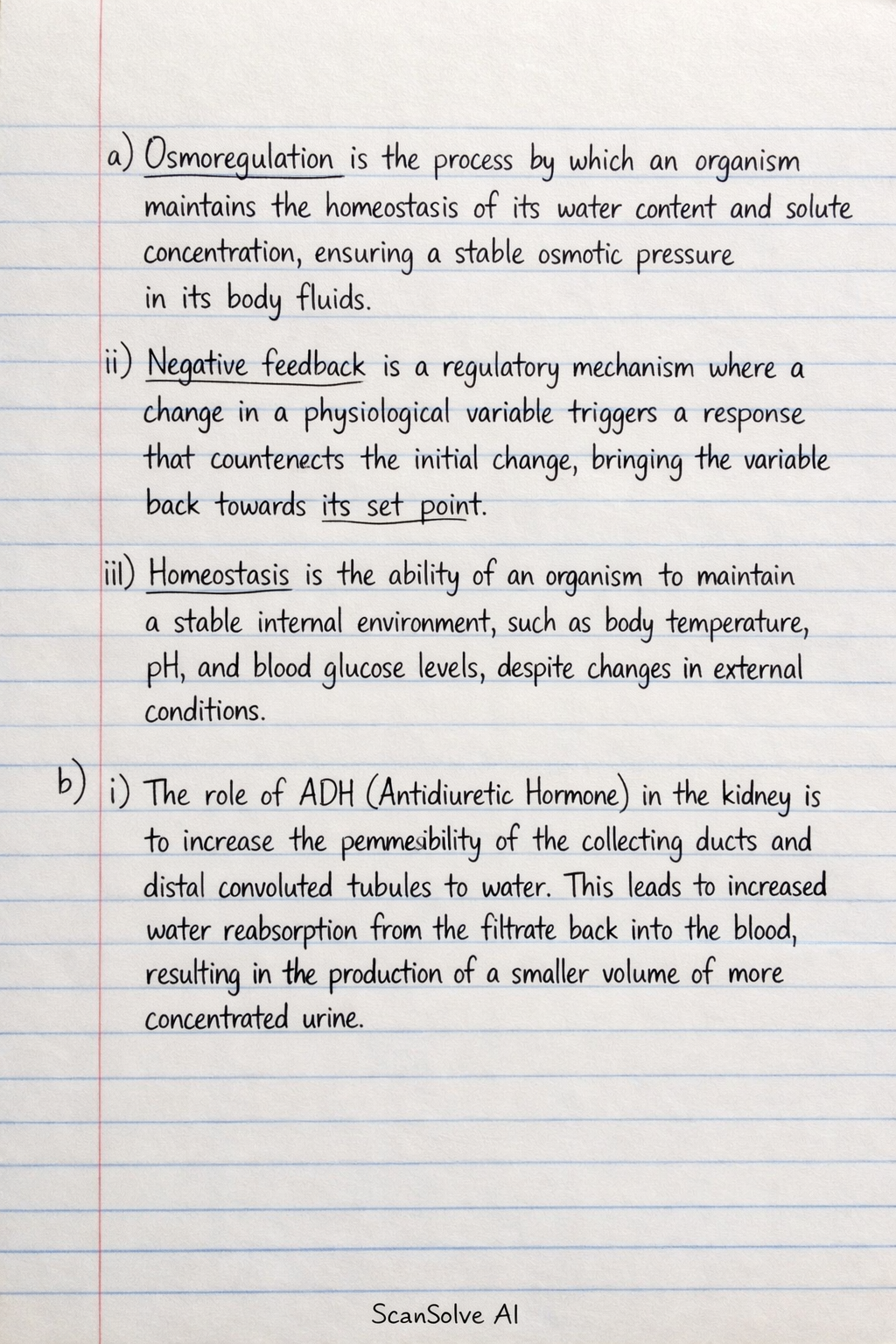
I) Osmoregulation is the process by which an organism maintains the homeostasis of its water content and solute concentration, ensuring a stable osmotic pressure in its body fluids.
ScanSolve AI Answer
Step-by-step solution
4 stepsPart a(i)
Osmoregulation is the process by which an organism maintains the homeostasis of its water content and solute concentration, ensuring a stable osmotic pressure in its body fluids.
Part a(ii)
Negative feedback is a regulatory mechanism where a change in a physiological variable triggers a response that counteracts the initial change, bringing the variable back towards its *set point
Part a(iii)
Homeostasis is the ability of an organism to maintain a stable internal environment, such as body temperature, pH, and blood glucose levels, despite changes in external conditions.
Part b(ii)
i) The role of ADH (Antidiuretic Hormone) in the kidney is to increase the permeability of the collecting ducts and distal convoluted tubules to water. This leads to increased water reabsorption from the filtrate back into the blood, resulting in the production of a smaller volume of more concentrated urine.
Part c· 4 steps
When a student drinks increased volumes of water, the blood water potential increases (blood becomes more dilute).
Osmoreceptors* in the hypothalamus detect this increase in blood water potential.
The hypothalamus then sends signals to the posterior pituitary gland, inhibiting the release of ADH (Antidiuretic Hormone).
With less ADH, the collecting ducts and distal convoluted tubules in the kidneys become less permeable to water.
Consequently, less water is reabsorbed from the filtrate back into the blood, leading to the excretion of a larger volume of more dilute urine.
This mechanism is vital for survival in flood-prone areas of Cameroon because it allows the body to efficiently excrete excess water that might be consumed, preventing overhydration and the dangerous swelling of cells (e.g., brain cells), which could lead to electrolyte imbalances and be fatal. It helps maintain the body's internal fluid balance despite high water intake.
Still stuck on this one?
Ask a follow-up, and the answer starts from this question.
More Computer Science Questions
Handwritten Step-by-Step Solution
Get this as a handwritten image on WhatsApp — like a tutor wrote it for you.
Try on WhatsApp