We read your photo as:

Evaluate the integral of (e^x + e^-x) / (e^x - e^-x) dx from 0 to infinity.

Mathematics

ScanSolve AI Answer

Answer

Diverges\text{Diverges}

Step-by-step solution

5 steps
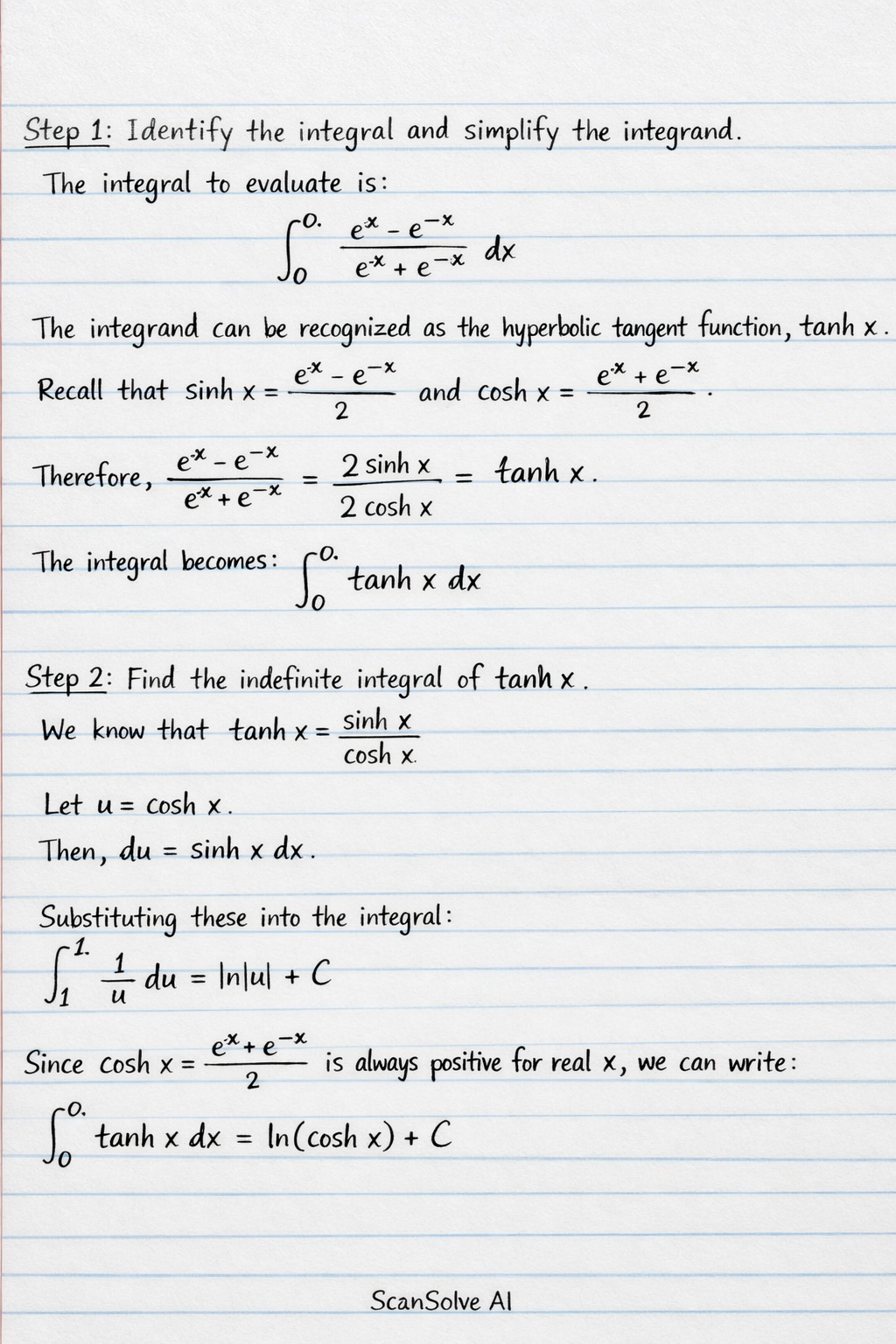
  1. Identify the integral and simplify the integrand.

    The integral to evaluate is:

    ∫0∞ex−e−xex+e−x dx\int_{0}^{\infty} \frac{e^x - e^{-x}}{e^x + e^{-x}} \,dx

    The integrand can be recognized as the hyperbolic tangent function, tanh⁡x\tanh x.
    Recall that sinh⁡x=ex−e−x2\sinh x = \frac{e^x - e^{-x}}{2} and cosh⁡x=ex+e−x2\cosh x = \frac{e^x + e^{-x}}{2}.
    Therefore, ex−e−xex+e−x=2sinh⁡x2cosh⁡x=tanh⁡x\frac{e^x - e^{-x}}{e^x + e^{-x}} = \frac{2 \sinh x}{2 \cosh x} = \tanh x.
    The integral becomes:

    ∫0∞tanh⁡x dx\int_{0}^{\infty} \tanh x \,dx
  2. Find the indefinite integral of tanh⁡x\tanh x.

    We know that tanh⁡x=sinh⁡xcosh⁡x\tanh x = \frac{\sinh x}{\cosh x}.
    Let u=cosh⁡xu = \cosh x.
    Then, du=sinh⁡x dxdu = \sinh x \,dx.
    Substituting these into the integral:

    ∫1u du=ln⁡∣u∣+C\int \frac{1}{u} \,du = \ln|u| + C

    Since cosh⁡x=ex+e−x2\cosh x = \frac{e^x + e^{-x}}{2} is always positive for real xx, we can write:

    ∫tanh⁡x dx=ln⁡(cosh⁡x)+C\int \tanh x \,dx = \ln(\cosh x) + C
  3. Evaluate the improper integral using limits.

    Since the upper limit is ∞\infty, this is an improper integral. We evaluate it using a limit:

    ∫0∞tanh⁡x dx=lim⁡b→∞∫0btanh⁡x dx\int_{0}^{\infty} \tanh x \,dx = \lim_{b \to \infty} \int_{0}^{b} \tanh x \,dx

    Substitute the indefinite integral:

    =lim⁡b→∞[ln⁡(cosh⁡x)]0b= \lim_{b \to \infty} \left[ \ln(\cosh x) \right]_{0}^{b}

    Apply the limits of integration:

    =lim⁡b→∞(ln⁡(cosh⁡b)−ln⁡(cosh⁡0))= \lim_{b \to \infty} (\ln(\cosh b) - \ln(\cosh 0))
  4. Calculate the values at the limits.

    First, evaluate cosh⁡0\cosh 0:

    cosh⁡0=e0+e−02=1+12=1\cosh 0 = \frac{e^0 + e^{-0}}{2} = \frac{1+1}{2} = 1

    So, ln⁡(cosh⁡0)=ln⁡(1)=0\ln(\cosh 0) = \ln(1) = 0.

    Next, evaluate the limit of ln⁡(cosh⁡b)\ln(\cosh b) as b→∞b \to \infty:
    As b→∞b \to \infty, eb→∞e^b \to \infty and e−b→0e^{-b} \to 0.
    Therefore, cosh⁡b=eb+e−b2→∞\cosh b = \frac{e^b + e^{-b}}{2} \to \infty as b→∞b \to \infty.
    Since ln⁡(y)→∞\ln(y) \to \infty as y→∞y \to \infty, we have:

    lim⁡b→∞ln⁡(cosh⁡b)=∞\lim_{b \to \infty} \ln(\cosh b) = \infty
  5. Conclude the result.

    Substitute these values back into the expression from Step 3:

    ∫0∞tanh⁡x dx=∞−0=∞\int_{0}^{\infty} \tanh x \,dx = \infty - 0 = \infty

    Since the limit is infinite, the integral diverges.

    The final answer is Diverges\text{Diverges}.

Was this helpful?

Try one yourself

A new problem that tests the same skill.

Still stuck on this one?

Ask a follow-up, and the answer starts from this question.

Got a different question?Ask your own question
Handwritten step-by-step solution preview

Handwritten Step-by-Step Solution

Get this as a handwritten image on WhatsApp — like a tutor wrote it for you.

Try on WhatsApp