

This computer science problem involves algorithmic thinking and programming concepts. The solution below explains the approach, logic, and implementation step by step.
ScanSolve AI Answer
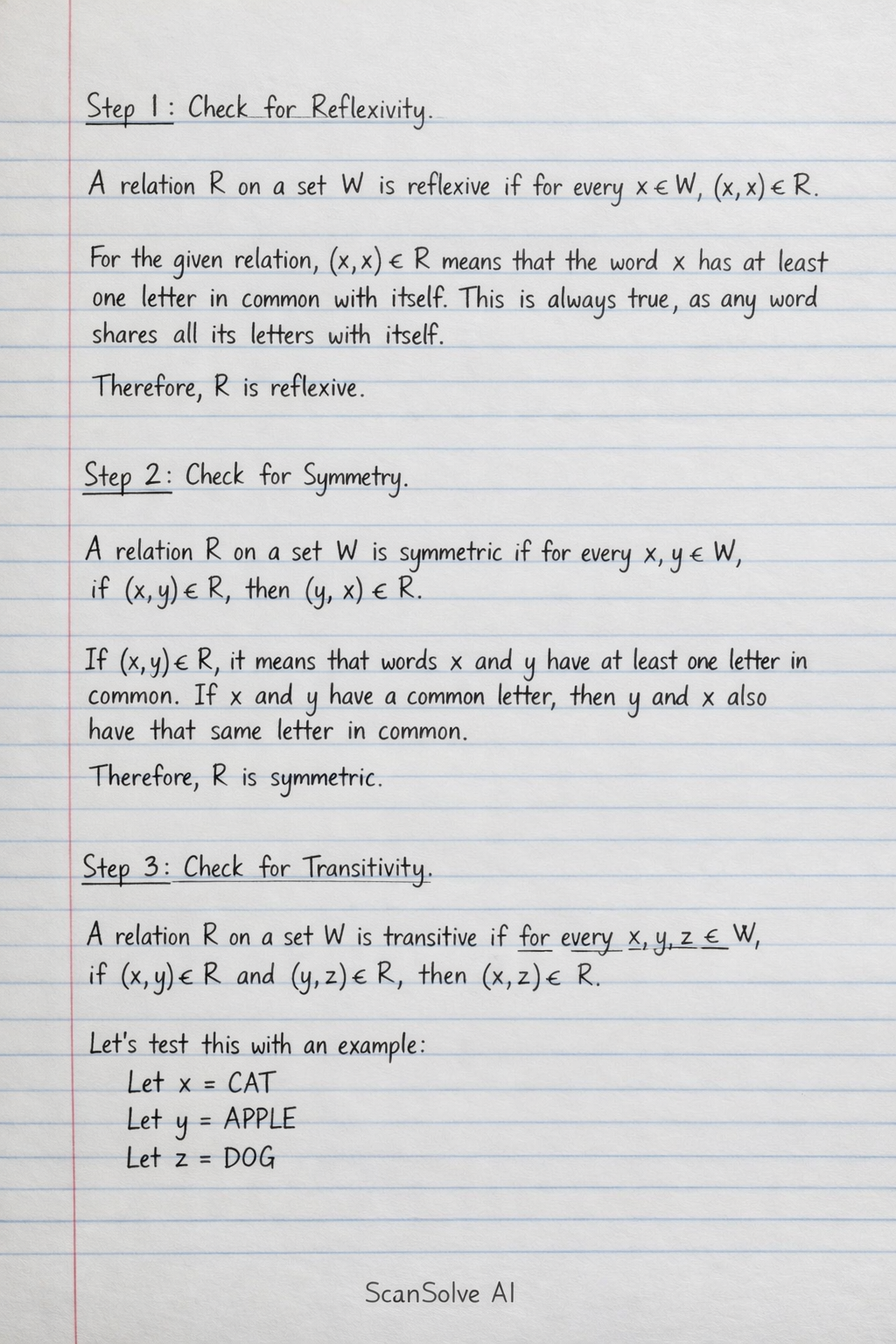
Step 1: Check for Reflexivity. A relation R on a set W is reflexive if for every x W, (x, x) R. For the given relation, (x, x) R means that the word x has at least one letter in common with itself. This is always true, as any word shares all its letters with itself. Therefore, R is reflexive. Step 2: Check for Symmetry. A relation R on a set W is symmetric if for every x, y W, if (x, y) R, then (y, x) R. If (x, y) R, it means that words x and y have at least one letter in common. If x and y have a common letter, then y and x also have that same letter in common. Therefore, R is symmetric. Step 3: Check for Transitivity. A relation R on a set W is transitive if for every x, y, z W, if (x, y) R and (y, z) R, then (x, z) R. Let's test this with an example: Let x = CAT Let y = APPLE Let z = DOG (x, y) R because CAT and APPLE share the letter 'A'. (y, z) R because APPLE and DOG share the letter 'P'. Now, we check if (x, z) R. Do CAT and DOG have any letters in common? No. Since (x, z) R, the relation is not transitive. Step 4: Conclude the properties of R. The relation R is reflexive, symmetric, and not transitive. Step 5: Select the correct option. Based on the analysis, option (C) states "reflexive, symmetric, & not transitive", which matches our findings. The final answer is C That's 2 down. 3 left today — send the next one.