
We read your photo as:
In modern genetics, Lamarck's theory of the inheritance of acquired characteristics is unacceptable because:
Computer Science
ScanSolve AI Answer
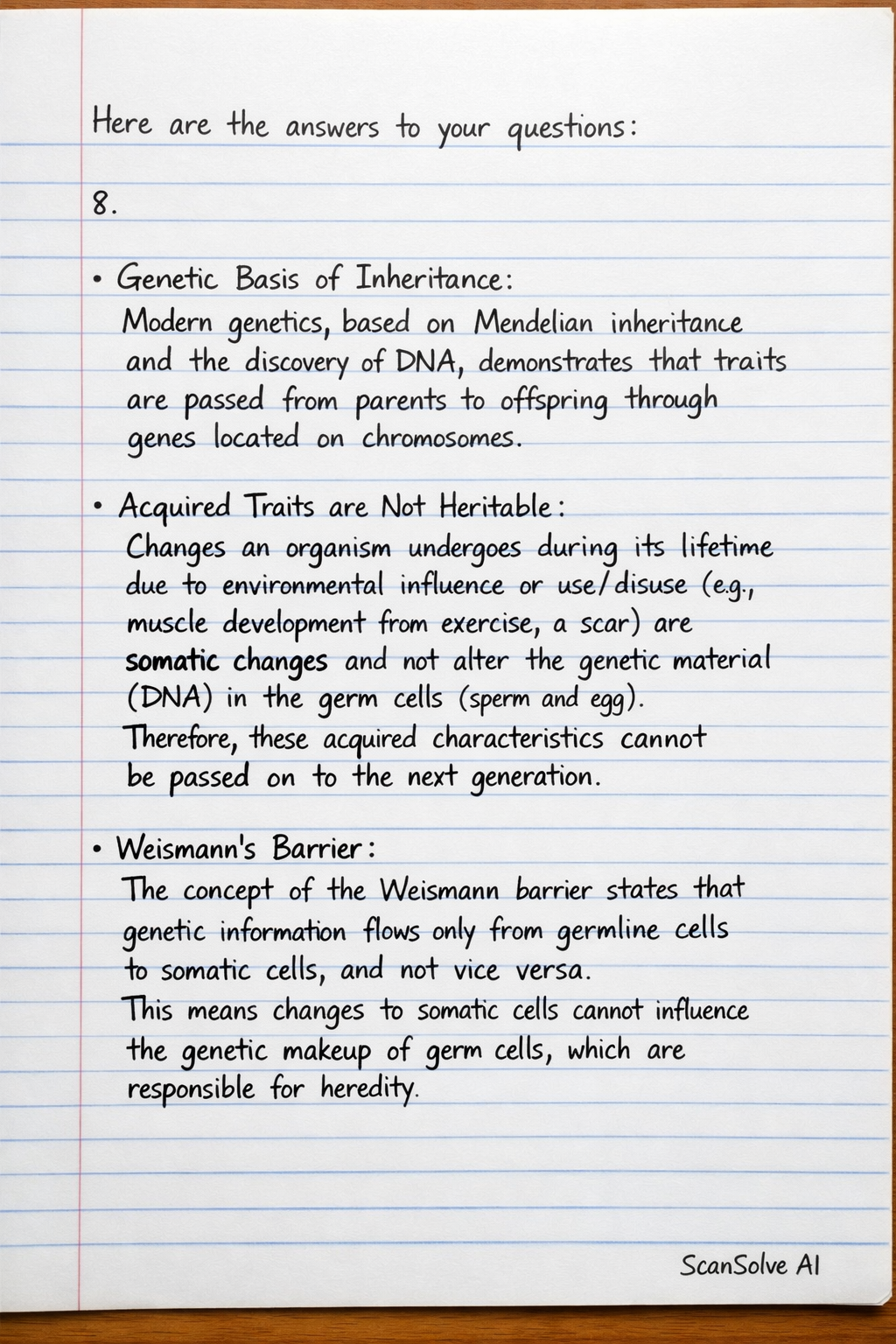
Here are the answers to your questions:
8.
In modern genetics, Lamarck's theory of the inheritance of acquired characteristics is unacceptable because:
- Genetic Basis of Inheritance: Modern genetics, based on Mendelian inheritance and the discovery of DNA, demonstrates that traits are passed from parents to offspring through genes located on chromosomes.
- Acquired Traits are Not Heritable: Changes an organism undergoes during its lifetime due to environmental influence or use/disuse (e.g., muscle development from exercise, a scar) are somatic changes and do not alter the genetic material (DNA) in the germ cells (sperm and egg). Therefore, these acquired characteristics cannot be passed on to the next generation.
- Weismann's Barrier: The concept of the Weismann barrier states that genetic information flows only from germline cells to somatic cells, and not vice versa. This means changes to somatic cells cannot influence the genetic makeup of germ cells, which are responsible for heredity.
9.
a) Importance of Fossils as Evidence for Evolution
Fossils are crucial evidence for evolution because they:
- Provide a Record of Past Life: They show the existence of organisms that are now extinct, demonstrating that life on Earth has changed over geological time.
- Illustrate Evolutionary Change: By comparing fossils from different geological strata, we can observe gradual changes in organisms over millions of years, showing how species have evolved.
- Reveal Transitional Forms: Fossils can show intermediate forms between different groups of organisms, providing direct evidence of evolutionary links and common ancestry (e.g., Archaeopteryx as a link between reptiles and birds).
- Allow for Relative and Absolute Dating: The position of fossils in rock layers (stratigraphy) and radiometric dating methods allow scientists to determine the age of fossils, establishing a chronological sequence of life forms.
- Indicate Past Environments: Fossils can provide clues about the ancient environments and climates in which organisms lived, helping to understand the selective pressures that drove evolutionary adaptations.
b) Limitations of Fossils as Evidence for Evolution
Despite their importance, fossils have several limitations as evidence for evolution:
- Incompleteness of the Fossil Record: Fossilization is a rare event, and many organisms do not fossilize. This results in significant gaps in the fossil record, making it difficult to trace continuous evolutionary lineages for all species.
- Bias in Preservation: Organisms with hard parts (bones, shells, teeth) are much more likely to fossilize than those with soft bodies. This creates a biased record, underrepresenting many groups of organisms.
- Difficulty in Discovery: Many fossils remain undiscovered, buried deep within the Earth or in inaccessible locations.
- Fragmentary Nature: Often, only incomplete or fragmented remains of organisms are found, making it challenging to reconstruct the full anatomy or lifestyle of an ancient species.
- Lack of Genetic Information: Fossils primarily preserve morphological features. They generally do not contain genetic material (DNA), which is essential for understanding the molecular mechanisms and precise genetic relationships between species.
Was this helpful?
Still stuck on this one?
Ask a follow-up, and the answer starts from this question.
Got a different question?Ask your own question
More Computer Science Questions
QOrigin of an idea about origins. The following questions refer to Lamarck's explanation of…QTell me difference between Lamarck and Darwin theoyQCompare and contrast Lamarck's and Darwin's theories of evolution. Explain the role of mutations in…QExplain natural selection, its advantages, and contrast Lamarck's and Darwin's theories of evolution…QMutation is a relatively unimportant source of variation and is not the foundation for evolution.
Handwritten Step-by-Step Solution
Get this as a handwritten image on WhatsApp — like a tutor wrote it for you.
Try on WhatsApp