
We read your photo as:
List and explain three key enterprise features that improve file server reliability and explain why a dual 10 Gb Ethernet network interface is recommended for high-user file servers.
ScanSolve AI Answer
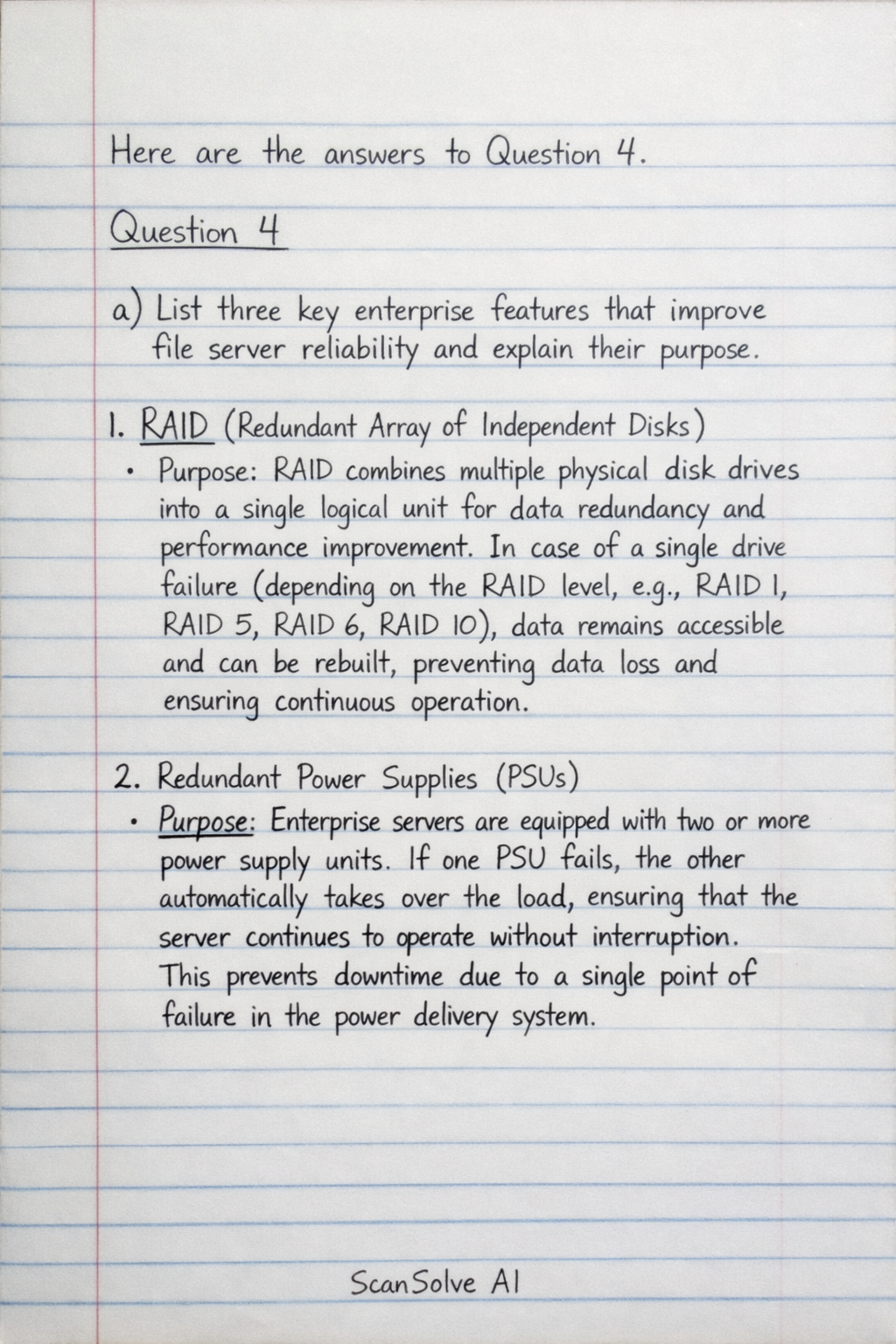
Here are the answers to Question 4.
Question 4
a) List three key enterprise features that improve file server reliability and explain their purpose.
-
RAID (Redundant Array of Independent Disks)
- Purpose: RAID combines multiple physical disk drives into a single logical unit for data redundancy and performance improvement. In case of a single drive failure (depending on the RAID level, e.g., RAID 1, RAID 5, RAID 6, RAID 10), data remains accessible and can be rebuilt, preventing data loss and ensuring continuous operation.
-
Redundant Power Supplies (PSUs)
- Purpose: Enterprise servers are equipped with two or more power supply units. If one PSU fails, the other automatically takes over the load, ensuring that the server continues to operate without interruption. This prevents downtime due to a single point of failure in the power delivery system.
-
ECC (Error-Correcting Code) RAM
- Purpose: ECC RAM detects and corrects common types of internal data corruption. This is crucial for servers, as memory errors can lead to system crashes, data corruption, and instability. ECC RAM significantly improves the reliability and stability of the server, especially under heavy loads and continuous operation.
b) Explain why a dual 10 Gb Ethernet network interface is recommended for high-user file servers.
A dual 10 Gb Ethernet network interface is recommended for high-user file servers for two primary reasons:
-
Increased Bandwidth: A 10 Gigabit Ethernet connection offers ten times the bandwidth of a standard 1 Gigabit Ethernet connection. For a high-user file server, many users will be simultaneously accessing and transferring files, generating significant network traffic. Dual 10 GbE interfaces, especially when configured with NIC Teaming (Link Aggregation), provide an aggregate bandwidth of up to 20 Gbps, which is essential to prevent network bottlenecks and ensure fast file access speeds for all concurrent users.
-
Redundancy and Fault Tolerance: Having two separate network interfaces provides critical redundancy. If one 10 GbE NIC fails or its network cable is disconnected, the other NIC can automatically take over the network traffic. This network fault tolerance ensures continuous network connectivity for the file server, preventing downtime and maintaining user access to shared files, which is vital for enterprise operations.
c) Compare Windows Server 2022 and Ubuntu Server as choices for a file server in an enterprise.
Here is a comparison of Windows Server 2022 and Ubuntu Server for enterprise file server deployment:
| Feature | Windows Server 2022
Still stuck on this one?
Ask a follow-up, and the answer starts from this question.
More Computer Science Questions
Handwritten Step-by-Step Solution
Get this as a handwritten image on WhatsApp — like a tutor wrote it for you.
Try on WhatsApp