
We read your photo as:
NATIONAL COUNCIL FOR TECHNICAL VOCATIONAL AND EDUCATION Republic of Sierra Leone PROGRAMME: HIGHER DIPLOMA EXAMINATIONS- 2026 SUBJECT: TELECOMMUNICATION SYSTEMS INSTRUCTIONS: Answer Any FIVE (5) Questions
ScanSolve AI Answer
Answer
Step-by-step solution
3 stepsHere's the solution for question 2a:
a) A high-fidelity audio signal with a bandwidth of is to be digitized.
Determine the minimum Nyquist sampling rate.
The bandwidth of the audio signal is . For an audio signal, this bandwidth represents the maximum frequency component, .
According to the Nyquist sampling theorem, the minimum sampling rate () must be at least twice the maximum frequency component.The minimum Nyquist sampling rate is .
Calculate the resulting bit rate.
The samples are quantized using a uniform PCM system with bits per sample.
Using the minimum Nyquist sampling rate from Step 1, the bit rate () is calculated as:The resulting bit rate is .
Calculate the theoretical maximum Signal-to-Quantization Noise Ratio (SQNR) in decibels.
For a uniform PCM system with bits per sample, the theoretical maximum SQNR in decibels is given by the formula:
The theoretical maximum SQNR is .
Try one yourself
A new problem that tests the same skill.
Still stuck on this one?
Ask a follow-up, and the answer starts from this question.
More Computer Science Questions
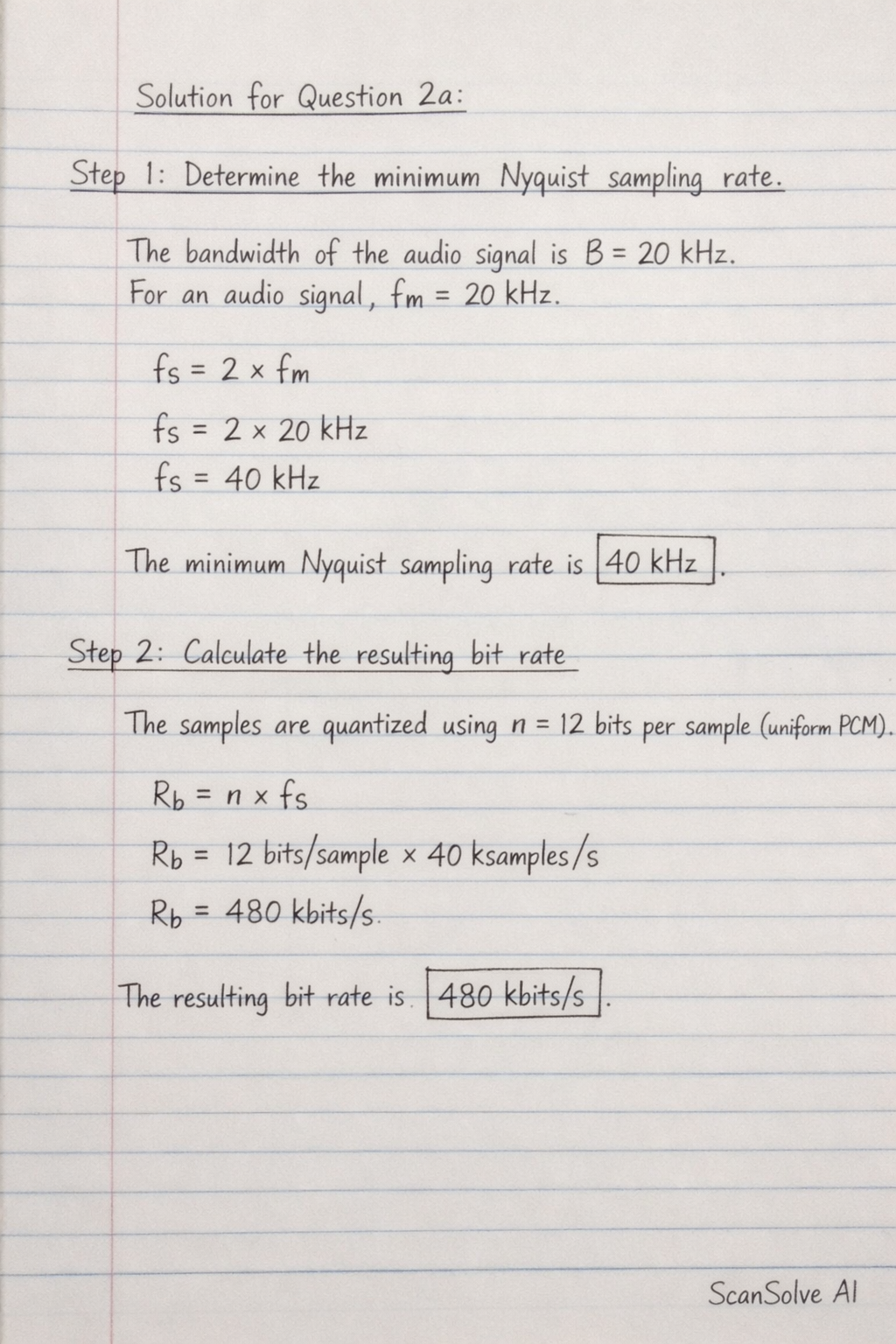
Handwritten Step-by-Step Solution
Get this as a handwritten image on WhatsApp — like a tutor wrote it for you.
Try on WhatsApp