
We read your photo as:
SUBJECT: ENGINE SYSTEM. INSTRUCTIONS: Answer any Five (5) Questions.
ScanSolve AI Answer
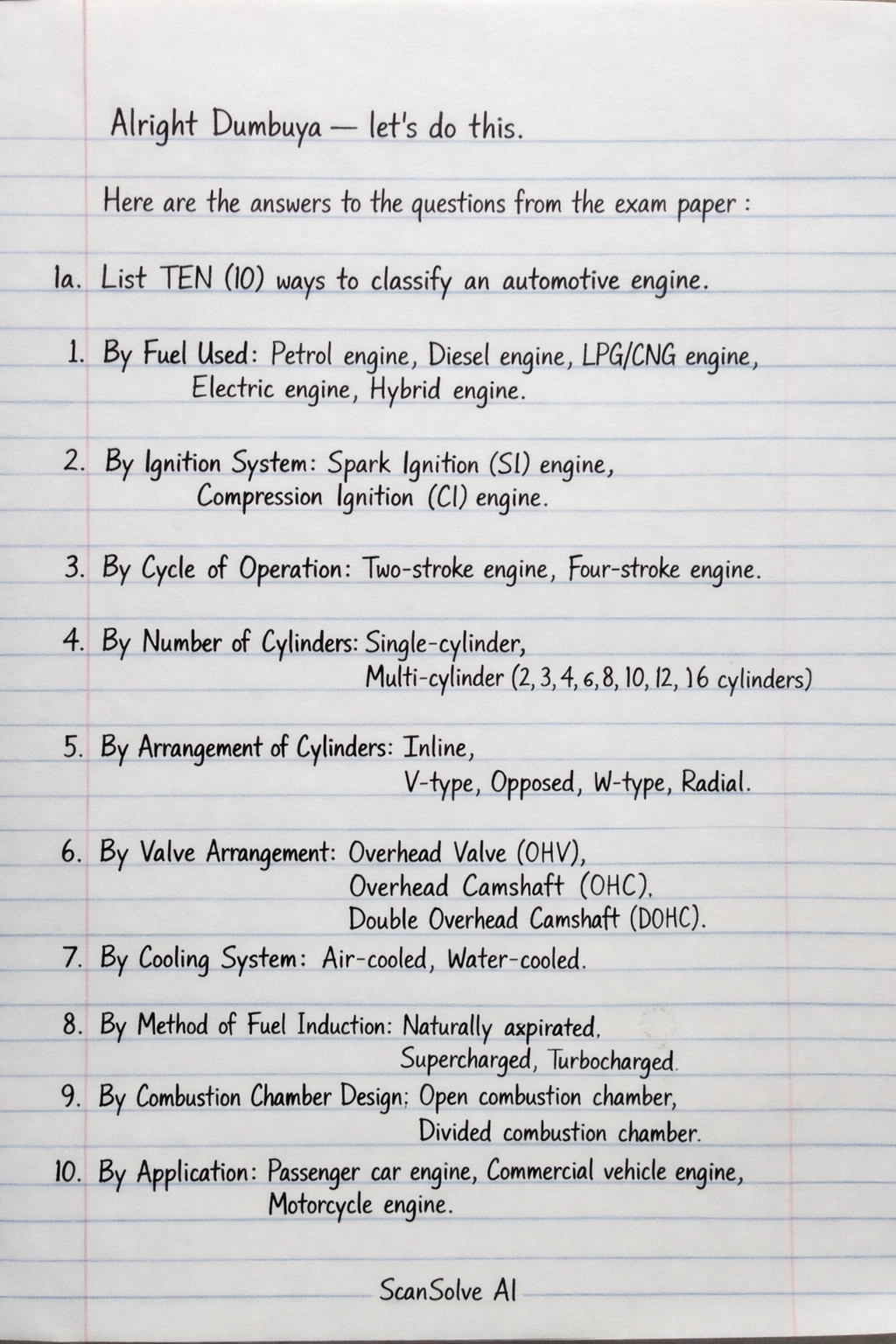
Here are the answers to the questions from the exam paper:
1a. List TEN (10) ways to classify an automotive engine.
Automotive engines can be classified in many ways, including:
- By Fuel Used: Petrol engine, Diesel engine, LPG/CNG engine, Electric engine, Hybrid engine.
- By Ignition System: Spark Ignition (SI) engine, Compression Ignition (CI) engine.
- By Cycle of Operation: Two-stroke engine, Four-stroke engine.
- By Number of Cylinders: Single-cylinder, Multi-cylinder (2, 3, 4, 6, 8, 10, 12, 16 cylinders).
- By Arrangement of Cylinders: Inline, V-type, Opposed (Boxer), W-type, Radial.
- By Valve Arrangement: Overhead Valve (OHV), Overhead Camshaft (OHC), Double Overhead Camshaft (DOHC).
- By Cooling System: Air-cooled, Water-cooled.
- By Method of Fuel Induction: Naturally aspirated, Supercharged, Turbocharged.
- By Combustion Chamber Design: Open combustion chamber, Divided combustion chamber.
- By Application: Passenger car engine, Commercial vehicle engine, Motorcycle engine.
1b. Compare and contrast spark ignition engine and compression ignition engine.
-
Spark Ignition (SI) Engine (Petrol Engine)
- Fuel: Gasoline (petrol).
- Ignition: Uses a spark plug to ignite the air-fuel mixture.
- Compression Ratio: Lower (typically 8:1 to 12:1).
- Fuel-Air Mixture: Air and fuel are mixed before compression (in carburetor or by fuel injection).
- Efficiency: Generally lower thermal efficiency.
- Noise/Vibration: Quieter and smoother operation.
- Weight: Lighter construction for a given power output.
- Emissions: Produces more carbon monoxide (CO) and unburnt hydrocarbons (HC).
-
Compression Ignition (CI) Engine (Diesel Engine)
- Fuel: Diesel fuel.
- Ignition: Air is compressed to a very high temperature, and fuel is then injected, igniting due to the heat of compression. No spark plug is used for ignition.
- Compression Ratio: Higher (typically 16:1 to 24:1).
- Fuel-Air Mixture: Only air is compressed; fuel is injected directly into the combustion chamber at the end of the compression stroke.
- Efficiency: Higher thermal efficiency due to higher compression ratio.
- Noise/Vibration: Generally noisier and more vibration.
- Weight: Heavier construction due to higher pressures.
- Emissions: Produces more nitrogen oxides (NOx) and particulate matter (soot).
1c. Explain the following terms:
- i. Camshaft lift: This refers to the maximum distance the valve is opened from its fully closed position by the action of the camshaft lobe. Greater lift allows more air/fuel mixture to enter or exhaust gases to leave the cylinder.
- ii. Camshaft duration: This is the angular rotation of the crankshaft (measured in degrees) during which a valve is held open by the camshaft lobe. Longer duration means the valve stays open for a longer period, affecting engine breathing at different RPMs.
- iii. Valve timing: This refers to the precise moments (in relation to crankshaft position, usually Top Dead Center or Bottom Dead Center) when the intake and exhaust valves open and close. Correct valve timing is crucial for efficient engine operation across various speeds.
- iv. Valve overlap: This is the period (in crankshaft degrees) during which both the intake and exhaust valves are open simultaneously at the end of the exhaust stroke and the beginning of the intake stroke. It helps in scavenging exhaust gases and initiating intake flow.
1d. Why are hydraulic valve lifters used more than solid or mechanical lifters?
Hydraulic valve lifters are preferred over solid or mechanical lifters primarily because they automatically adjust for valve train clearance. This eliminates the need for manual valve lash adjustments, reducing maintenance requirements and ensuring quieter operation by preventing valve clatter. They also help maintain optimal valve timing and lift throughout the engine's operating temperature range, improving efficiency and reducing wear.
Still stuck on this one?
Ask a follow-up, and the answer starts from this question.
More Computer Science Questions
Handwritten Step-by-Step Solution
Get this as a handwritten image on WhatsApp — like a tutor wrote it for you.
Try on WhatsApp