
We read your photo as:
Which of the following BEST distinguishes parametric from non-parametric statistical methods?
ScanSolve AI Answer
Step-by-step solution
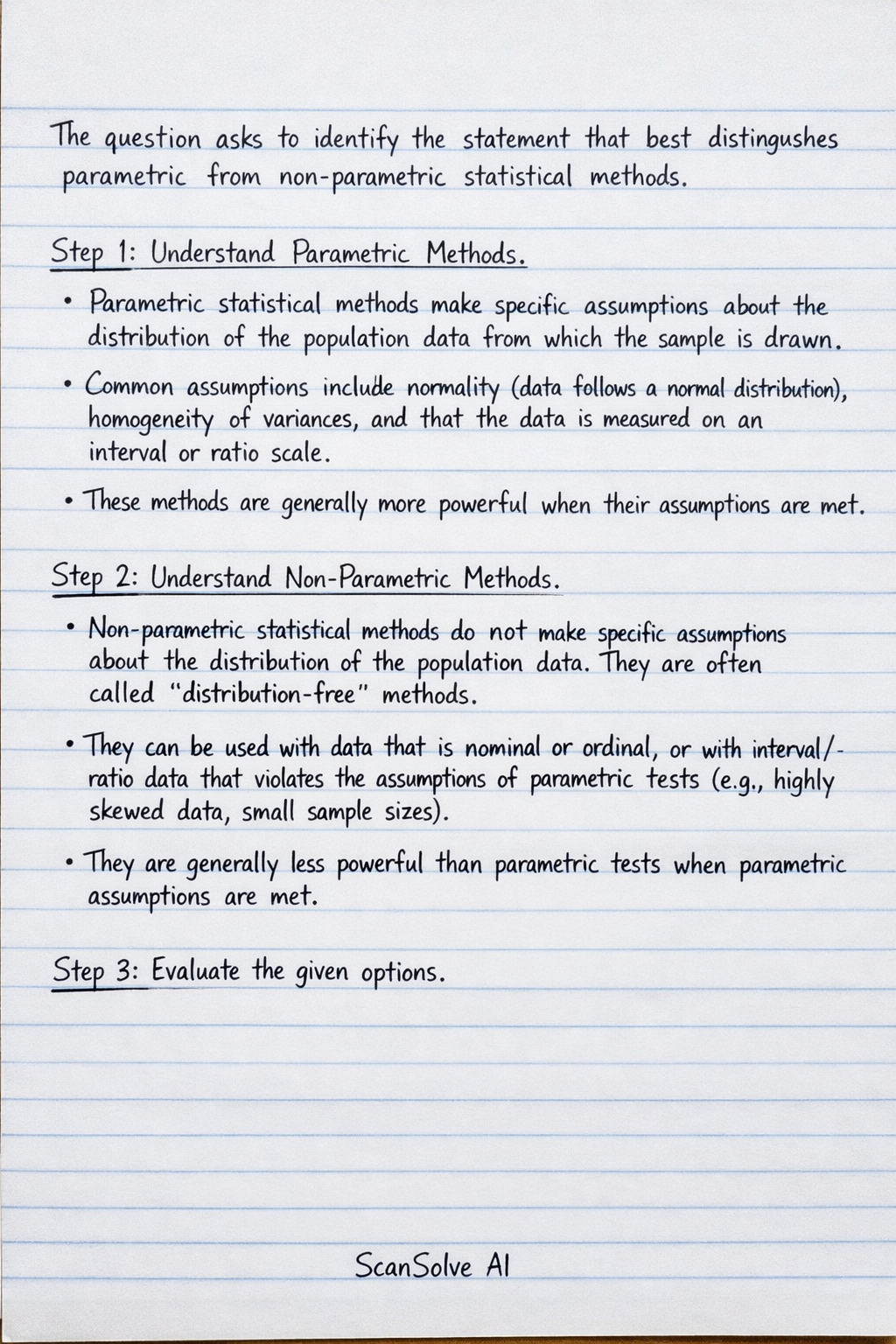
4 stepsThe question asks to identify the statement that best distinguishes parametric from non-parametric statistical methods.
Understand Parametric Methods.
- Parametric statistical methods make specific assumptions about the distribution of the population data from which the sample is drawn.
- Common assumptions include normality (data follows a normal distribution), homogeneity of variances, and that the data is measured on an interval or ratio scale.
- These methods are generally more powerful when their assumptions are met.
Understand Non-Parametric Methods.
- Non-parametric statistical methods do not make specific assumptions about the distribution of the population data. They are often called "distribution-free" methods.
- They can be used with data that is nominal or ordinal, or with interval/ratio data that violates the assumptions of parametric tests (e.g., highly skewed data, small sample sizes).
- They are generally less powerful than parametric tests when parametric assumptions are met.
Evaluate the given options.
-
a. Parametric methods are always more accurate than non-parametric methods.
- This is incorrect. If the assumptions for a parametric test are violated, a non-parametric test can be more appropriate and lead to more accurate conclusions.
-
b. Parametric methods are used only for qualitative data, while non-parametric methods are used for quantitative data.
- This is incorrect. Parametric methods are used for quantitative data (interval/ratio scales). Non-parametric methods can be used for both qualitative (nominal/ordinal) and quantitative data.
-
c. Parametric methods assume specific distributional properties (e.g., normality), while non-parametric methods do not.
- This statement accurately captures the fundamental difference. Parametric tests rely on assumptions about the population distribution (like normality), whereas non-parametric tests are free from such assumptions.
-
d. Non-parametric methods require larger sample sizes than parametric methods.
- This is often true in practice to achieve comparable statistical power, especially when parametric assumptions are met. However, it is a consequence of their relative power, not the defining distinction between the two types of methods. The core distinction lies in the distributional assumptions.
-
Conclude the best distinguishing factor.
The most fundamental difference between parametric and non-parametric methods is the assumption (or lack thereof) regarding the underlying distribution of the data.
The final answer is .
Still stuck on this one?
Ask a follow-up, and the answer starts from this question.
More Computer Science Questions
Handwritten Step-by-Step Solution
Get this as a handwritten image on WhatsApp — like a tutor wrote it for you.
Try on WhatsApp