
We read your photo as:
Outline a lesson plan that you can use to teach a Grade 6 topic under Matter and Materials using cooperative learning as a teaching strategy.
Computer Science
ScanSolve AI Answer
Step-by-step solution
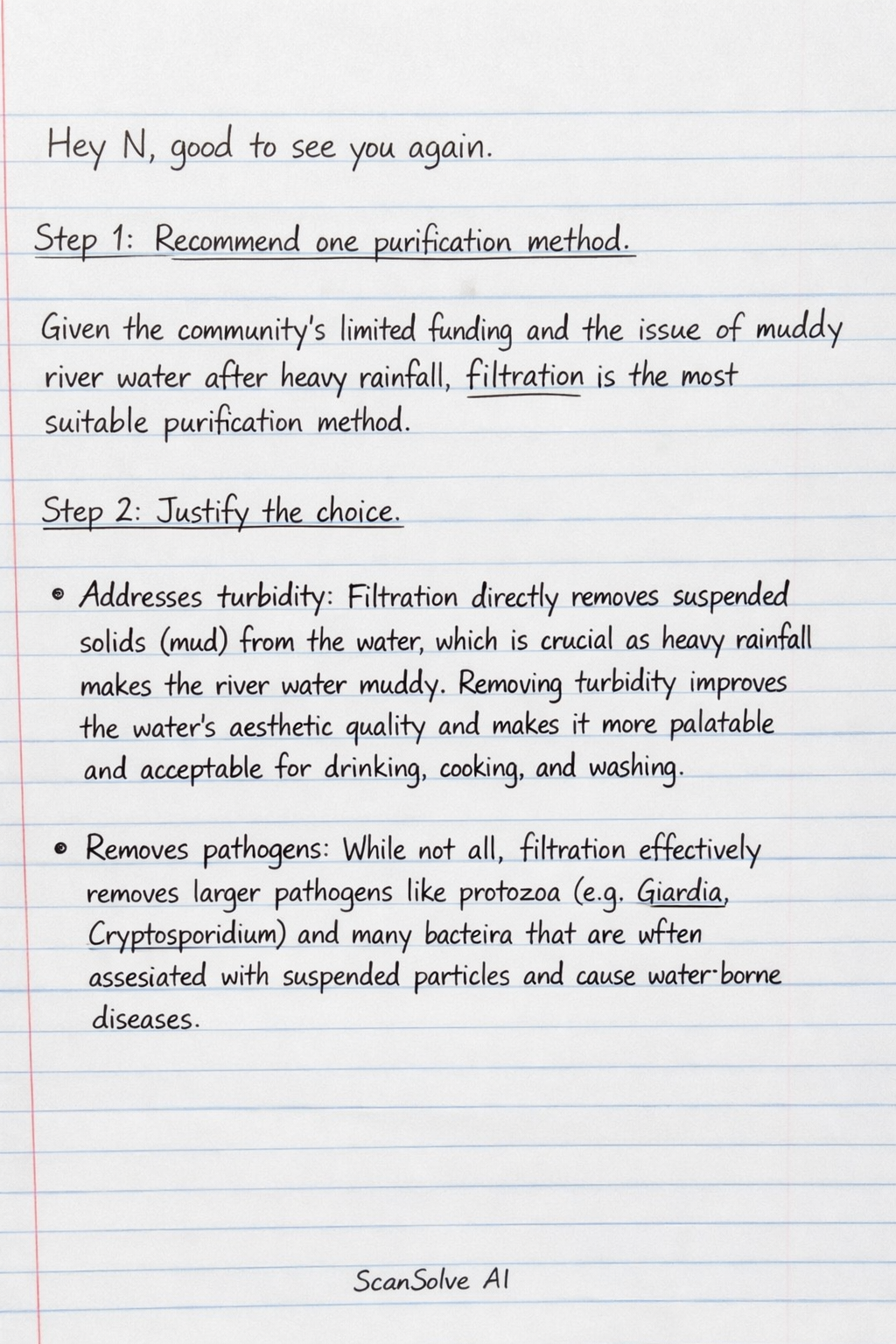
2 stepsRecommend one purification method.
Given the community's limited funding and the issue of muddy river water after heavy rainfall, filtration is the most suitable purification method.
Justify the choice.
- Addresses turbidity: Filtration directly removes suspended solids (mud) from the water, which is crucial as heavy rainfall makes the river water muddy. Removing turbidity improves the water's aesthetic quality and makes it more palatable and acceptable for drinking, cooking, and washing.
- Removes pathogens: While not all, filtration effectively removes larger pathogens like protozoa (e.g., Giardia, Cryptosporidium) and many bacteria that are often associated with suspended particles and cause water-borne diseases.
- Cost-effectiveness and sustainability: Simple filtration systems, such as slow sand filters, can be constructed and maintained using local materials and labor. This makes them a highly cost-effective and sustainable solution for a community with limited funding, compared to the ongoing fuel costs of boiling or the chemical supply needs of chlorination, especially when dealing with highly turbid water.
The most suitable method is:
- Filtration
Was this helpful?
Still stuck on this one?
Ask a follow-up, and the answer starts from this question.
Got a different question?Ask your own question
More Computer Science Questions
QGrade 6 daily lesson plan from 6.1.1-6.3.2QCreate a Grade 3 Mathematics lesson plan based on previous examples, detailing teacher and student…QFor English, based on the topic written sentence. Write me a grade 6 lesson for me to teach my grade…QPlease fill in the following lesson plan template for a 6th grade math class on equivalent…QUsing the text selected in Question 1.1, develop six questions for a Grade 6 EFAL classwork…
Handwritten Step-by-Step Solution
Get this as a handwritten image on WhatsApp — like a tutor wrote it for you.
Try on WhatsApp