
We read your photo as:
Subtract the following hexadecimal numbers: EBA16 - 2E16
ScanSolve AI Answer
Answer
Step-by-step solution
7 stepsOkay CØTBØJ, let's tackle these hexadecimal subtraction problems.
Hexadecimal (base 16) uses digits 0-9 and letters A-F, where:
A = 10
B = 11
C = 12
D = 13
E = 14
F = 15
When you need to borrow in hexadecimal subtraction, you borrow 1 from the next column to the left, which adds 16 to the current column's value.
Problem (c):
We'll subtract column by column, from right to left.
Subtract the rightmost column (16⁰ place).
We need to calculate .
In decimal, this is . Since , we need to borrow from the next column.
Borrow 1 from B in the place. B () becomes A ().
The borrowed 1 is equivalent to in the current column. So, A () becomes .
Now, subtract: .
In hexadecimal, is C.
So, the rightmost digit is C.Subtract the middle column (16¹ place).
The B in became A after borrowing.
We need to calculate .
In decimal, this is .
In hexadecimal, is 8.
So, the middle digit is 8.Subtract the leftmost column (16² place).
We need to calculate (since there's no digit in the place for ).
In decimal, this is .
In hexadecimal, is E.
So, the leftmost digit is E.Combining the results:
Problem (d):
We'll subtract column by column, from right to left.
Subtract the rightmost column (16⁰ place).
We need to calculate .
In decimal, this is .
So, the rightmost digit is 0.Subtract the second column from the right (16¹ place).
We need to calculate .
In decimal, this is .
So, the second digit from the right is 0.Subtract the third column from the right (16² place).
We need to calculate .
In decimal, this is . Since , we need to borrow from the next column.
Borrow 1 from B in the place. B () becomes A ().
The borrowed 1 is equivalent to in the current column. So, A () becomes .
Now, subtract: .
In hexadecimal, is C.
So, the third digit from the right is C.Subtract the leftmost column (16³ place).
The B in became A after borrowing.
We need to calculate (since there's no digit in the place for ).
In decimal, this is .
In hexadecimal, is A.
So, the leftmost digit is A.Combining the results:
Still stuck on this one?
Ask a follow-up, and the answer starts from this question.
More Computer Science Questions
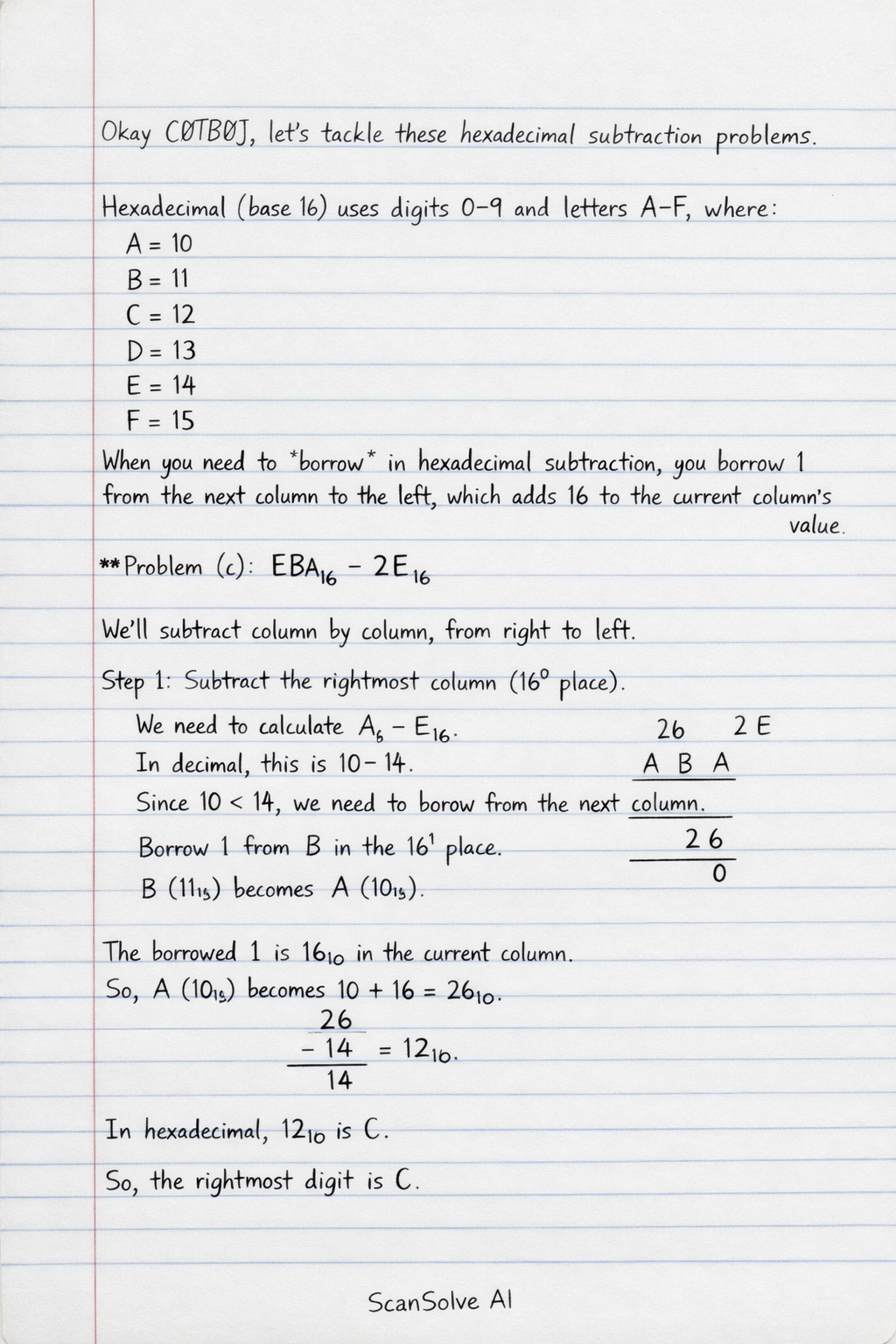
Handwritten Step-by-Step Solution
Get this as a handwritten image on WhatsApp — like a tutor wrote it for you.
Try on WhatsApp