
We read your photo as:
Prove that p (p q) is a tautology using a truth table.
Computer Science
ScanSolve AI Answer
Step-by-step solution
3 stepsConstruct a truth table for the expression .
We need columns for , , , , and .
Fill in the truth values for all possible combinations of and .
Recall that is false only when is true and is false; otherwise, it is true.
Examine the final column for .
All the truth values in the column for are 'T' (True).
Since the expression is true for all possible truth values of and , it is a tautology.
Was this helpful?
Still stuck on this one?
Ask a follow-up, and the answer starts from this question.
Got a different question?Ask your own question
More Computer Science Questions
QProve that (p q) is logically equivalent to p q using a truth table.QConstruct a truth table for the expression p o (p ext or q) and determine if it is a tautology.QConstruct the truth table for the negation of a conjunction, (p q).QShow that (p q) and p q are logically equivalent.QDraw the truth table for each of the propositions p q and p q and show that they are identical…
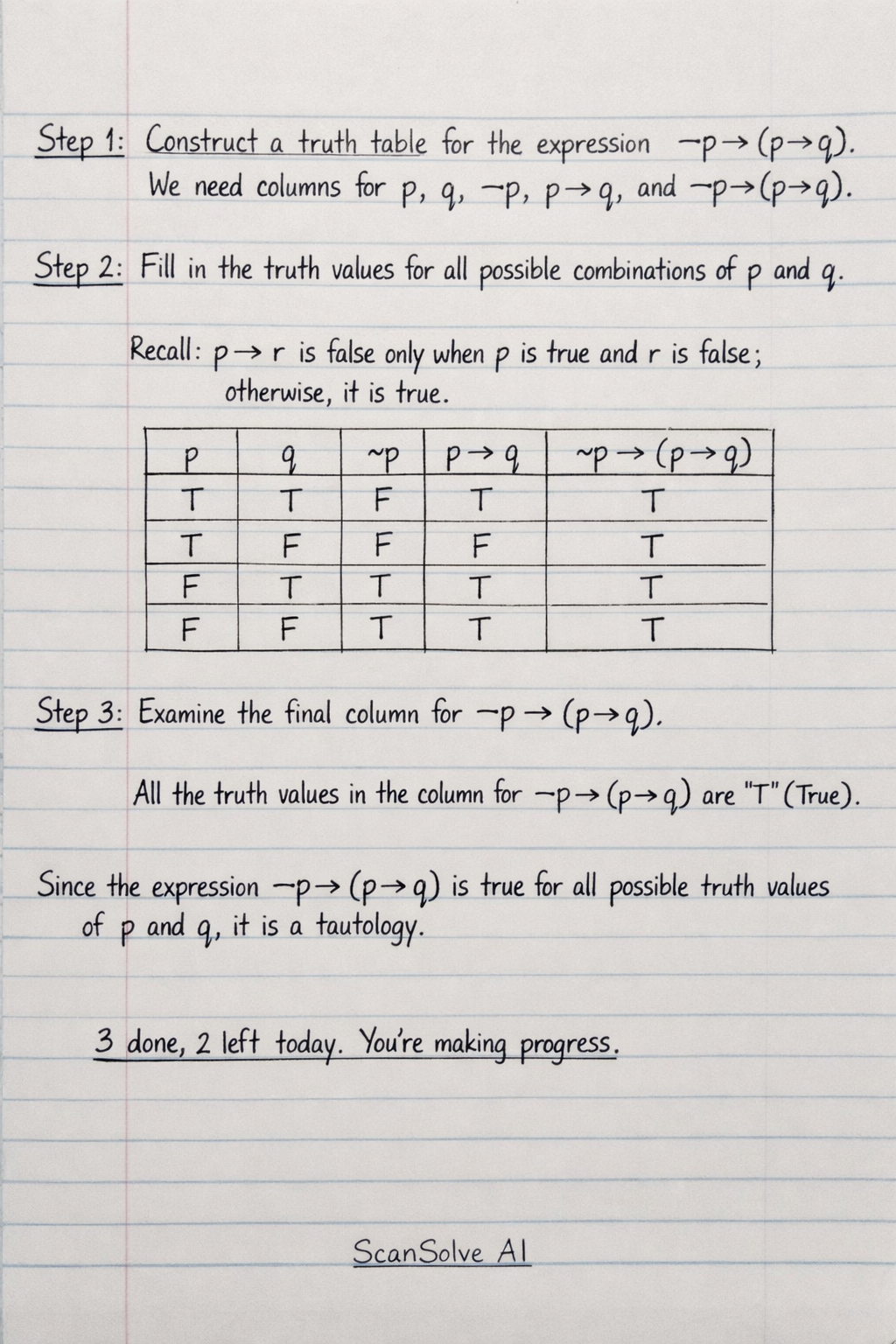
Handwritten Step-by-Step Solution
Get this as a handwritten image on WhatsApp — like a tutor wrote it for you.
Try on WhatsApp