
We read your photo as:
Draw the truth table for each of the propositions p q and p q and show that they are identical. Also, given that ^-1(x) = alpha and ^-1(x) = beta, show that (alpha + beta) = 1.
ScanSolve AI Answer
Answer
Step-by-step solution
17 stepsHere are the solutions to the problems:
3. (i) Draw the truth table for each of the propositions and and show that they are identical.
Step 1: Create a truth table for and .
Step 2: Determine the truth values for .
Step 3: Determine the truth values for .
Step 4: Determine the truth values for .
Step 5: Compare the columns for and .
The columns for and are identical, which shows that the two propositions are equivalent.
3. (ii) Given that and , show that .
Step 1: Use the property of inverse trigonometric functions.
We know that for any , the sum of and is .
Step 2: Substitute the given values into the identity.
Given and , we have:
Step 3: Calculate .
Step 4: Evaluate the sine function.
Thus, .
4. (i) The function is given by . Express in partial fractions. Hence find .
Part 1· 4 steps
Partial Fractions
Set up the partial fraction decomposition.
Multiply by the common denominator .
Solve for A, B, and C.
Substitute :
Expand the equation:
Equate coefficients:
Coefficient of :
Coefficient of :
Constant term: (consistent)Write the partial fraction decomposition.
Part 2
Integration
Integrate each term.
The first integral is .
For the second integral, let , then , so .Combine the results.
The final answer is .
4. (ii) By using the substitution , find .
Define the substitution.
Let .
Find .
Differentiating with respect to gives .
Substitute and into the integral.
Evaluate the resulting integral.
This is a standard integral:
Substitute back .
The final answer is .
4. (iii) Find .
Use integration by parts, .
Choose and .
Let and .
Find and .
Differentiate : .
Integrate : .Apply the integration by parts formula.
Evaluate the remaining integral.
Simplify the expression.
You can also factor out :
The final answer is .
Try one yourself
A new problem that tests the same skill.
Still stuck on this one?
Ask a follow-up, and the answer starts from this question.
More Mathematics Questions
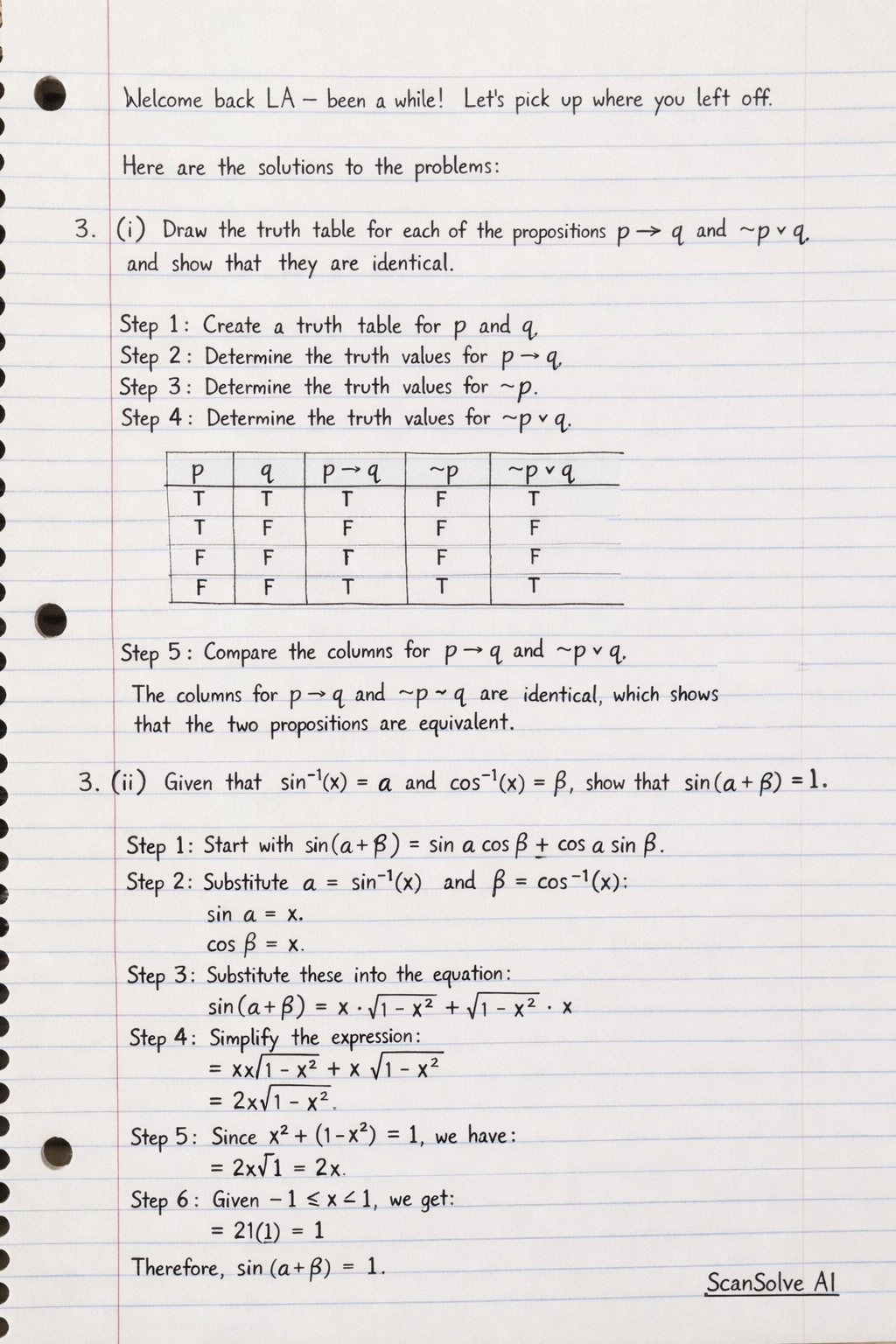
Handwritten Step-by-Step Solution
Get this as a handwritten image on WhatsApp — like a tutor wrote it for you.
Try on WhatsApp