
We read your photo as:
To identify the correct match between a part of the female reproductive system and its function.
ScanSolve AI Answer
Step-by-step solution
9 stepsAnalyze Question 33.
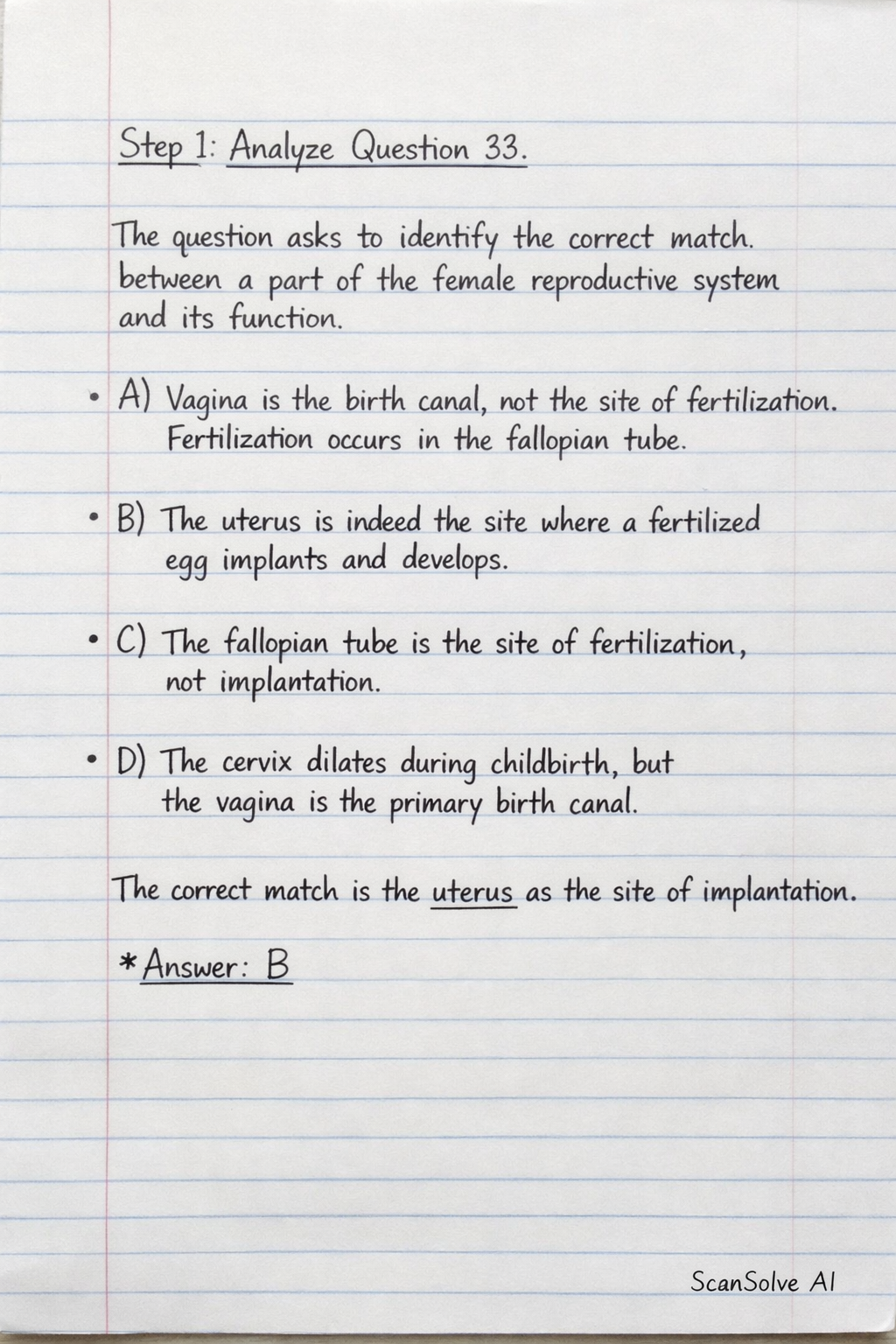
The question asks to identify the correct match between a part of the female reproductive system and its function.
- A) Vagina is the birth canal, not the site of fertilization. Fertilization occurs in the fallopian tube.
- B) The uterus is indeed the site where a fertilized egg implants and develops.
- C) The fallopian tube is the site of fertilization, not implantation.
- D) The cervix dilates during childbirth, but the vagina is the primary birth canal.
The correct match is the uterus as the site of implantation.
- Answer: B
Analyze Question 34.
The question asks for "Intratraction methods of birth control." This term is likely a typo. Given the options, it most probably refers to surgical or permanent methods of birth control.
- A) Intrauterine device (IUD) is a method, but birth control pills are hormonal and oral.
- B) Condoms are barrier methods, and vasectomy is surgical.
- C) Diaphragm is a barrier method, and tubal ligation is surgical.
- D) Vasectomy (for males) and tubal ligation (for females) are both surgical procedures that provide permanent birth control.
Assuming "Intratraction" refers to surgical/permanent methods, option D is the best fit as both listed methods are surgical.
- Answer: D
Analyze Question 35.
The question asks to identify a change that occurs in males during puberty.
- A) Broadening of the chest and shoulders is a characteristic secondary sexual trait in males due to increased testosterone.
- B) Enlargement of the breasts (gynecomastia) can occur in some males but is not a typical or primary characteristic of male puberty; it's more characteristic of female puberty.
- C) Broadening of the hips is a characteristic of female puberty.
- D) Males typically experience an increase in muscle mass and a decrease in body fat percentage during puberty, not an increase in body fat.
The correct change is the broadening of the chest and shoulders.
- Answer: A
Analyze Question 36.
The question asks for the term describing observable characteristics determined by both genes and the environment.
- A) Genotype refers to the genetic makeup of an organism.
- B) An allele is a variant form of a gene.
- C) Phenotype refers to the observable physical or biochemical characteristics of an organism, resulting from the interaction of its genotype with the environment.
- D) A chromosome is a structure of nucleic acids and protein found in the nucleus of most living cells, carrying genetic information in the form of genes.
The correct term is phenotype.
- Answer: C
Analyze Question 37.
Haemophilia is a sex-linked recessive trait.
Father with haemophilia:
Mother who is a carrier:To find the probability of having a daughter with haemophilia (), we perform a Punnett square for the cross:
The possible genotypes for daughters are (carrier) and (haemophiliac).
Out of the two possible daughter genotypes, one is .
Therefore, the probability of a daughter having haemophilia is or .- Answer: D
Analyze Question 38.
The question asks for the usual direction of energy flow in an ecosystem.
- Energy in an ecosystem flows unidirectionally, starting from primary producers (autotrophs) who capture energy (usually from the sun).
- This energy is then transferred to consumers at various trophic levels (herbivores, carnivores).
- At each trophic level, a significant portion of energy is lost as heat.
- Decomposers break down dead organic matter from all trophic levels, returning nutrients to the soil but not recycling energy back to producers in the same way. Energy does not flow "back" from decomposers to producers.
Option B accurately describes this flow: from primary producers to consumers at various trophic levels, and eventually to decomposers.
- Answer: B
Analyze Question 39.
The question asks which bacterial disease is transmitted through contaminated water.
- A) Tetanus is caused by Clostridium tetani, usually entering the body through wounds contaminated with soil or feces.
- B) Leprosy is caused by Mycobacterium leprae, transmitted through prolonged close contact with an infected person.
- C) Cholera is caused by Vibrio cholerae, primarily transmitted through contaminated water or food.
- D) Tuberculosis is caused by Mycobacterium tuberculosis, primarily transmitted through airborne droplets from an infected person.
Cholera is well-known for its transmission via contaminated water.
- Answer: C
Analyze Question 40.
The question asks what stage of the malaria parasite (Plasmodium) is injected into a human host during a mosquito bite.
- A) Merozoites are the stage that infect red blood cells in the human host.
- B) Sporozoites are the infective stage injected by the mosquito into the human bloodstream, which then travel to the liver.
- C) Trophozoites are the feeding stage of the parasite, typically found within red blood cells.
- D) Gametocytes are the sexual stages of the parasite that are taken up by a mosquito when it bites an infected human.
The stage injected by the mosquito is the sporozoite.
- Answer: B
Analyze Question 41.
The diagram shows the nitrogen cycle. We need to identify the type of bacteria responsible for the process labeled with number 4.
- Arrow 4 points from "Nitrogen in the soil" to "Nitrogen in the atmosphere". This process converts nitrates/nitrites in the soil back into atmospheric nitrogen gas (). This process is called denitrification.
- Denitrifying bacteria are responsible for denitrification.
- A) Nitrogen-fixing bacteria (e.g., Rhizobium) convert atmospheric nitrogen () into ammonia (process 5).
- B) Nitrifying bacteria (e.g., Nitrosomonas, Nitrobacter) convert ammonia to nitrites and then to nitrates (process 1).
- D) Putrefying bacteria are involved in decomposition, breaking down organic matter into ammonium compounds (part of process 3).
Therefore, the bacteria at number 4 are denitrifying bacteria.
- Answer: C
Still stuck on this one?
Ask a follow-up, and the answer starts from this question.
More Computer Science Questions
Handwritten Step-by-Step Solution
Get this as a handwritten image on WhatsApp — like a tutor wrote it for you.
Try on WhatsApp