
We read your photo as:
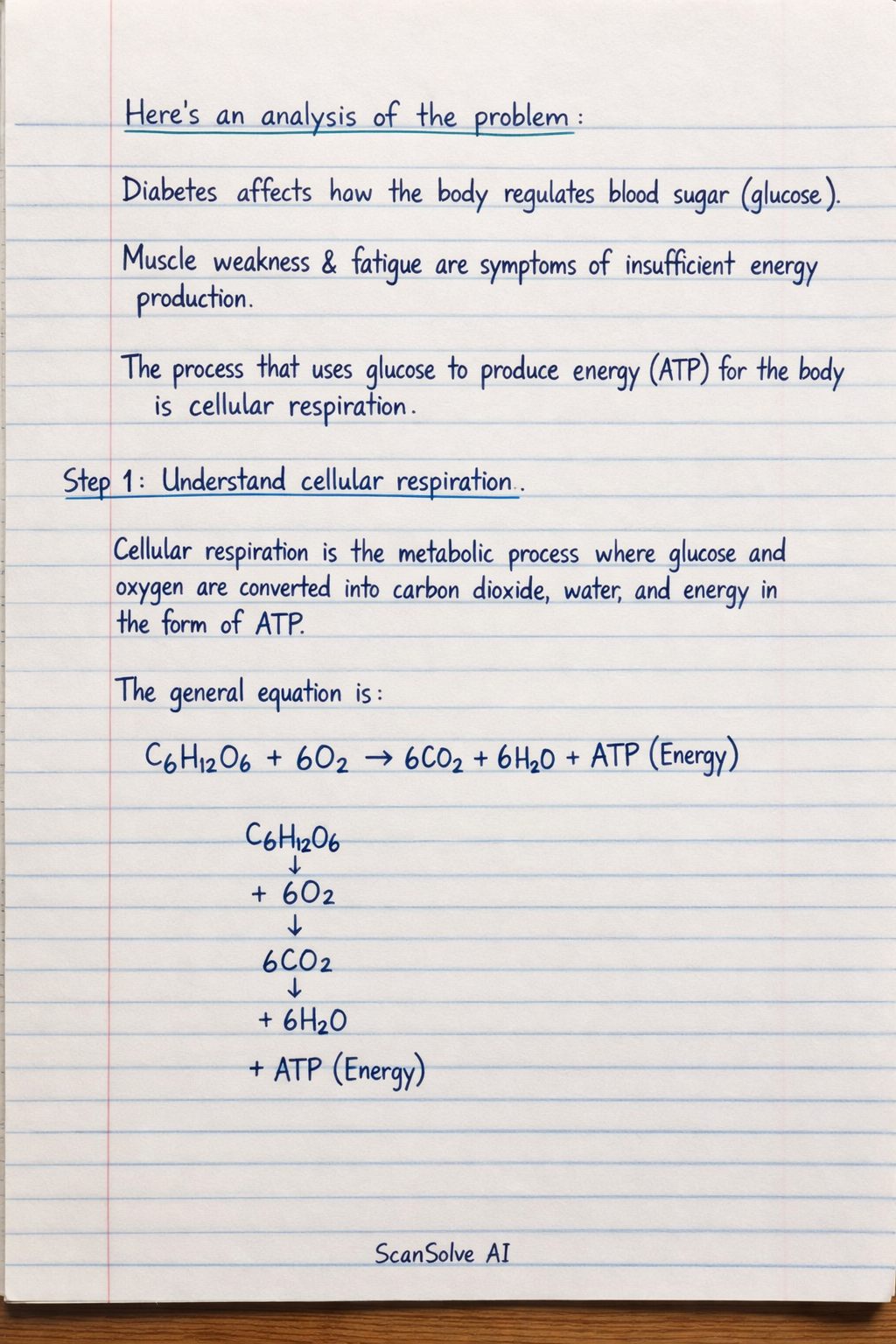
To identify the model that summarizes the process disrupted by diabetes, leading to muscle weakness and fatigue. Diabetes affects how the body regulates blood sugar (glucose). Muscle weakness and fati
ScanSolve AI Answer
Answer
Step-by-step solution
3 stepsThe question asks to identify the model that summarizes the process disrupted by diabetes, leading to muscle weakness and fatigue. Diabetes affects how the body regulates blood sugar (glucose). Muscle weakness and fatigue are symptoms of insufficient energy production. The process that uses glucose to produce energy (ATP) for the body is cellular respiration.
Understand cellular respiration.
Cellular respiration is the metabolic process where glucose and oxygen are converted into carbon dioxide, water, and energy in the form of ATP. The general equation is:
Evaluate each model.
- Model (1): Shows Glucose () + Oxygen () reacting to produce Carbon dioxide () + Water () + ATP. This matches the equation for cellular respiration.
- Model (2): Shows Carbon dioxide () + ATP reacting to produce Glucose () + Oxygen () + Water (). This is not cellular respiration; it represents a process that consumes ATP to make glucose.
- Model (3): Shows Glucose () + Oxygen () + ATP reacting to produce Carbon dioxide () + Water (). In cellular respiration, ATP is a product, not a reactant.
- Model (4): Shows Water () + Oxygen () reacting to produce Glucose () + Carbon dioxide () + ATP. This is incorrect as glucose is a reactant in cellular respiration, not a product from water and oxygen.
Conclude the correct model.
Model (1) accurately represents cellular respiration, the process by which the body generates energy (ATP) from glucose. A disruption in this process due to diabetes would lead to insufficient energy, causing muscle weakness and fatigue.
The final answer is .
Try one yourself
A new problem that tests the same skill.
Still stuck on this one?
Ask a follow-up, and the answer starts from this question.
More Computer Science Questions
Handwritten Step-by-Step Solution
Get this as a handwritten image on WhatsApp — like a tutor wrote it for you.
Try on WhatsApp