
We read your photo as:
Translate the logical statement y implies x into a natural language sentence, given x: The school bus arrived late, and y: The students walked down to school.
ScanSolve AI Answer
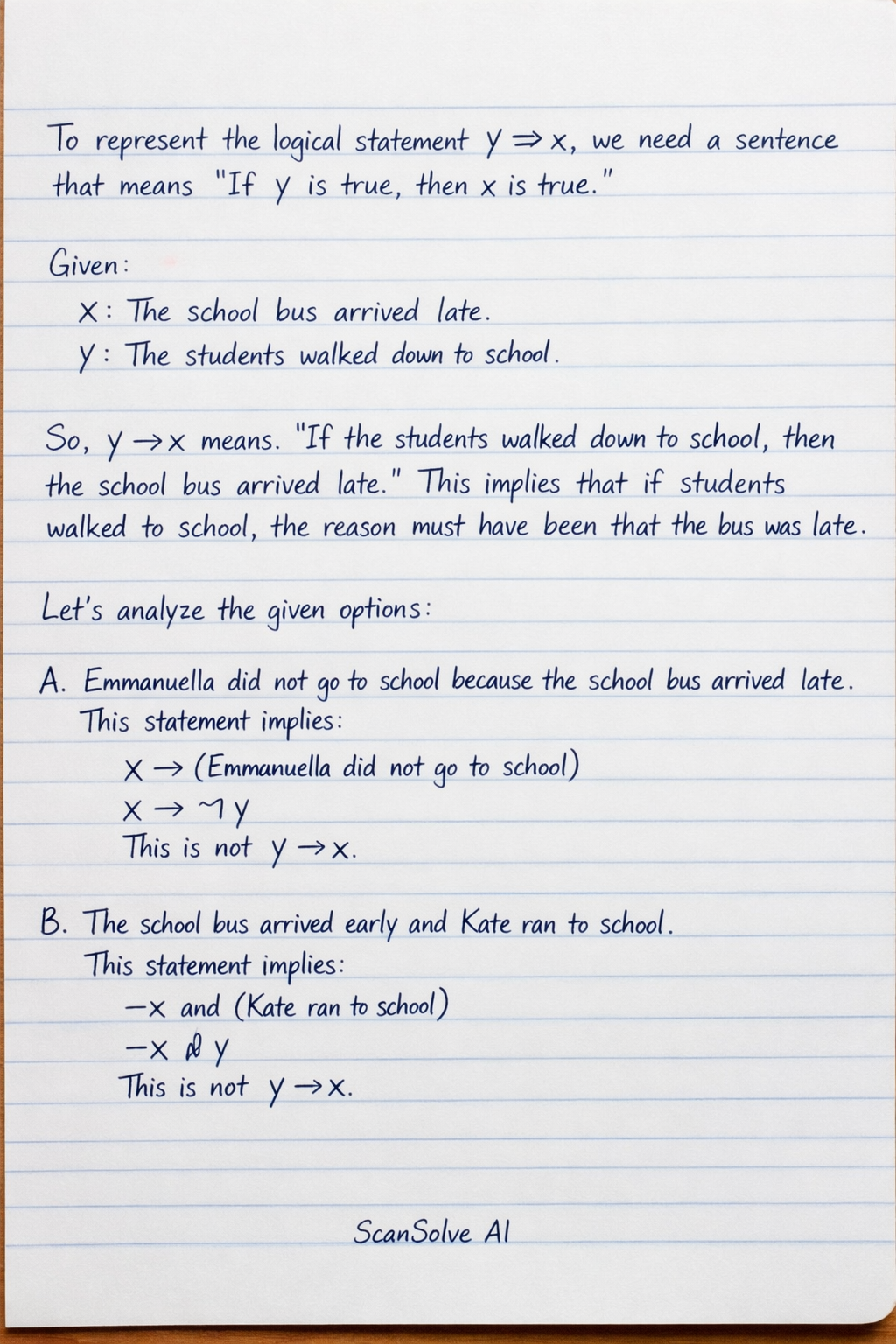
To represent the logical statement , we need a sentence that means "If is true, then is true."
Given:
: The school bus arrived late
: The students walked down to school
So, means "If the students walked down to school, then the school bus arrived late." This implies that if students walked to school, the reason must have been that the bus was late.
Let's analyze the given options:
-
A. Emmanuella did not go to school because the school bus arrived late. This statement implies that the school bus arriving late () caused Emmanuella not to go to school. This can be represented as . This is not .
-
B. The school bus arrived early and Kate ran to school. This statement describes two events: the bus did not arrive late () and Kate ran to school. This is . This is not .
-
C. Mary walked to school because the school bus arrived late. In natural language, "A because B" often implies that B is the reason for A. If we interpret this as "If A happened, then B must have been the reason," then: A = "Mary walked to school" (an instance of ) B = "the school bus arrived late" (an instance of ) So, "If Mary walked to school (), then the school bus arrived late ()." This directly matches the form .
-
D. Either the school bus arrived late or Maryan walked to school. This statement means "The school bus arrived late () OR Maryan walked to school ()." This is represented as . The logical statement is equivalent to . The statement is not equivalent to .
Therefore, option C is the best representation of .
The final answer is
Still stuck on this one?
Ask a follow-up, and the answer starts from this question.
More Computer Science Questions
Handwritten Step-by-Step Solution
Get this as a handwritten image on WhatsApp — like a tutor wrote it for you.
Try on WhatsApp