We read your photo as:

Translate the logical statements ~("~p or ~q") and ~("~p and q") into English, and differentiate ln(3x3/sin x).

Mathematics

ScanSolve AI Answer

This answer stops before the end.

It was cut off when it was first written. Ask ScanSolve this question again for the full working.

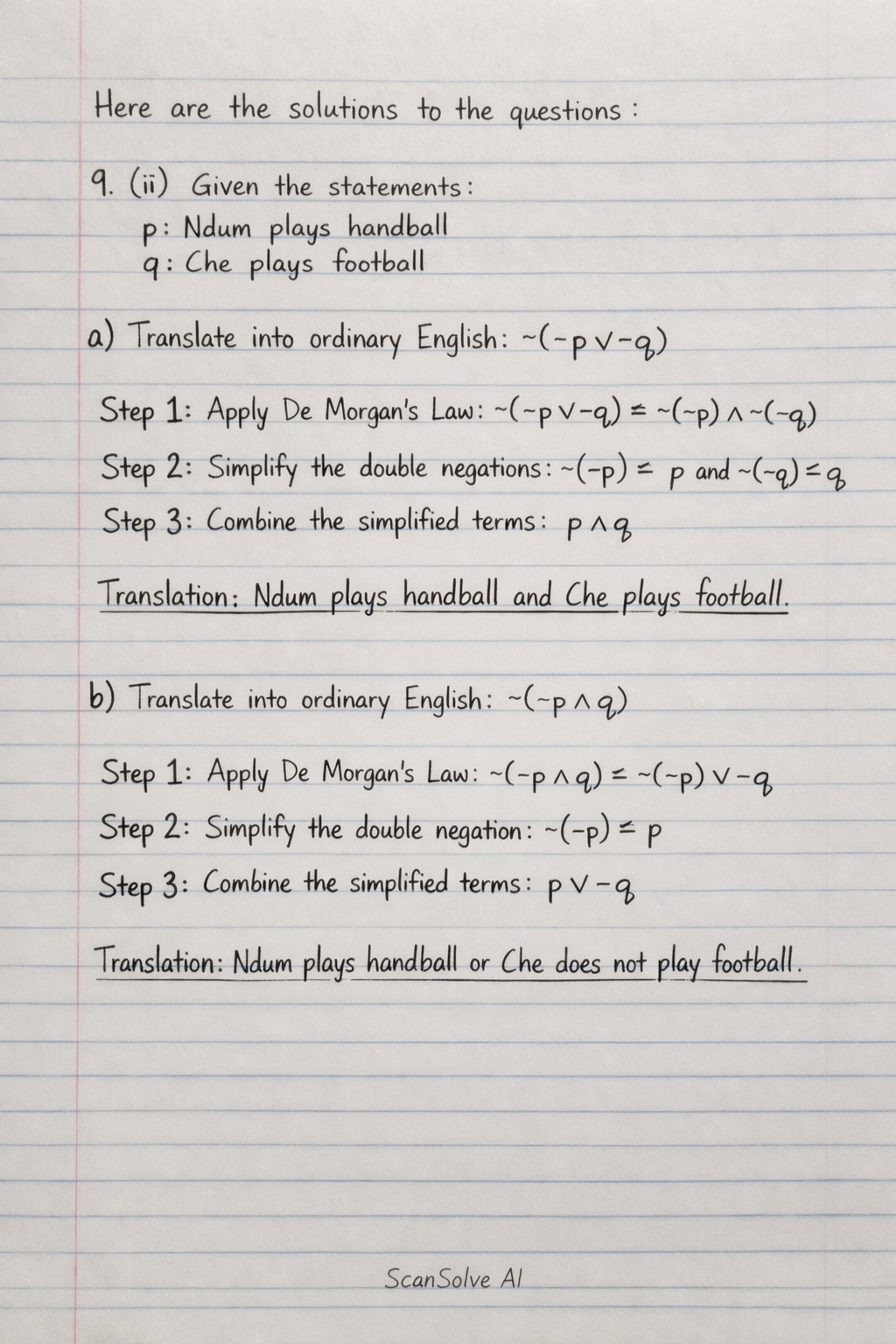
Here are the solutions to the questions:

9. (ii) Given the statements:
p: Ndum plays handball
q: Che plays football

a) Translate into ordinary English: ∼(∼p∨∼q)\sim(\sim p \lor \sim q)

Step 1: Apply De Morgan's Law: ∼(∼p∨∼q)≡∼(∼p)∧∼(∼q)\sim(\sim p \lor \sim q) \equiv \sim(\sim p) \land \sim(\sim q).

Step 2: Simplify the double negations: ∼(∼p)≡p\sim(\sim p) \equiv p and ∼(∼q)≡q\sim(\sim q) \equiv q.

Step 3: Combine the simplified terms: p∧qp \land q.
Translation: Ndum plays handball and Che plays football.

b) Translate into ordinary English: ∼(∼p∧q)\sim(\sim p \land q)

Step 1: Apply De Morgan's Law: ∼(∼p∧q)≡∼(∼p)∨∼q\sim(\sim p \land q) \equiv \sim(\sim p) \lor \sim q.

Step 2: Simplify the double negation: ∼(∼p)≡p\sim(\sim p) \equiv p.

Step 3: Combine the simplified terms: p∨∼qp \lor \sim q.
Translation: Ndum plays handball or Che does not play football.


1. (i) a) Differentiate ln⁡(3x3sin⁡x)\ln\left(\frac{3x^3}{\sin x}\right) with respect to xx.

Step 1: Use logarithm properties to simplify the expression.

y=ln⁡(3x3sin⁡x)=ln⁡(3x3)−ln⁡(sin⁡x)y = \ln\left(\frac{3x^3}{\sin x}\right) = \ln(3x^3) - \ln(\sin x) y=ln⁡3+ln⁡(x3)−ln⁡(sin⁡x)y = \ln 3 + \ln(x^3) - \ln(\sin x) y=ln⁡3+3ln⁡x−ln⁡(sin⁡x)y = \ln 3 + 3\ln x - \ln(\sin x)

Step 2: Differentiate each term with respect to xx.
Recall that ddx(ln⁡k)=0\frac{d}{dx}(\ln k) = 0 for a constant kk, and ddx(ln⁡u)=1ududx\frac{d}{dx}(\ln u) = \frac{1}{u} \frac{du}{dx}.

dydx=ddx(ln⁡3)+ddx(3ln⁡x)−ddx(ln⁡(sin⁡x))\frac{dy}{dx} = \frac{d}{dx}(\ln 3) + \frac{d}{dx}(3\ln x) - \frac{d}{dx}(\ln(\sin x)) dydx=0+3(1x)−(1sin⁡x⋅cos⁡x)\frac{dy}{dx} = 0 + 3\left(\frac{1}{x}\right) - \left(\frac{1}{\sin x} \cdot \cos x\right) dydx=3x−cos⁡xsin⁡x\frac{dy}{dx} = \frac{3}{x} - \frac{\cos x}{\sin x} dydx=3x−cot⁡x\frac{dy}{dx} = \frac{3}{x} - \cot x

The derivative is 3x−cot⁡x\boxed{\frac{3}{x} - \cot x}.

1. (i) b) A curve is defined parametrically by x=t3x = t^3, y=t(1−14t3)y = t\left(1 - \frac{1}{4}t^3\right). Find the equation of the tangent to the curve at the point where t=−1t = -1.

Step 1: Find the coordinates (x0,y0)(x_0, y_0) of the point of tangency when t=−1t = -1.

x0=(−1)3=−1x_0 = (-1)^3 = -1 y0=(−1)(1−14(−1)3)=(−1)(1−14(−1))=(−1)(1+14)=(−1)(54)=−54y_0 = (-1)\left(1 - \frac{1}{4}(-1)^3\right) = (-1)\left(1 - \frac{1}{4}(-1)\right) = (-1)\left(1 + \frac{1}{4}\right) = (-1)\left(\frac{5}{4}\right) = -\frac{5}{4}

The point is (−1,−54)\left(-1, -\frac{5}{4}\right).

Step 2: Find dxdt\frac{dx}{dt} and dydt\frac{dy}{dt}.

x=t3  ⟹  dxdt=3t2x = t^3 \implies \frac{dx}{dt} = 3t^2 y=t−14t4  ⟹  dydt=1−14(4t3)=1−t3y = t - \frac{1}{4}t^4 \implies \frac{dy}{dt} = 1 - \frac{1}{4}(4t^3) = 1 - t^3

Step 3: Find the gradient dydx\frac{dy}{dx} using the chain rule dydx=dy/dtdx/dt\frac{dy}{dx} = \frac{dy/dt}{dx/dt}.

dydx=1−t33t2\frac{dy}{dx} = \frac{1 - t^3}{3t^2}

Step 4: Evaluate the gradient at t=−1t = -1.

m=dydx∣t=−1=1−(−1)33(−1)2=1−(−1)3(1)=1+13=23m = \left.\frac{dy}{dx}\right|_{t=-1} = \frac{1 - (-1)^3}{3(-1)^2} = \frac{1 - (-1)}{3(1)} = \frac{1+1}{3} = \frac{2}{3}

Step 5: Use the point-slope form of a line y−y0=m(x−x0)y - y_0 = m(x - x_0).

y−(−54)=23(x−(−1))y - \left(-\frac{5}{4}\right) = \frac{2}{3}(x - (-1)) y+54=23(x+1)y + \frac{5}{4} = \frac{2}{3}(x + 1)

Step 6: Clear denominators and rearrange into general form. Multiply by 12 (the LCM of 4 and 3).

12(y+54)=12(23(x+1))12\left(y + \frac{5}{4}\right) = 12\left(\frac{2}{3}(x + 1)\right) 12y+15=8(x+1)12y + 15 = 8(x + 1)
Was this helpful?

Still stuck on this one?

Ask a follow-up, and the answer starts from this question.

Got a different question?Ask your own question
Handwritten step-by-step solution preview

Handwritten Step-by-Step Solution

Get this as a handwritten image on WhatsApp — like a tutor wrote it for you.

Try on WhatsApp