

This computer science problem involves algorithmic thinking and programming concepts. The solution below explains the approach, logic, and implementation step by step.
ScanSolve AI Answer
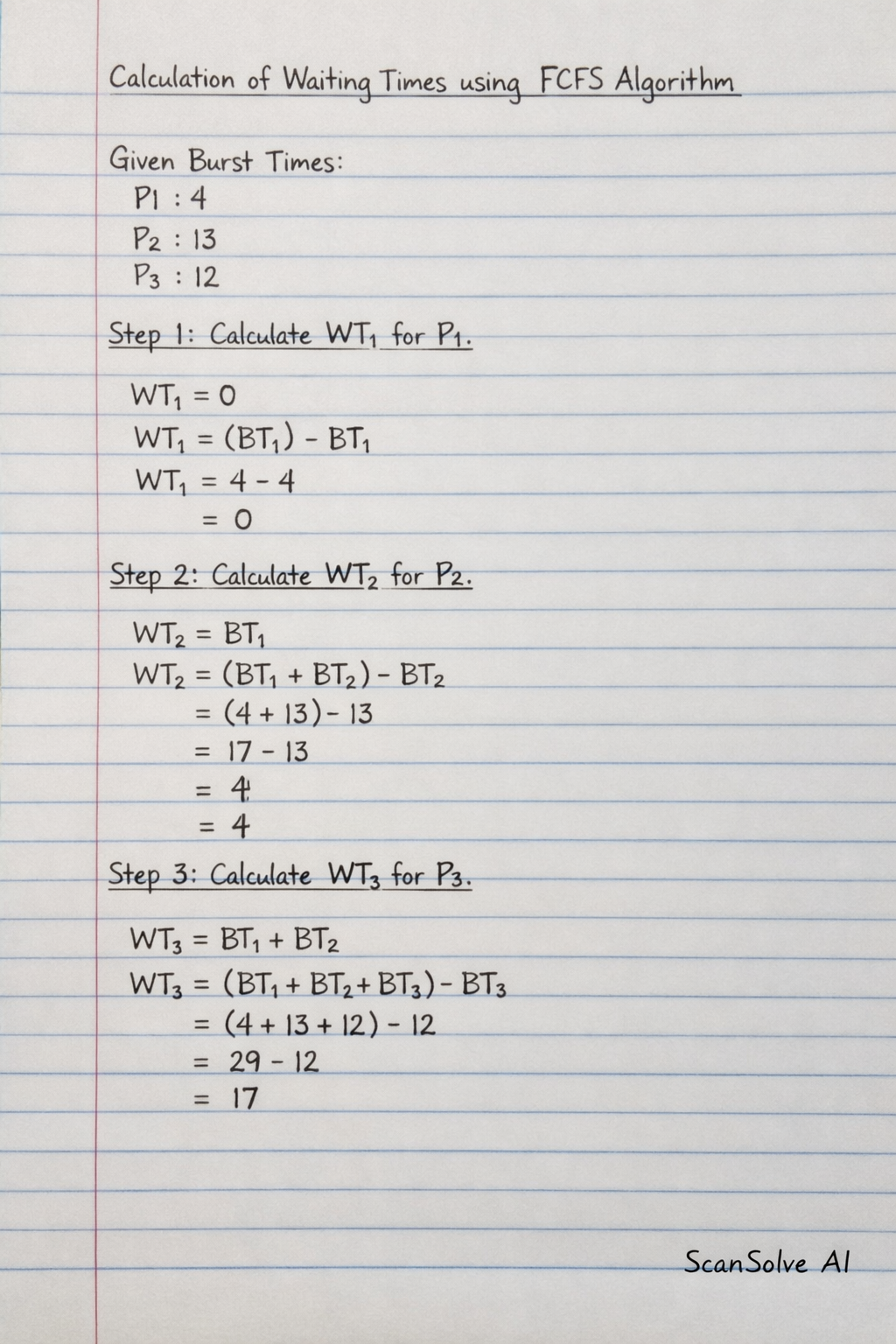
Here's the calculation for the waiting times and average waiting time using the First Come First Served (FCFS) scheduling algorithm, based on the provided burst times. Given Burst Times: P1: 4 P2: 13 P3: 12 The waiting time for a process i is calculated as the sum of the burst times of all processes that completed before it. The formula from your notes, WT_i = (_j=1^i BT_j) - BT_i, correctly represents this. Step 1: Calculate the waiting time for P1. P1 is the first process, so it starts immediately. WT_1 = 0 Using the formula: WT_1 = (BT_1) - BT_1 = 4 - 4 = 0 Step 2: Calculate the waiting time for P2. P2 waits for P1 to complete. WT_2 = BT_1 Using the formula: WT_2 = (BT_1 + BT_2) - BT_2 WT_2 = (4 + 13) - 13 WT_2 = 17 - 13 WT_2 = 4 Your calculation for P2 incorrectly subtracted 4 instead of 13. Step 3: Calculate the waiting time for P3. P3 waits for P1 and P2 to complete. WT_3 = BT_1 + BT_2 Using the formula: WT_3 = (BT_1 + BT_2 + BT_3) - BT_3 WT_3 = (4 + 13 + 12) - 12 WT_3 = 29 - 12 WT_3 = 17 Step 4: Calculate the average waiting time. The average waiting time is the sum of all waiting times divided by the number of processes. Average Waiting Time = (WT_1 + WT_2 + WT_3)/(3) Average Waiting Time = (0 + 4 + 17)/(3) Average Waiting Time = (21)/(3) Average Waiting Time = 7 3 done, 2 left today. You're making progress.