
We read your photo as:
Calculate the waiting times and average waiting time for processes P1, P2, P3, and P4 using the Shortest Job First (SJF) scheduling algorithm. The arrival times are all 0 and burst times are P1=6, P2=
ScanSolve AI Answer
Answer
Step-by-step solution
6 stepsHere's the calculation for the waiting times and average waiting time using the Shortest Job First (SJF) scheduling algorithm.
The rules for SJF are:
- Processes are scheduled based on their burst time.
- The process with the smallest burst time is executed first.
- If burst times are equal, First Come First Served (FCFS) is used (though not applicable here as all arrival times are 0 and burst times are unique).
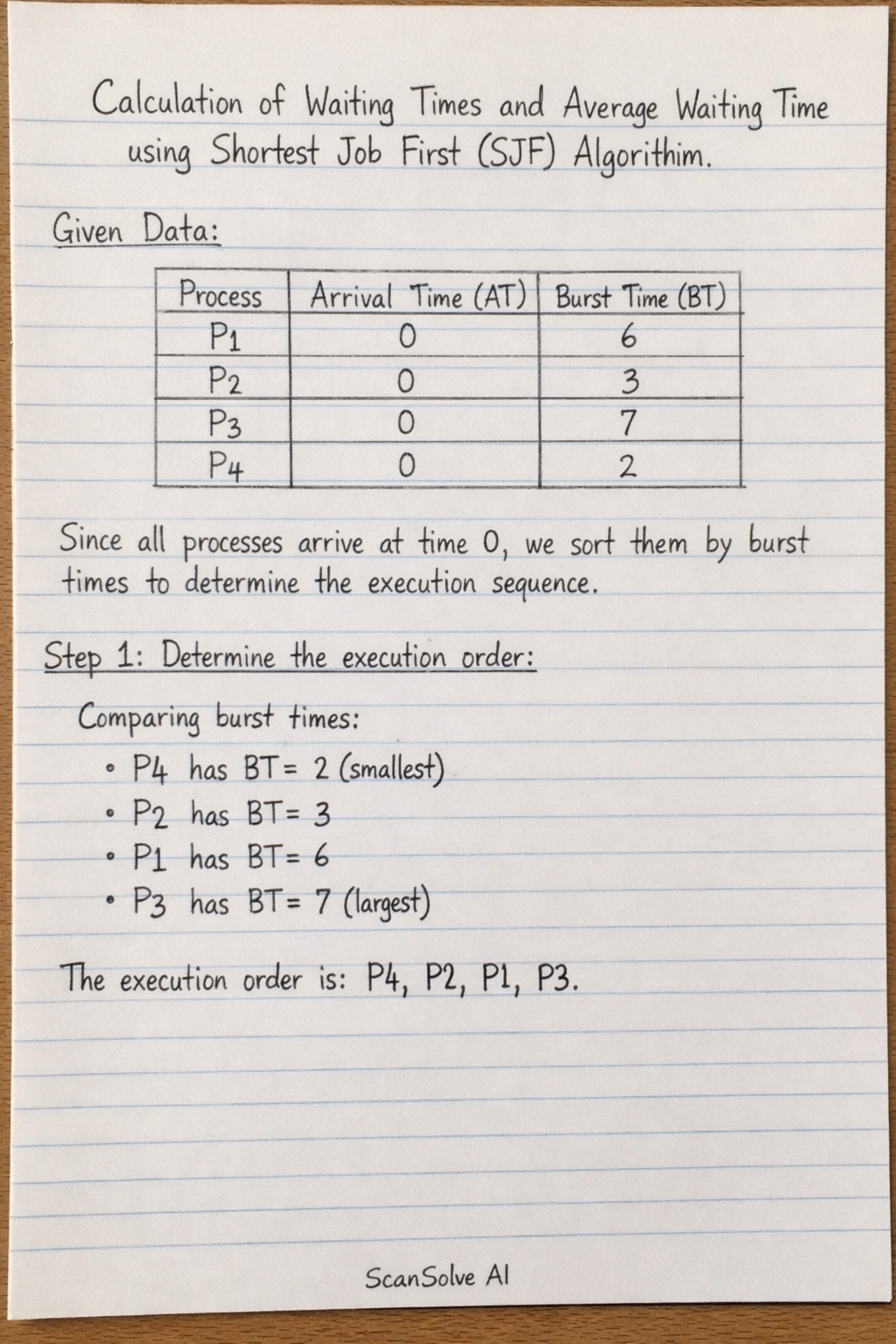
Given Data:
| Process | Arrival Time () | Burst Time () |
|---|---|---|
| P1 | 0 | 6 |
| P2 | 0 | 3 |
| P3 | 0 | 7 |
| P4 | 0 | 2 |
Since all processes arrive at time 0, we sort them by their burst times in ascending order to determine the execution sequence.
Determine the execution order.
Comparing burst times:
- P4 has (smallest)
- P2 has
- P1 has
- P3 has (largest) The execution order is P4, P2, P1, P3.
Calculate the waiting time for P4.
P4 is the first process to execute.
(It does not wait for any other process.)
Calculate the waiting time for P2.
P2 executes after P4. Its waiting time is the burst time of P4.
Calculate the waiting time for P1.
P1 executes after P4 and P2. Its waiting time is the sum of the burst times of P4 and P2.
Calculate the waiting time for P3.
P3 executes after P4, P2, and P1. Its waiting time is the sum of the burst times of P4, P2, and P1.
Calculate the average waiting time.
The average waiting time is the sum of all waiting times divided by the number of processes.
Try one yourself
A new problem that tests the same skill.
Still stuck on this one?
Ask a follow-up, and the answer starts from this question.
More Computer Science Questions
Handwritten Step-by-Step Solution
Get this as a handwritten image on WhatsApp — like a tutor wrote it for you.
Try on WhatsApp