
We read your photo as:
1.7 All money received and deposited by the business that increases the capital of the owner is called:
ScanSolve AI Answer
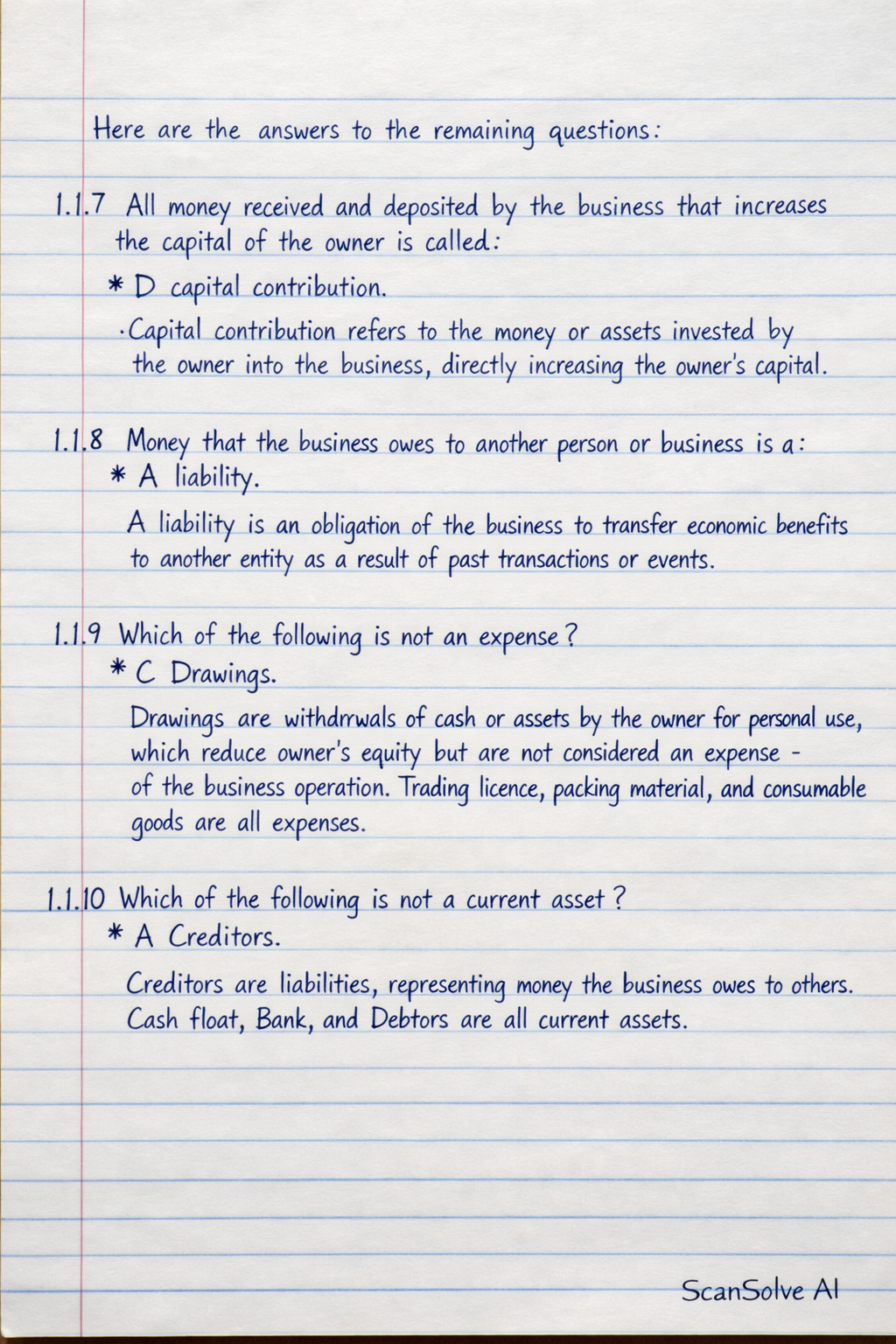
Here are the answers to the remaining questions:
1.1.7 All money received and deposited by the business that increases the capital of the owner is called:
- D capital contribution.
- Capital contribution refers to the money or assets invested by the owner into the business, directly increasing the owner's capital.
1.1.8 Money that the business owes to another person or business is a:
- A liability.
- A liability is an obligation of the business to transfer economic benefits to another entity as a result of past transactions or events.
1.1.9 Which of the following is not an expense?
- C Drawings
- Drawings are withdrawals of cash or assets by the owner for personal use, which reduce owner's equity but are not considered an expense of the business operation. Trading licence, packing material, and consumable goods are all expenses.
1.1.10 Which of the following is not a current asset?
- A Creditors
- Creditors are liabilities, representing money the business owes to others. Cash float, Bank, and Debtors are all current assets.
1.2 Indicate whether the following statements are true or false:
1.2.1 Loss is the amount with which expenses exceed the receipts for services rendered.
- True. A loss occurs when total expenses are greater than total revenue (receipts).
1.2.2 A business's possessions are called its assets.
- True. Assets are resources owned or controlled by the business.
1.2.3 Liabilities are payments that decrease owner's equity.
- False. Liabilities are obligations (amounts owed) by the business. Payments made to settle liabilities decrease both the liability and an asset (like cash), but liabilities themselves are not "payments that decrease owner's equity."
1.2.4 Cash float is the money the owner took for personal use.
- False. Cash float is a small amount of cash kept on hand for minor expenses. Money taken by the owner for personal use is called drawings.
1.2.5 A sole trader is a form of business owned by two persons.
- False. A sole trader (or sole proprietorship) is a business owned and operated by one individual.
1.2.6 Trading stock are items bought with the purpose of selling them for a profit.
- True. Trading stock (inventory) consists of goods held for resale in the ordinary course of business.
1.2.7 Trade is one word for the rendering of a service.
- False. "Trade" typically refers to the buying and selling of goods. "Rendering a service" refers to providing a service.
1.2.8 Receipts that increase owner's equity are called income.
- True. Income (revenue) increases owner's equity. Capital contributions also increase owner's equity.
1.2.9 A budget is the plan that entrepreneurs draw up with the purpose of starting a business.
- True. A budget is a financial plan, often created by entrepreneurs as part of their business planning.
1.2.10 Savings is money set aside for a short-term goal.
- False. Savings can be set aside for both short-term and long-term goals.
Still stuck on this one?
Ask a follow-up, and the answer starts from this question.
More Economics Questions
Handwritten Step-by-Step Solution
Get this as a handwritten image on WhatsApp — like a tutor wrote it for you.
Try on WhatsApp