
We read your photo as:
1 Eskom is an example of a natural monopoly.
ScanSolve AI Answer
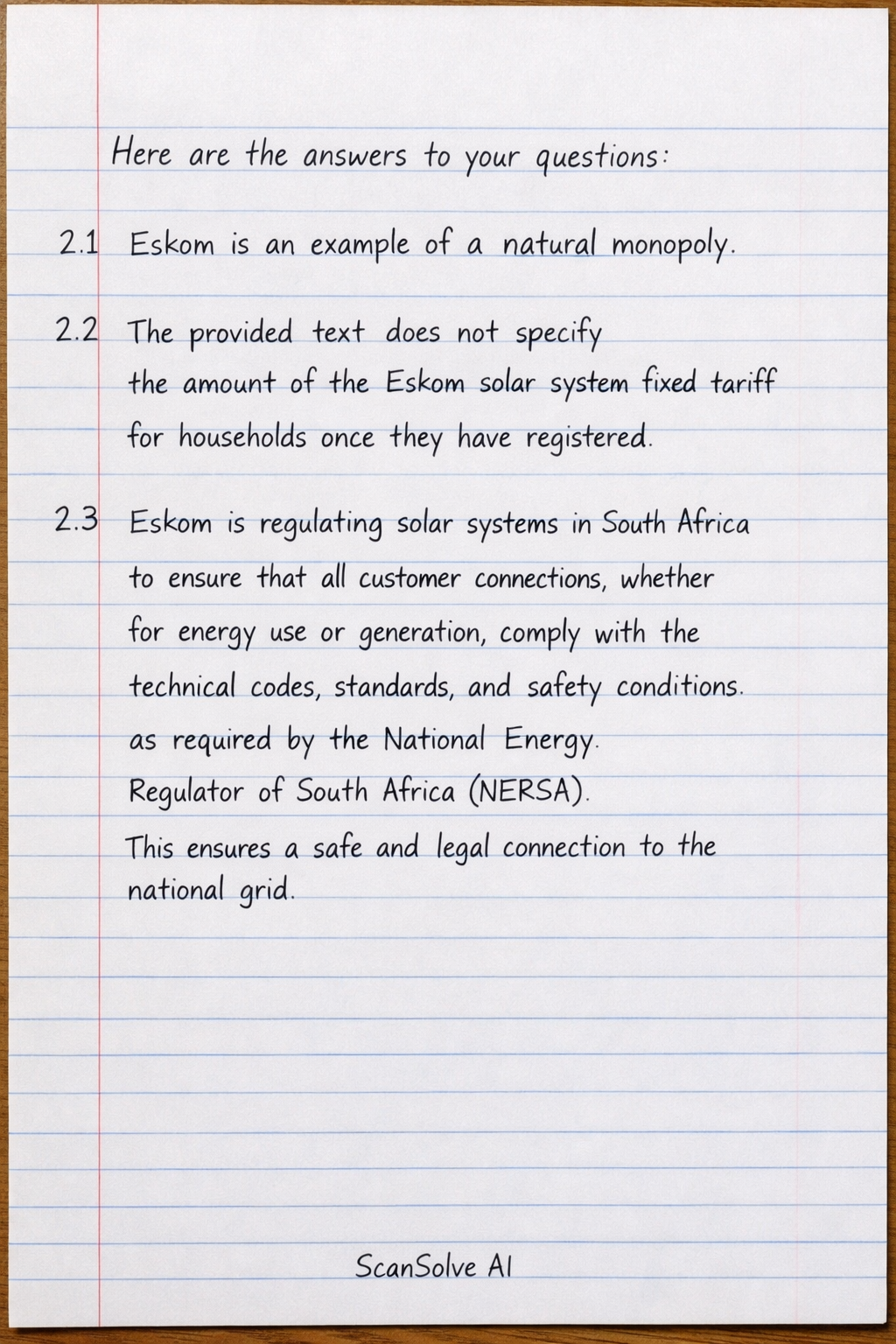
Here are the answers to your questions:
2.1 Eskom is an example of a natural monopoly.
2.2 The provided text does not specify the amount of the Eskom solar system fixed tariff for households once they have registered.
2.3 Eskom is regulating solar systems in South Africa to ensure that all customer connections, whether for energy use or generation, comply with the technical codes, standards, and safety conditions as required by the National Energy Regulator of South Africa (NERSA). This ensures a safe and legal connection to the national grid.
2.4 Eskom's regulation of solar systems can influence the macroeconomic objective of economic growth in several ways. If the regulations are streamlined, clear, and promote affordability, as stated in the text, they can facilitate the adoption of solar energy. This can lead to reduced energy costs for households and businesses, freeing up capital for investment and consumption, thereby stimulating economic activity and growth. It can also foster the growth of the renewable energy sector, creating jobs and attracting investment. Conversely, if the regulations are overly complex, costly, or bureaucratic, they could deter investment in solar systems, slow down the transition to renewable energy, and potentially hinder economic growth by increasing compliance costs and limiting energy independence.
2.5 Most natural monopolies in South Africa are owned or controlled by the government for several key reasons:
- To prevent exploitation of consumers by a private monopolist who might charge excessively high prices and restrict output, ensuring essential services remain affordable and accessible.
- To ensure universal access to critical services like electricity, water, and transport, even in less profitable areas, which a private firm might neglect.
- To avoid the inefficient duplication of expensive infrastructure, as it is more efficient for a single entity to manage the extensive networks required for these services.
- To align the provision of these strategically important services with national development goals and social welfare objectives rather than purely profit motives.
2.6 Eskom's regulation of solar systems can have negative impacts on market efficiency and consumer choice.
- On market efficiency: If Eskom's regulations are overly stringent, bureaucratic, or costly, they can act as barriers to entry for new solar providers and increase the transaction costs for existing ones. This can stifle competition and innovation in the solar market, leading to a less efficient allocation of resources. Furthermore, as Eskom is also a competitor in electricity supply, its role as a regulator could create a conflict of interest, potentially leading to regulations that inadvertently or intentionally favour its traditional business model over distributed solar generation, thus hindering the overall efficiency of the energy market.
- On consumer choice: Complex or expensive regulations can discourage households and businesses from investing in solar power, thereby limiting their ability to choose alternative energy sources, reduce their electricity bills, or become more energy independent. This reduces the range of energy options available to consumers. If the regulatory burden is high, it could also lead to fewer solar installation companies operating in the market, further restricting consumer choice in terms of service providers and system types.
Still stuck on this one?
Ask a follow-up, and the answer starts from this question.
More Economics Questions
Handwritten Step-by-Step Solution
Get this as a handwritten image on WhatsApp — like a tutor wrote it for you.
Try on WhatsApp