

This economics question tests your understanding of economic models and analysis. The step-by-step answer below applies the relevant framework and explains the reasoning.
ScanSolve AI Answer
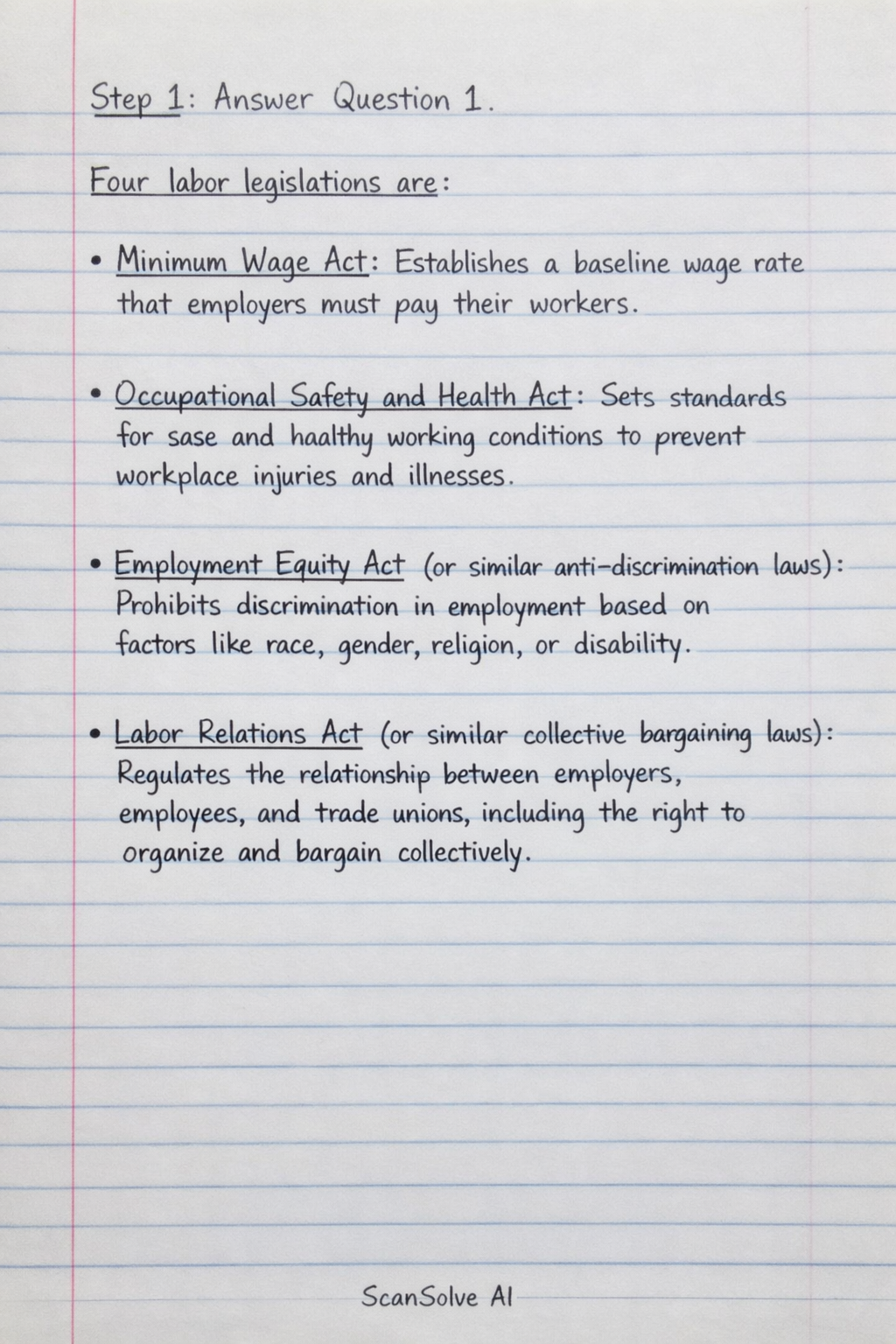
Step 1: Answer Question 1. Four labor legislations are: • Minimum Wage Act: Establishes a baseline wage rate that employers must pay their workers. • Occupational Safety and Health Act: Sets standards for safe and healthy working conditions to prevent workplace injuries and illnesses. • Employment Equity Act (or similar anti-discrimination laws): Prohibits discrimination in employment based on factors like race, gender, religion, or disability. • Labor Relations Act (or similar collective bargaining laws): Regulates the relationship between employers, employees, and trade unions, including the right to organize and bargain collectively. Step 2: Answer Question 2. Four examples of trade unions are: • National Education Association (NEA): Represents educators and other public school employees. • United Auto Workers (UAW): Represents workers in the automotive industry. • American Federation of Labor and Congress of Industrial Organizations (AFL-CIO): A federation of many different unions in the United States. • National Union of Mineworkers (NUM): Represents workers in the mining industry. Step 3: Answer Question 3. Definitions: • Unemployment: The state of being jobless while actively seeking employment and being available to work. • Skilled: Possessing specialized knowledge, training, or abilities required to perform a particular job or task effectively. • Emigration: The act of leaving one's own country to settle permanently in another. • Quasi money: Financial assets that are highly liquid and can be easily converted into cash but are not directly used as a medium of exchange (e.g., savings accounts, time deposits, money market funds). Step 4: Answer Question 4. Four methods used to measure unemployment are: • Labor Force Survey (LFS): A household survey that collects data on employment, unemployment, and other labor market characteristics. • Unemployment Rate: The percentage of the labor force that is unemployed. • Claimant Count: Measures the number of people claiming unemployment-related benefits. • Underemployment Rate: Measures individuals who are employed but wish to work more hours or are working in jobs that do not fully utilize their skills. Step 5: Answer Question 5. Four types of unemployment are: • Frictional unemployment: Temporary unemployment experienced by individuals who are between jobs or are new entrants to the labor force. • Structural unemployment: Unemployment caused by a mismatch between the skills workers have and the skills employers need, often due to technological changes or shifts in industry structure. • Cyclical unemployment: Unemployment that arises from fluctuations in the business cycle, increasing during economic recessions and decreasing during expansions. • Seasonal unemployment: Unemployment that occurs due to seasonal variations in demand for labor in certain industries, such as agriculture or tourism.