ScanSolve logoScanSolve
Toggle sidebar
  • Homework
  • Tutor
  • Humanizer
  • AI Detector
  • Questions
  • Blog
  • History
  • Mobile App

  • Homework
  • Tutor
  • Humanizer
  • AI Detector

  • Questions
  • Math homework helpMath
    Physics homework helpPhysics
    Chemistry homework helpChemistry
    Biology homework helpBiology
    Computer Science homework helpComputer Science
    History homework helpHistory
    More homework helpMore
  • Blog
  • History

  • Mobile App
ScanSolvePLUS
  • Unlimited answers
  • ScanSolve AI Pro
Start Free Trial →
Try on WhatsApp
Home > Economics Homework Help > Solution

1) State the law of diminishing returns and justify why it holds 2) l list three assumption of this law 3) identify three characteristic of public goods 4) suggest four reasons why the government of Cameroon subsidized the production of merits goods 5) outline four factors that may détermine de size of a firm

Asked on March 27, 2026|Economics

This economics question tests your understanding of economic models and analysis. The step-by-step answer below applies the relevant framework and explains the reasoning.

ScanSolve AI AnswerAnswered on March 27, 2026
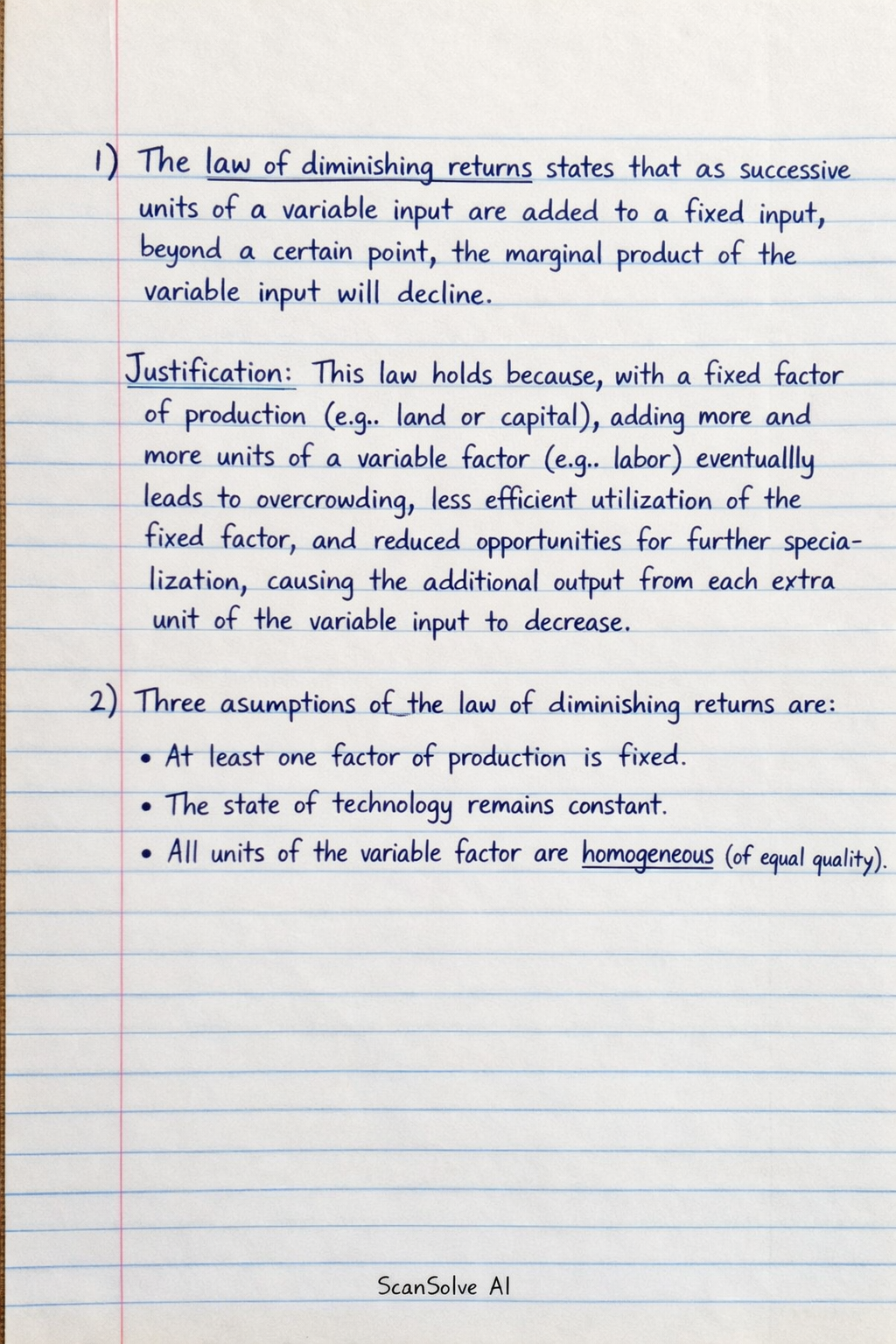
1) The law of diminishing returns states that as successive units of a variable input are added to a fixed input, beyond a certain point, the marginal product of the variable input will decline. Justification: This law holds because, with a fixed factor of production (e.g., land or capital), adding more and more units of a variable factor (e.g., labor) eventually leads to overcrowding, less efficient utilization of the fixed factor, and reduced opportunities for further specialization, causing the additional output from each extra unit of the variable input to decrease. 2) Three assumptions of the law of diminishing returns are: • At least one factor of production is fixed. • The state of technology remains constant. • All units of the variable factor are homogeneous (of equal quality). 3) Three characteristics of public goods are: • Non-rivalry: One person's consumption of the good does not reduce its availability for others. • Non-excludability: It is impossible or very costly to prevent individuals from consuming the good, even if they do not pay for it. • Non-rejectability: Individuals cannot opt out of consuming the good once it is provided. 4) Four reasons why the government of Cameroon might subsidize the production of merit goods are: • To correct positive externalities: Merit goods generate benefits for third parties (e.g., education benefits society), which the market under-provides. Subsidies encourage greater production and consumption. • To ensure equity and access: Subsidies make essential goods and services (like healthcare or education) more affordable and accessible to lower-income groups, promoting social welfare. • To address information failure: Consumers may underestimate the long-term benefits of merit goods. Subsidies encourage consumption to overcome this lack of information. • To promote economic development: Investing in human capital through subsidized education and healthcare can lead to a more productive workforce and long-term economic growth. 5) Four factors that may determine the size of a firm are: • Capital availability: Firms with greater access to financial capital can invest in more resources, technology, and expansion, leading to a larger scale of operation. • Market size: The potential demand for a firm's products or services in the market influences how large it can grow. A larger market allows for greater output and economies of scale. • Technology: The type of technology used can dictate optimal firm size. Some technologies require large-scale production to be efficient, while others are suited for smaller operations. • Managerial ability: The effectiveness and capacity of management to organize, coordinate, and control a larger workforce and more complex operations can limit or enable a firm's growth.

Related Economics Questions

  • Principle of micro economics
  • Eco 101 course outline: ECONOMICS Meaning of economics Principles of micro economics Economic statement Macro economics...
  • 1. a) With the aid of production possibility curves, distinguish between increasing and decreasing opportunity costs.
  • Report on Periodic Trends and Production Process Recommendations
  • 1) Enumerate four different actions trade union's can take to enforce their demands 2) state four Economics factors whic...
  • 1. Outline four strategies that may be adopted by an industry to overcome competition in a market:
See all Economics questions

This step-by-step solution was generated by ScanSolve AI. Need help with more economics problems? Browse Economics solutions or ask your own question.

Home›Economics Homework Help›1) State the law of diminishing returns and justify why it h…
Q

1) State the law of diminishing returns and justify why it holds 2) l list three assumption of this law 3) identify three characteristic of public goods 4) suggest four reasons why the government of Cameroon subsidized the production of merits goods 5) outline four factors that may détermine de size of a firm

March 27, 2026|Economics
ScanSolve AI

ScanSolve AI Answer

Answered on March 27, 2026
  1. The law of diminishing returns states that as successive units of a variable input are added to a fixed input, beyond a certain point, the marginal product of the variable input will decline. Justification: This law holds because, with a fixed factor of production (e.g., land or capital), adding more and more units of a variable factor (e.g., labor) eventually leads to overcrowding, less efficient utilization of the fixed factor, and reduced opportunities for further specialization, causing the additional output from each extra unit of the variable input to decrease.

  2. Three assumptions of the law of diminishing returns are: • At least one factor of production is fixed. • The state of technology remains constant. • All units of the variable factor are homogeneous (of equal quality).

  3. Three characteristics of public goods are: • Non-rivalry: One person's consumption of the good does not reduce its availability for others. • Non-excludability: It is impossible or very costly to prevent individuals from consuming the good, even if they do not pay for it. • Non-rejectability: Individuals cannot opt out of consuming the good once it is provided.

  4. Four reasons why the government of Cameroon might subsidize the production of merit goods are: • To correct positive externalities: Merit goods generate benefits for third parties (e.g., education benefits society), which the market under-provides. Subsidies encourage greater production and consumption. • To ensure equity and access: Subsidies make essential goods and services (like healthcare or education) more affordable and accessible to lower-income groups, promoting social welfare. • To address information failure: Consumers may underestimate the long-term benefits of merit goods. Subsidies encourage consumption to overcome this lack of information. • To promote economic development: Investing in human capital through subsidized education and healthcare can lead to a more productive workforce and long-term economic growth.

  5. Four factors that may determine the size of a firm are: • Capital availability: Firms with greater access to financial capital can invest in more resources, technology, and expansion, leading to a larger scale of operation. • Market size: The potential demand for a firm's products or services in the market influences how large it can grow. A larger market allows for greater output and economies of scale. • Technology: The type of technology used can dictate optimal firm size. Some technologies require large-scale production to be efficient, while others are suited for smaller operations. • Managerial ability: The effectiveness and capacity of management to organize, coordinate, and control a larger workforce and more complex operations can limit or enable a firm's growth.

Need help with your own homework?

Get instant step-by-step solutions to any question. Free to start.

Ask Your Question
Handwritten step-by-step solution

Handwritten Step-by-Step Solution

Get this solution as a handwritten image on WhatsApp — just like a tutor wrote it for you.

Try on WhatsApp

More Economics Questions

Principle of micro economicsEco 101 course outline: ECONOMICS Meaning of economics Principles of micro economics Economic statem…1. a) With the aid of production possibility curves, distinguish between increasing and decreasing o…Report on Periodic Trends and Production Process Recommendations1) Enumerate four different actions trade union's can take to enforce their demands 2) state four Ec…1. Outline four strategies that may be adopted by an industry to overcome competition in a market:
See all Economicsquestions →
Economics: 1) State the law of diminishing returns and justify why it holds 2) l list three... — Step-by-Step Solution | ScanSolve