
We read your photo as:
(i) Write down the equation for the production of chlorine at the appropriate electrode and name the type of chemical reaction taking place.
ScanSolve AI Answer
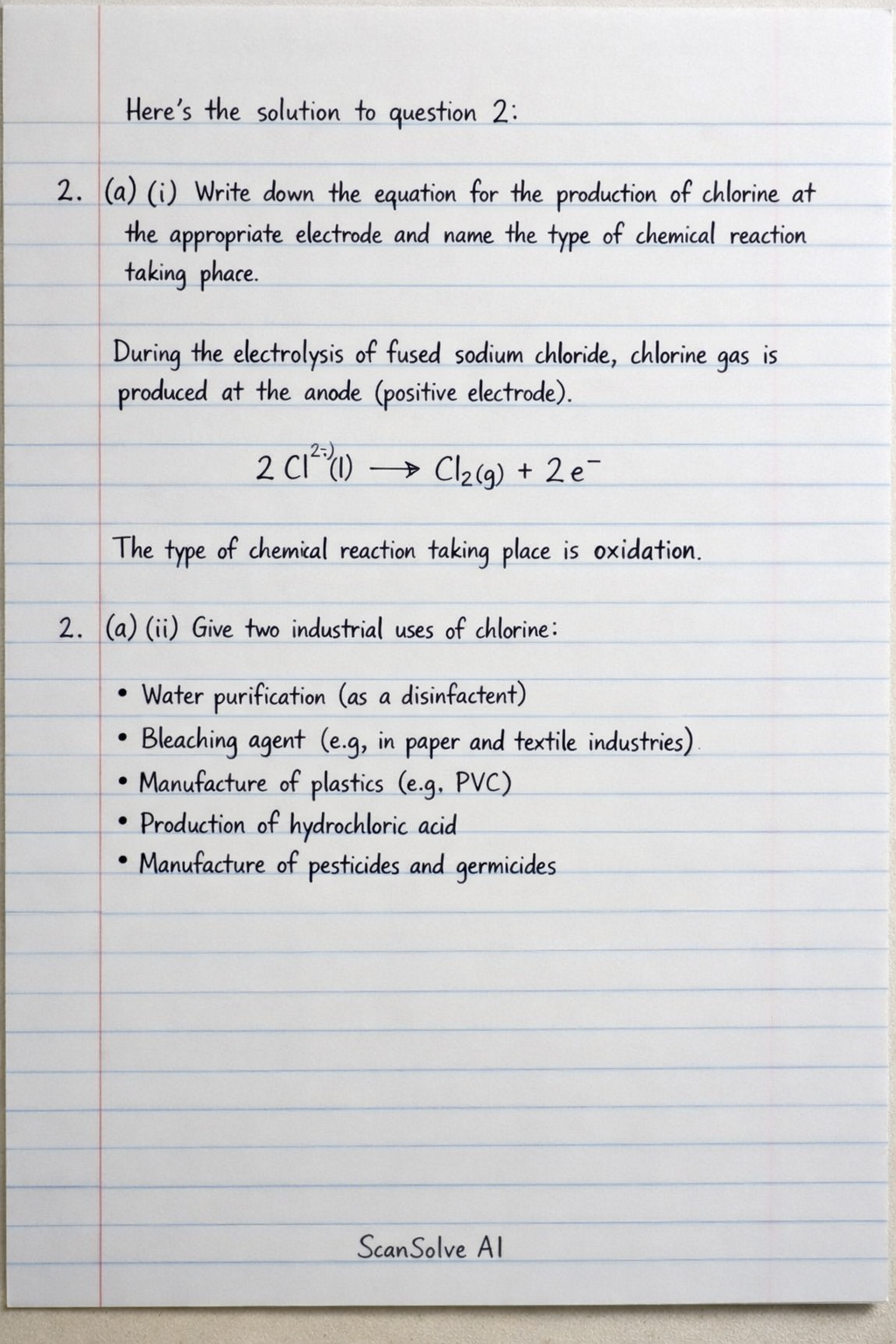
Here's the solution to question 2:
2. (a) (i) Write down the equation for the production of chlorine at the appropriate electrode and name the type of chemical reaction taking place.
During the electrolysis of fused sodium chloride, chlorine gas is produced at the anode (positive electrode).
The type of chemical reaction taking place is oxidation.
2. (a) (ii) Give two industrial uses of chlorine.
- Water purification (as a disinfectant)
- Bleaching agent (e.g., in paper and textile industries)
- Manufacture of plastics (e.g., PVC)
- Production of hydrochloric acid
- Manufacture of pesticides and germicides
2. (b) Explain how the bleaching action of moist chlorine is achieved.
Moist chlorine bleaches by reacting with water to form hydrochloric acid () and hypochlorous acid (). The hypochlorous acid is unstable and decomposes to produce nascent oxygen (atomic oxygen). This nascent oxygen is a powerful oxidizing agent that reacts with the colored substance, oxidizing it to a colorless compound.
2. (c) Bromine and iodine are members of the same group in the Periodic Table as chlorine. Describe tests by which these three members could be arranged in order of their reactivity.
The reactivity of halogens decreases down Group 17. This means a more reactive halogen can displace a less reactive halogen from its halide solution.
Tests:
-
Add chlorine water to separate solutions of potassium bromide and potassium iodide.
- When chlorine water is added to potassium bromide solution, the solution turns orange-brown. This indicates that chlorine has displaced bromine:
- When chlorine water is added to potassium iodide solution, the solution turns brown. This indicates that chlorine has displaced iodine:
These observations show that chlorine is more reactive than both bromine and iodine.
-
Add bromine water to potassium iodide solution.
- When bromine water is added to potassium iodide solution, the solution turns brown. This indicates that bromine has displaced iodine:
This observation shows that bromine is more reactive than iodine.
Conclusion:
Based on these displacement reactions, the order of reactivity is:
Chlorine > Bromine > Iodine
Still stuck on this one?
Ask a follow-up, and the answer starts from this question.
More Economics Questions
Handwritten Step-by-Step Solution
Get this as a handwritten image on WhatsApp — like a tutor wrote it for you.
Try on WhatsApp