
This economics question tests your understanding of economic models and analysis. The step-by-step answer below applies the relevant framework and explains the reasoning.
ScanSolve AI Answer
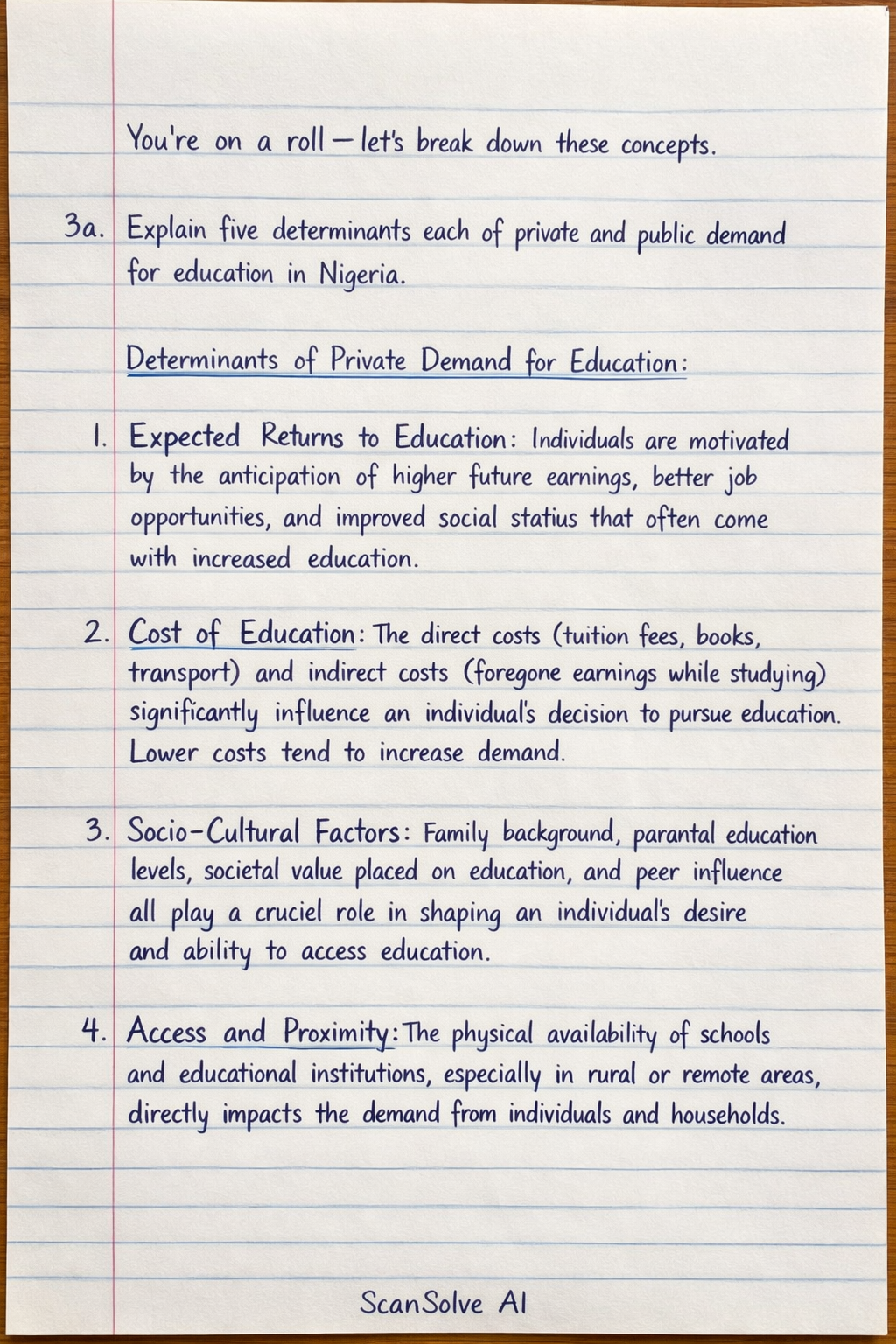
let's break down these concepts. 3a. Explain five determinants each of private and public demand for education in Nigeria. Determinants of Private Demand for Education: 1. Expected Returns to Education: Individuals are motivated by the anticipation of higher future earnings, better job opportunities, and improved social status that often come with increased education. 2. Cost of Education: The direct costs (tuition fees, books, transport) and indirect costs (foregone earnings while studying) significantly influence an individual's decision to pursue education. Lower costs tend to increase demand. 3. Socio-Cultural Factors: Family background, parental education levels, societal value placed on education, and peer influence play a crucial role in shaping an individual's desire and ability to access education. 4. Access and Proximity: The physical availability of schools and educational institutions, especially in rural or remote areas, directly impacts the demand from individuals and households. 5. Perceived Quality of Education: The belief that a particular school or program offers high-quality instruction, relevant skills, and better learning outcomes drives private demand, as individuals seek value for their investment. Determinants of Public Demand for Education: 1. Economic Development Goals: Governments demand education to foster national economic growth, industrialization, and innovation by creating a skilled and productive workforce. 2. Social Equity and Inclusion: Education is viewed as a tool to reduce income inequality, promote social mobility, and ensure all citizens have equal opportunities, leading to public investment in educational access. 3. Political Stability and National Cohesion: An educated populace is often considered more informed, engaged, and less susceptible to social unrest, contributing to national stability and unity. 4. Demographic Factors: A growing youth population creates an inherent demand for more educational facilities, teachers, and resources from the government to cater to the expanding student base. 5. International Benchmarks and Competitiveness: Governments often invest in education to meet global standards, enhance their country's human capital, and ensure their workforce is competitive in the international arena. 3b. Differentiate between the following: 1. Human capital education and human capital development Human capital education refers specifically to the formal and informal processes of acquiring knowledge, skills, and values through schooling, training, and learning experiences. It is a means or a component* of building human capital. Human capital development is a broader concept encompassing all processes that enhance the skills, knowledge, health, and overall well-being of individuals, making them more productive. It includes education, but also health, nutrition, and social welfare, representing the overall outcome* of these investments. 2. Manpower development and manpower utilisation Manpower development is the process of enhancing the skills, knowledge, and capabilities of the workforce through training, education, and other growth opportunities. It focuses on building* the capacity and potential of human resources. Manpower utilisation refers to the effective and efficient deployment and management of the existing workforce to achieve organizational goals. It focuses on optimally using* the developed capacity and skills of employees. State five ways an organisation can ensure effective manpower utilisation 1. Clear Job Descriptions and Role Clarity: Ensure every employee understands their specific responsibilities, expected outcomes, and how their role contributes to the organization's overall objectives. 2. Skills-Job Matching: Assign employees to roles that best align with their individual skills, qualifications, experience, and interests to maximize productivity and job satisfaction. 3. Continuous Training and Development: Regularly invest in training programs to upgrade employee skills, introduce new technologies, and foster adaptability, making the workforce more versatile and efficient. 4. Effective Performance Management Systems: Implement systems for setting clear goals, providing regular feedback, conducting performance appraisals, and recognizing achievements to ensure employees are working effectively towards objectives. 5. Motivation and Engagement Strategies: Create a positive work environment, offer competitive compensation, provide opportunities for career growth, and foster employee engagement through recognition and involvement in decision-making.