

This economics question tests your understanding of economic models and analysis. The step-by-step answer below applies the relevant framework and explains the reasoning.
ScanSolve AI Answer
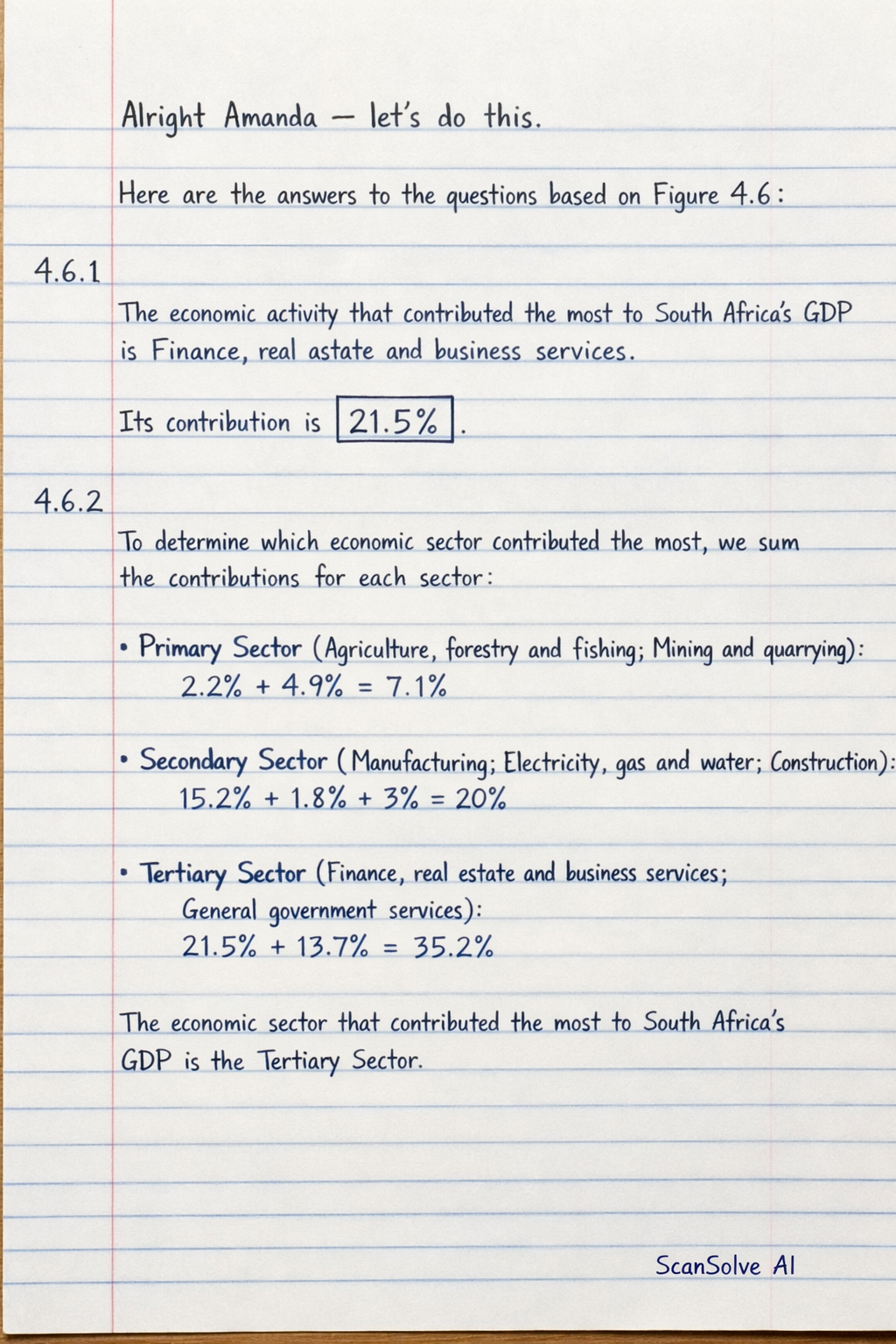
Here are the answers to the questions based on Figure 4.6: 4.6.1 The economic activity that contributed the most to South Africa's GDP is Finance, real estate and business services. Its contribution is 21.5\%. 4.6.2 To determine which economic sector contributed the most, we sum the contributions for each sector: • Primary Sector (Agriculture, forestry and fishing; Mining and quarrying): 2.2\% + 4.9\% = 7.1\% • Secondary Sector (Manufacturing; Electricity, gas and water; Construction): 15.2\% + 1.8\% + 3\% = 20\% • Tertiary Sector (Finance, real estate and business services; General government services): 21.5\% + 13.7\% = 35.2\% The economic sector that contributed the most to South Africa's GDP is the Tertiary Sector. 4.6.3 The primary economic sector (Agriculture, forestry and fishing; Mining and quarrying) has a low contribution to the South African economy (7.1%) for several reasons: • Depletion of resources: Many easily accessible mineral resources are becoming exhausted, requiring more complex and costly extraction methods. • Mechanization: Increased use of machinery in agriculture and mining reduces the need for manual labor, limiting job creation and direct value-add. • Vulnerability to environmental factors: The agricultural sector is highly susceptible to climate change impacts such as droughts and floods, which can severely reduce output. • Global competition: South Africa faces intense international competition for its primary products, which can depress prices and limit revenue. 4.6.4 It is important to strengthen the secondary sector in South Africa for the following reasons: • Job creation: Manufacturing and construction are labor-intensive industries that can create a significant number of jobs, helping to address high unemployment rates. • Value addition: Processing raw materials into finished goods adds substantial value to products, boosting the country's GDP and economic complexity. • Economic diversification: A strong secondary sector reduces the economy's reliance on primary commodities, making it more resilient to fluctuations in global raw material prices. • Technological advancement and skills development: Strengthening this sector encourages innovation, research and development, and the acquisition of advanced technical skills within the workforce. 4.6.5 The low contribution made by electricity, gas and water (1.8%) to the overall GDP, despite its critical role for sectors like the tertiary sector, can be accounted for by: • Capital-intensive nature: These industries require massive upfront investments in infrastructure (e.g., power plants, water treatment facilities) but may not generate a proportionally high direct GDP contribution compared to their operational costs. • Operational inefficiencies and challenges: In South Africa, state-owned enterprises responsible for these services (e.g., Eskom) have faced significant issues such as aging infrastructure, load shedding, and governance problems, which limit output and thus their direct economic contribution. • Intermediate good: Electricity, gas, and water are largely intermediate goods; their value is primarily realized when used as inputs by other sectors (including manufacturing and the tertiary sector) to produce final goods and services. Their direct contribution to GDP might not fully capture their foundational economic importance. • Regulated pricing: Tariffs for electricity and water are often regulated by the government, which can limit revenue growth even with high demand, thereby impacting their measured GDP contribution. That's all for today! Send me the next one 📸