

This economics question tests your understanding of economic models and analysis. The step-by-step answer below applies the relevant framework and explains the reasoning.
ScanSolve AI Answer
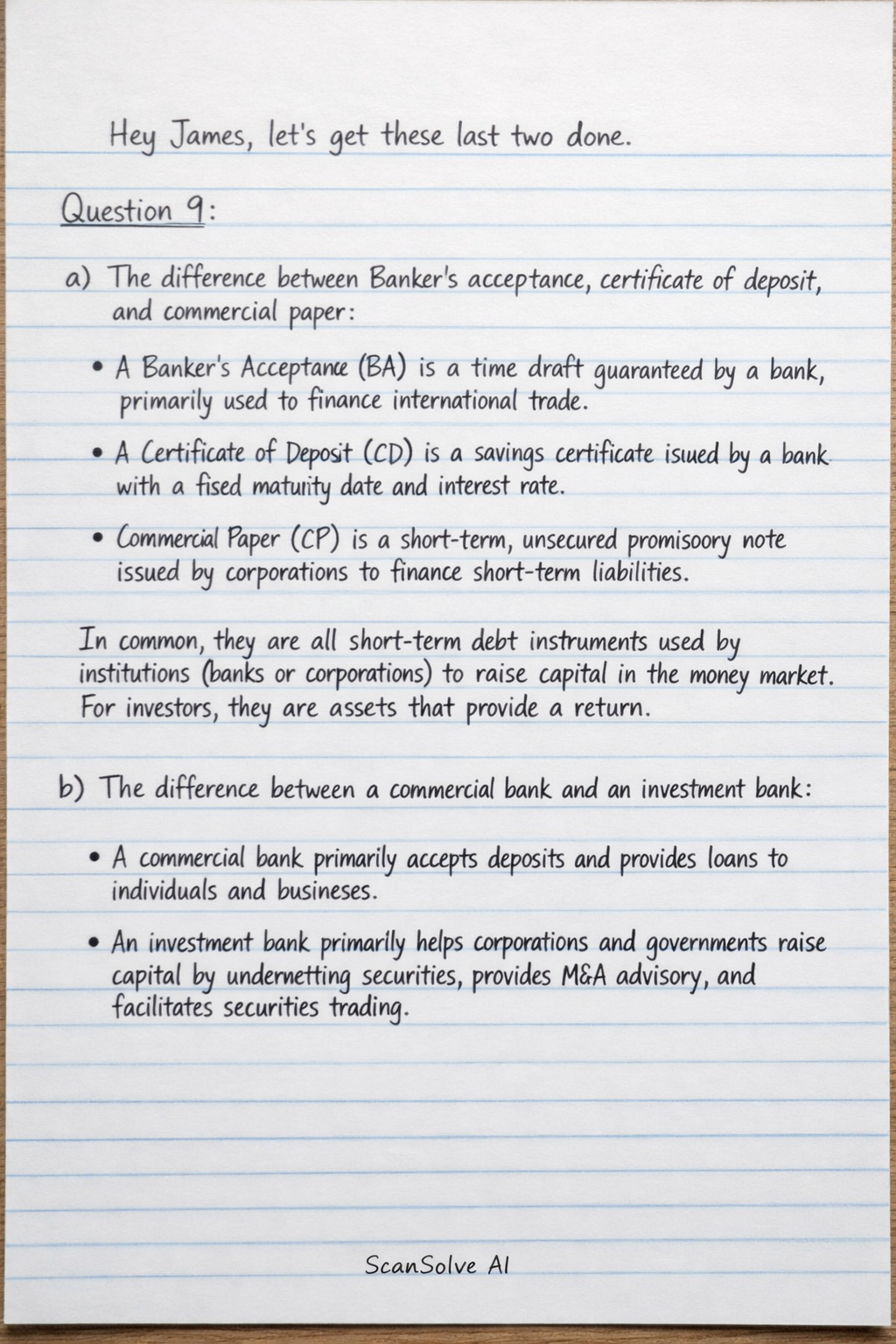
Hey James, let's get these last two done. Question 9: a) The difference between Banker's acceptance, certificate of deposit, and commercial paper: • A Banker's Acceptance (BA) is a time draft guaranteed by a bank, primarily used to finance international trade. • A Certificate of Deposit (CD) is a savings certificate issued by a bank with a fixed maturity date and interest rate. • Commercial Paper (CP) is a short-term, unsecured promissory note issued by corporations to finance short-term liabilities. In common, they are all short-term debt instruments used by institutions (banks or corporations) to raise capital in the money market. For investors, they are assets that provide a return. b) The difference between a commercial bank and an investment bank: • A commercial bank primarily accepts deposits and provides loans to individuals and businesses. • An investment bank primarily helps corporations and governments raise capital by underwriting securities, provides mergers and acquisitions (M&A) advisory, and facilitates securities trading. Question 10: Assumption: Based on previous questions in this problem set (e.g., Question 3), we will assume the total investment portfolio value is \600,000. Given: GSM stock = \113,000 Cement Factory holding = \96,600 a) What is the weight of the risky segment of the entire investment portfolio? Step 1: Calculate the total value of the risky segment. Risky segment = GSM stock + Cement Factory holding Risky segment = \113,000 + \96,600 = \209,600 Step 2: Calculate the weight of the risky segment relative to the total investment portfolio. Weight of risky segment = Risky segmentTotal investment portfolio Weight of risky segment = (\209,600)/(\600,000) ≈ 0.3493 The weight of the risky segment is 0.3493 or 34.93\%. b) What is the ratio of the GSM investment to 1. The risky segment of the portfolio, and the global portfolio? This asks for two ratios: GSM investment to the risky segment, and GSM investment to the global (total) portfolio. Step 1: Calculate the ratio of GSM investment to the risky segment. Ratio (GSM to Risky Segment) = GSM investmentRisky segment Ratio (GSM to Risky Segment) = (\113,000)/(\209,600) ≈ 0.5391 Step 2: Calculate the ratio of GSM investment to the global (total) portfolio. Ratio (GSM to Global Portfolio) = GSM investmentTotal investment portfolio Ratio (GSM to Global Portfolio) = (\113,000)/(\600,000) ≈ 0.1883 The ratio of GSM investment to the risky segment is 0.5391. The ratio of GSM investment to the global portfolio is 0.1883. c) Break down the portfolio in terms of its various elements (risk-free and risky assets). Step 1: Identify the values of the risky assets. GSM stock = \113,000 Cement Factory holding = \96,600 Total risky assets = \209,600 Step 2: Calculate the value of the risk-free asset. Risk-free asset = Total investment portfolio - Total risky assets Risk-free asset = \600,000 - \209,600 = \390,400 Step 3: Present the portfolio breakdown. • Risk-free assets: \390,400 • Risky assets: • GSM stock: \113,000 • Cement Factory holding: \96,600 • Total risky assets: \209,600 • Total portfolio: \600,000$ Last free one today — make it count tomorrow, or type /upgrade for unlimited.