
We read your photo as:
Assignment: Q1. How various forms of Consumers responsibilities ensure national growth and development List 4. Q2. How to choose sustainable and Eco-friendly List 4. Q3. Ways of energy Conservation Practices List 4.
Economics
ScanSolve AI Answer
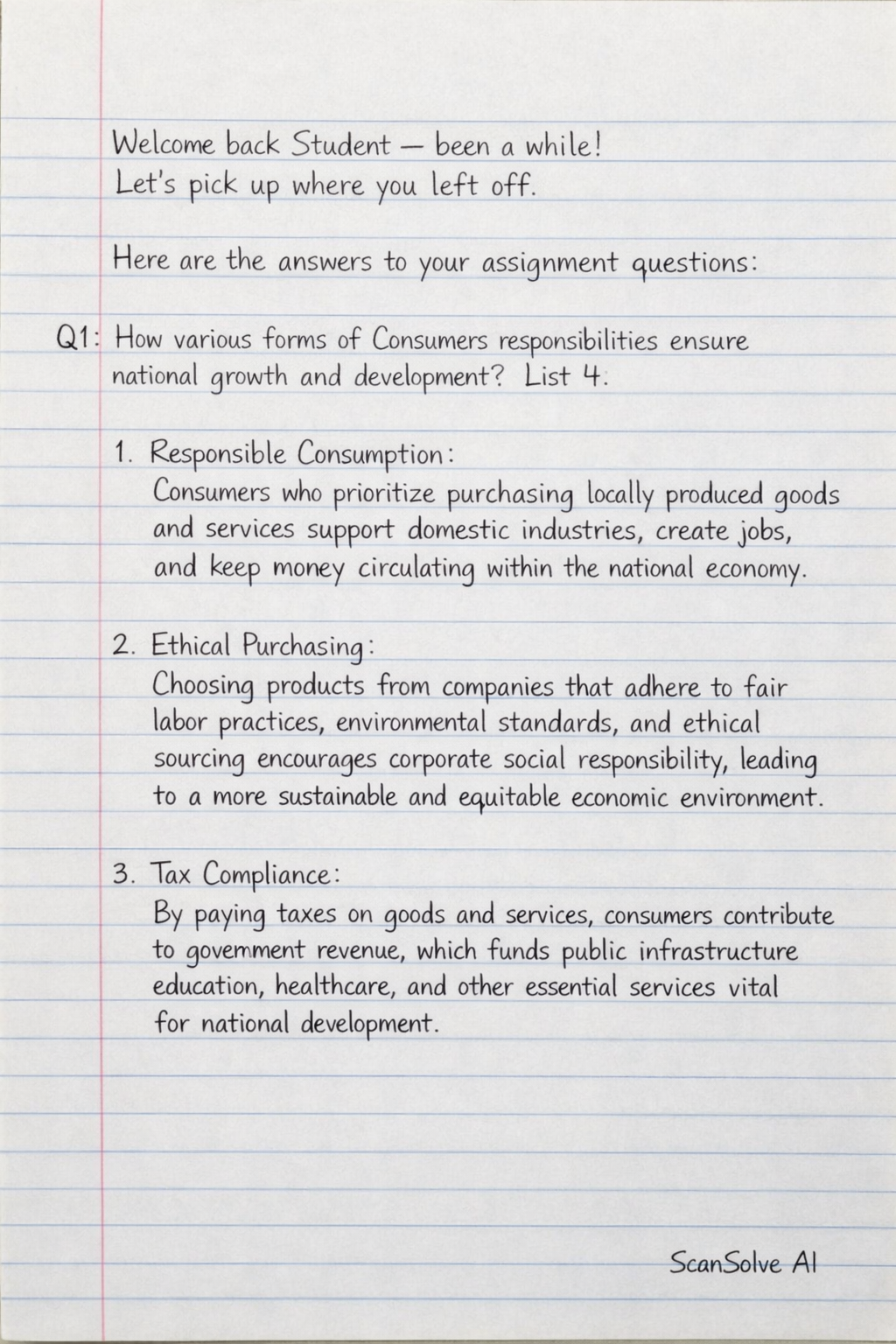
Here are the answers to your assignment questions:
Q1: How various forms of Consumers responsibilities ensure national growth and development. List 4.
- Responsible Consumption: Consumers who prioritize purchasing locally produced goods and services support domestic industries, create jobs, and keep money circulating within the national economy.
- Ethical Purchasing: Choosing products from companies that adhere to fair labor practices, environmental standards, and ethical sourcing encourages corporate social responsibility, leading to a more sustainable and equitable economic environment.
- Tax Compliance: By paying taxes on goods and services, consumers contribute to government revenue, which funds public infrastructure, education, healthcare, and other essential services vital for national development.
- Informed Decision-Making: Consumers who research products, demand quality, and provide feedback drive competition and innovation among businesses, leading to better products, efficient resource use, and overall economic growth.
Q2: How to choose sustainable and ECO-friendly products. List 4.
- Look for Certifications: Choose products with recognized eco-labels and certifications (e.g., Energy Star, Fair Trade, Organic, FSC) that verify environmental and social standards.
- Check Materials and Ingredients: Opt for products made from recycled, renewable, non-toxic, or sustainably sourced materials, and avoid those with harmful chemicals or excessive plastic.
- Consider Product Lifecycle: Prioritize durable, repairable products with minimal packaging that can be reused or recycled at the end of their life, reducing waste and resource consumption.
- Support Local and Ethical Brands: Buying from local businesses reduces transportation emissions and supports community economies, while choosing ethical brands ensures responsible production practices.
Q3: Ways of energy conservation practices. List 4.
- Turn Off Lights and Appliances: Switch off lights when leaving a room and unplug electronics when not in use to prevent phantom load, saving electricity.
- Use Energy-Efficient Appliances: Replace old appliances with newer, energy-efficient models (e.g., those with an Energy Star rating) to significantly reduce energy consumption.
- Improve Home Insulation: Ensure proper insulation in walls, attics, and windows to minimize heat loss in winter and heat gain in summer, reducing the need for heating and air conditioning.
- Utilize Natural Light and Ventilation: Maximize the use of natural daylight by opening curtains and blinds, and use natural ventilation (opening windows) instead of air conditioning when possible.
Was this helpful?
Still stuck on this one?
Ask a follow-up, and the answer starts from this question.
Got a different question?Ask your own question
More Economics Questions
Q2026 WASSCE MANAGEMENT IN LIVING (ESSAY) CONFIRMED STANDARD QUESTION 1 Define the following terms…QSustainability Principles: Outline the three principles of sustainability and explain how human…QBECE 2026 Social Studies Section B Practice (For Candidates) INSTRUCTION: Answer any THREE…QQuestion 3: a) i. What is a balanced diet? ii. State three classes of food. b)Explain three…QA. Using suitable examples, briefly explain the following 1. Global warming 2. Endangered species 3…
Handwritten Step-by-Step Solution
Get this as a handwritten image on WhatsApp — like a tutor wrote it for you.
Try on WhatsApp