ScanSolve logoScanSolve
Toggle sidebar
  • Homework
  • Tutor
  • Humanizer
  • AI Detector
  • Questions
  • Blog
  • History
  • Mobile App

  • Homework
  • Tutor
  • Humanizer
  • AI Detector

  • Questions
  • Math homework helpMath
    Physics homework helpPhysics
    Chemistry homework helpChemistry
    Biology homework helpBiology
    Computer Science homework helpComputer Science
    History homework helpHistory
    More homework helpMore
  • Blog
  • History

  • Mobile App
ScanSolvePLUS
  • Unlimited answers
  • ScanSolve AI Pro
Start Free Trial →
Try on WhatsApp
Home > Economics Homework Help > Solution

Advanced level economics paper 3 north west mock 🥳🔥

Asked on March 27, 2026|Economics

This economics question tests your understanding of economic models and analysis. The step-by-step answer below applies the relevant framework and explains the reasoning.

ScanSolve AI AnswerAnswered on March 27, 2026
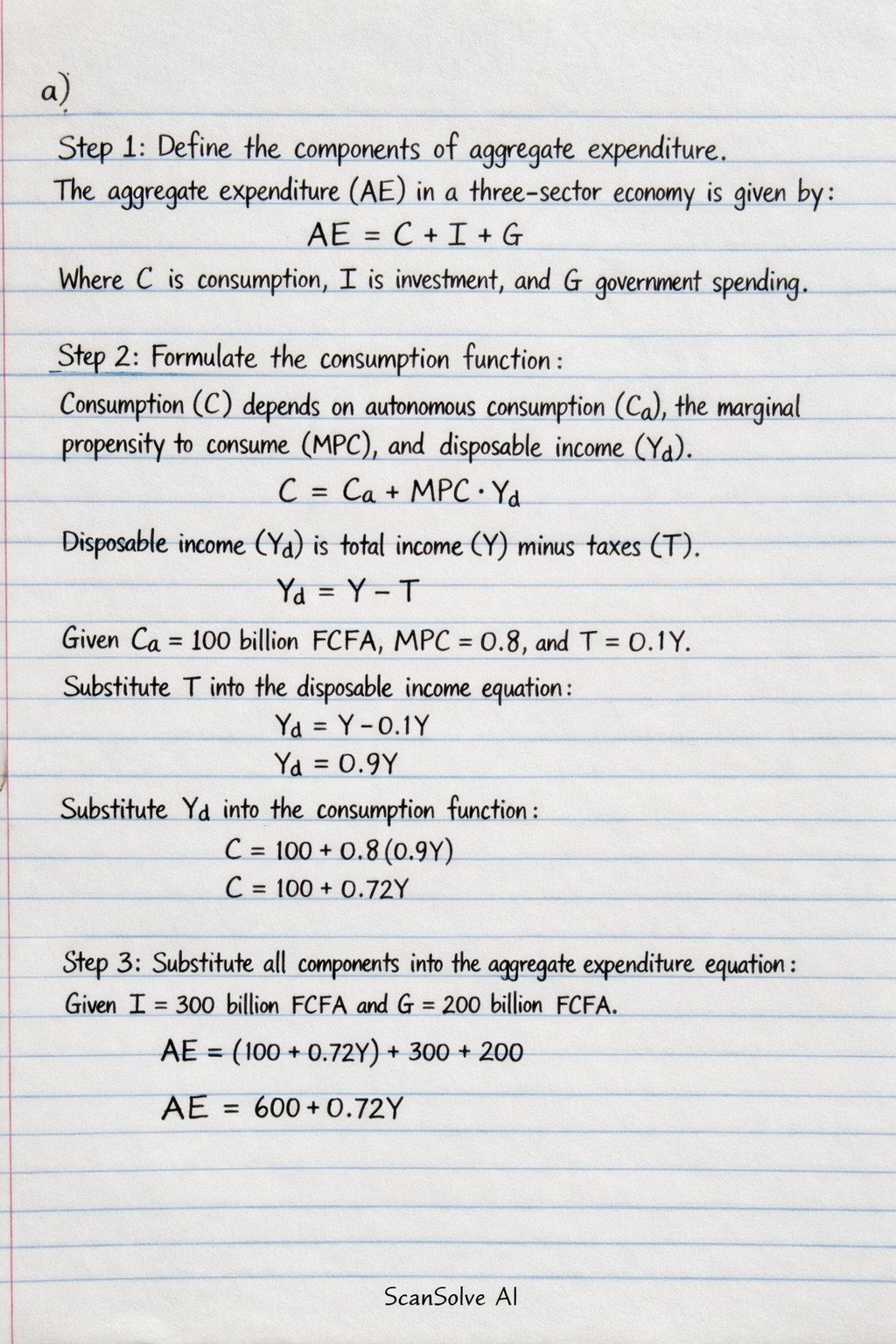
a) Step 1: Define the components of aggregate expenditure. The aggregate expenditure (AE) in a three-sector economy is given by: $$AE = C + I + G$$ Where $C$ is consumption, $I$ is investment, and $G$ is government spending. Step 2: Formulate the consumption function. Consumption ($C$) depends on autonomous consumption ($C_a$), the marginal propensity to consume (MPC), and disposable income ($Y_d$). $$C = C_a + MPC \cdot Y_d$$ Disposable income ($Y_d$) is total income ($Y$) minus direct taxes ($T$). $$Y_d = Y - T$$ Given $C_a = 100$ billion FCFA, $MPC = 0.8$, and $T = 0.1Y$. Substitute $T$ into the disposable income equation: $$Y_d = Y - 0.1Y = 0.9Y$$ Substitute $Y_d$ into the consumption function: $$C = 100 + 0.8(0.9Y)$$ $$C = 100 + 0.72Y$$ Step 3: Substitute all components into the aggregate expenditure equation. Given $I = 300$ billion FCFA and $G = 200$ billion FCFA. $$AE = (100 + 0.72Y) + 300 + 200$$ $$AE = 600 + 0.72Y$$ Step 4: Calculate the equilibrium level of national income. Equilibrium occurs when aggregate expenditure equals national income ($Y = AE$). $$Y = 600 + 0.72Y$$ $$Y - 0.72Y = 600$$ $$0.28Y = 600$$ $$Y = \frac{600}{0.28}$$ $$Y = 2142.85714...$$ Rounding to two decimal places: The equilibrium level of national income is $\boxed{\text{2142.86 billion FCFA}}$. b) The equilibrium level of national income calculated in (a) is $Y_e = 2142.86$ billion FCFA. The full employment level of income (potential income) is given as $Y_f = 3,000$ billion FCFA. Since $Y_e < Y_f$ ($2142.86 \text{ billion FCFA} < 3,000 \text{ billion FCFA}$), the economy is experiencing a deflationary gap. Reason: The equilibrium level of national income is below the full employment level. This indicates that the economy is operating below its potential, leading to unemployment and underutilization of resources. c) i) To represent the situation on a graph: • Draw a graph with National Income (Y) on the horizontal axis and Aggregate Expenditure (AE) on the vertical axis. • Draw a 45-degree line from the origin, representing the condition where $AE = Y$. • Plot the Aggregate Expenditure function $AE = 600 + 0.72Y$. This line will intersect the 45-degree line at the equilibrium income. • Mark the equilibrium income $Y_e = 2142.86$ billion FCFA on the horizontal axis where the AE curve intersects the 45-degree line. • Mark the full employment income $Y_f = 3,000$ billion FCFA on the horizontal axis to the right of $Y_e$. • At $Y_f = 3,000$ billion FCFA, the Aggregate Expenditure curve will be below the 45-degree line. The vertical distance between the 45-degree line and the AE curve at $Y_f$ represents the deflationary gap in terms of aggregate expenditure. ii) To close a deflationary gap, the government needs to stimulate aggregate demand. Two measures are: 1. Increase government spending (G): A direct increase in government expenditure on goods and services directly boosts aggregate demand. 2. Decrease direct taxes (T): A reduction in direct taxes increases disposable income for households, leading to higher consumption and thus an increase in aggregate demand. d) Step 1: Calculate the income gap. The income gap is the difference between the full employment income and the equilibrium income. $$\Delta Y = Y_f - Y_e$$ $$\Delta Y = 3,000 \text{ billion FCFA} - 2142.86 \text{ billion FCFA}$$ $$\Delta Y = 857.14 \text{ billion FCFA}$$ Step 2: Calculate the government spending multiplier. The multiplier ($k_G$) in an economy with taxes is given by: $$k_G = \frac{1}{1 - MPC(1-t)}$$ Where $MPC = 0.8$ and the tax rate $t = 0.1$. $$k_G = \frac{1}{1 - 0.8(1-0.1)}$$ $$k_G = \frac{1}{1 - 0.8(0.9)}$$ $$k_G = \frac{1}{1 - 0.72}$$ $$k_G = \frac{1}{0.28}$$ $$k_G = \frac{100}{28} = \frac{25}{7} \approx 3.5714$$ Step 3: Calculate the required change in government spending. To close the income gap, the change in income ($\Delta Y$) must be achieved through a change in government spending ($\Delta G$) using the multiplier: $$\Delta Y = k_G \times \Delta G$$ $$\Delta G = \frac{\Delta Y}{k_G}$$ Using the precise fractional values: $$\Delta G = \frac{\frac{6000}{7}}{\frac{25}{7}}$$ $$\Delta G = \frac{6000}{25}$$ $$\Delta

Related Economics Questions

  • Principle of micro economics
  • Eco 101 course outline: ECONOMICS Meaning of economics Principles of micro economics Economic statement Macro economics...
  • 1. a) With the aid of production possibility curves, distinguish between increasing and decreasing opportunity costs.
  • Report on Periodic Trends and Production Process Recommendations
  • 1) Enumerate four different actions trade union's can take to enforce their demands 2) state four Economics factors whic...
  • 1) State the law of diminishing returns and justify why it holds 2) l list three assumption of this law 3) identify thre...
See all Economics questions

This step-by-step solution was generated by ScanSolve AI. Need help with more economics problems? Browse Economics solutions or ask your own question.

Home›Economics Homework Help›Advanced level economics paper 3 north west mock 🥳🔥
Q

Advanced level economics paper 3 north west mock 🥳🔥

March 27, 2026|Economics
Advanced level economics paper 3 north west mock 🥳🔥

Advanced level economics paper 3 north west mock 🥳🔥

ScanSolve AI

ScanSolve AI Answer

Answered on March 27, 2026

a) Step 1: Define the components of aggregate expenditure. The aggregate expenditure (AE) in a three-sector economy is given by: AE=C+I+GAE = C + I + GAE=C+I+G Where CCC is consumption, III is investment, and GGG is government spending.

Step 2: Formulate the consumption function. Consumption (CCC) depends on autonomous consumption (CaC_aCa​), the marginal propensity to consume (MPC), and disposable income (YdY_dYd​). C=Ca+MPC⋅YdC = C_a + MPC \cdot Y_dC=Ca​+MPC⋅Yd​ Disposable income (YdY_dYd​) is total income (YYY) minus direct taxes (TTT). Yd=Y−TY_d = Y - TYd​=Y−T Given Ca=100C_a = 100Ca​=100 billion FCFA, MPC=0.8MPC = 0.8MPC=0.8, and T=0.1YT = 0.1YT=0.1Y. Substitute TTT into the disposable income equation: Yd=Y−0.1Y=0.9YY_d = Y - 0.1Y = 0.9YYd​=Y−0.1Y=0.9Y Substitute YdY_dYd​ into the consumption function: C=100+0.8(0.9Y)C = 100 + 0.8(0.9Y)C=100+0.8(0.9Y) C=100+0.72YC = 100 + 0.72YC=100+0.72Y

Step 3: Substitute all components into the aggregate expenditure equation. Given I=300I = 300I=300 billion FCFA and G=200G = 200G=200 billion FCFA. AE=(100+0.72Y)+300+200AE = (100 + 0.72Y) + 300 + 200AE=(100+0.72Y)+300+200 AE=600+0.72YAE = 600 + 0.72YAE=600+0.72Y

Step 4: Calculate the equilibrium level of national income. Equilibrium occurs when aggregate expenditure equals national income (Y=AEY = AEY=AE). Y=600+0.72YY = 600 + 0.72YY=600+0.72Y Y−0.72Y=600Y - 0.72Y = 600Y−0.72Y=600 0.28Y=6000.28Y = 6000.28Y=600 Y=6000.28Y = \frac{600}{0.28}Y=0.28600​ Y=2142.85714...Y = 2142.85714...Y=2142.85714... Rounding to two decimal places: The equilibrium level of national income is ∗2142.86billionFCFA∗\boxed{*2142.86 billion FCFA*}∗2142.86billionFCFA∗​.

b) The equilibrium level of national income calculated in (a) is Ye=2142.86Y_e = 2142.86Ye​=2142.86 billion FCFA. The full employment level of income (potential income) is given as Yf=3,000Y_f = 3,000Yf​=3,000 billion FCFA. Since Ye<YfY_e < Y_fYe​<Yf​ (2142.86billionFCFA<3,000 billion FCFA2142.86 billion FCFA < 3,000 \text{ billion FCFA}2142.86billionFCFA<3,000 billion FCFA), the economy is experiencing a deflationary gap. Reason: The equilibrium level of national income is below the full employment level. This indicates that the economy is operating below its potential, leading to unemployment and underutilization of resources.

c) i) To represent the situation on a graph: • Draw a graph with National Income (Y) on the horizontal axis and Aggregate Expenditure (AE) on the vertical axis. • Draw a 45-degree line from the origin, representing the condition where AE=YAE = YAE=Y. • Plot the Aggregate Expenditure function AE=600+0.72YAE = 600 + 0.72YAE=600+0.72Y. This line will intersect the 45-degree line at the equilibrium income. • Mark the equilibrium income Ye=2142.86Y_e = 2142.86Ye​=2142.86 billion FCFA on the horizontal axis where the AE curve intersects the 45-degree line. • Mark the full employment income Yf=3,000Y_f = 3,000Yf​=3,000 billion FCFA on the horizontal axis to the right of YeY_eYe​. • At Yf=3,000Y_f = 3,000Yf​=3,000 billion FCFA, the Aggregate Expenditure curve will be below the 45-degree line. The vertical distance between the 45-degree line and the AE curve at YfY_fYf​ represents the deflationary gap in terms of aggregate expenditure.

ii) To close a deflationary gap, the government needs to stimulate aggregate demand. Two measures are:

  1. Increase government spending (G): A direct increase in government expenditure on goods and services directly boosts aggregate demand.
  2. Decrease direct taxes (T): A reduction in direct taxes increases disposable income for households, leading to higher consumption and thus an increase in aggregate demand.

d) Step 1: Calculate the income gap. The income gap is the difference between the full employment income and the equilibrium income. ΔY=Yf−Ye\Delta Y = Y_f - Y_eΔY=Yf​−Ye​ ΔY=3,000billionFCFA−2142.86 billion FCFA\Delta Y = 3,000 billion FCFA - 2142.86 \text{ billion FCFA}ΔY=3,000billionFCFA−2142.86 billion FCFA ΔY=857.14 billion FCFA\Delta Y = 857.14 \text{ billion FCFA}ΔY=857.14 billion FCFA

Step 2: Calculate the government spending multiplier. The multiplier (kGk_GkG​) in an economy with taxes is given by: kG=11−MPC(1−t)k_G = \frac{1}{1 - MPC(1-t)}kG​=1−MPC(1−t)1​ Where MPC=0.8MPC = 0.8MPC=0.8 and the tax rate t=0.1t = 0.1t=0.1. kG=11−0.8(1−0.1)k_G = \frac{1}{1 - 0.8(1-0.1)}kG​=1−0.8(1−0.1)1​ kG=11−0.8(0.9)k_G = \frac{1}{1 - 0.8(0.9)}kG​=1−0.8(0.9)1​ kG=11−0.72k_G = \frac{1}{1 - 0.72}kG​=1−0.721​ kG=10.28k_G = \frac{1}{0.28}kG​=0.281​ kG=10028=257≈3.5714k_G = \frac{100}{28} = \frac{25}{7} \approx 3.5714kG​=28100​=725​≈3.5714

Step 3: Calculate the required change in government spending. To close the income gap, the change in income (ΔY\Delta YΔY) must be achieved through a change in government spending (ΔG\Delta GΔG) using the multiplier: ΔY=kG×ΔG\Delta Y = k_G \times \Delta GΔY=kG​×ΔG ΔG=ΔYkG\Delta G = \frac{\Delta Y}{k_G}ΔG=kG​ΔY​ Using the precise fractional values: ΔG=60007257\Delta G = \frac{\frac{6000}{7}}{\frac{25}{7}}ΔG=725​76000​​ ΔG=600025\Delta G = \frac{6000}{25}ΔG=256000​

Need help with your own homework?

Get instant step-by-step solutions to any question. Free to start.

Ask Your Question
Handwritten step-by-step solution

Handwritten Step-by-Step Solution

Get this solution as a handwritten image on WhatsApp — just like a tutor wrote it for you.

Try on WhatsApp

More Economics Questions

Principle of micro economicsEco 101 course outline: ECONOMICS Meaning of economics Principles of micro economics Economic statem…1. a) With the aid of production possibility curves, distinguish between increasing and decreasing o…Report on Periodic Trends and Production Process Recommendations1) Enumerate four different actions trade union's can take to enforce their demands 2) state four Ec…1) State the law of diminishing returns and justify why it holds 2) l list three assumption of this…
See all Economicsquestions →
Economics: Advanced level economics paper 3 north west mock 🥳🔥 — Step-by-Step Solution | ScanSolve