

This economics question tests your understanding of economic models and analysis. The step-by-step answer below applies the relevant framework and explains the reasoning.
ScanSolve AI Answer
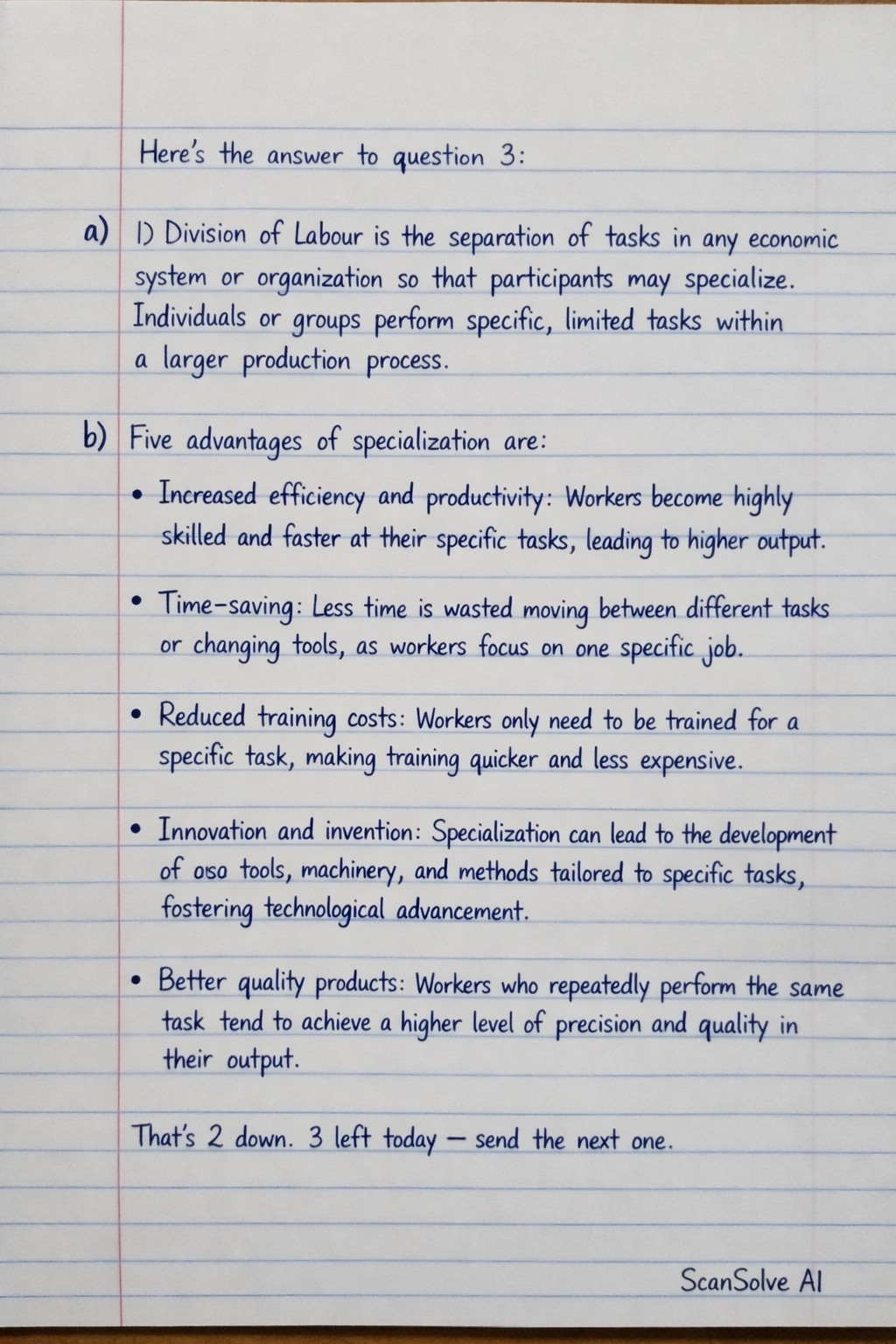
Here's the answer to question 3: a) Division of Labour is the separation of tasks in any economic system or organization so that participants may specialize. Individuals or groups perform specific, limited tasks within a larger production process. b) Five advantages of specialization are: • Increased efficiency and productivity: Workers become highly skilled and faster at their specific tasks, leading to higher output. • Time-saving: Less time is wasted moving between different tasks or changing tools, as workers focus on one specific job. • Reduced training costs: Workers only need to be trained for a specific task, making training quicker and less expensive. • Innovation and invention: Specialization can lead to the development of new tools, machinery, and methods tailored to specific tasks, fostering technological advancement. • Better quality products: Workers who repeatedly perform the same task tend to achieve a higher level of precision and quality in their output. That's 2 down. 3 left today — send the next one.