
We read your photo as:
How can the efficiency and geographical mobility of labor be improved in an economy?
Economics
ScanSolve AI Answer
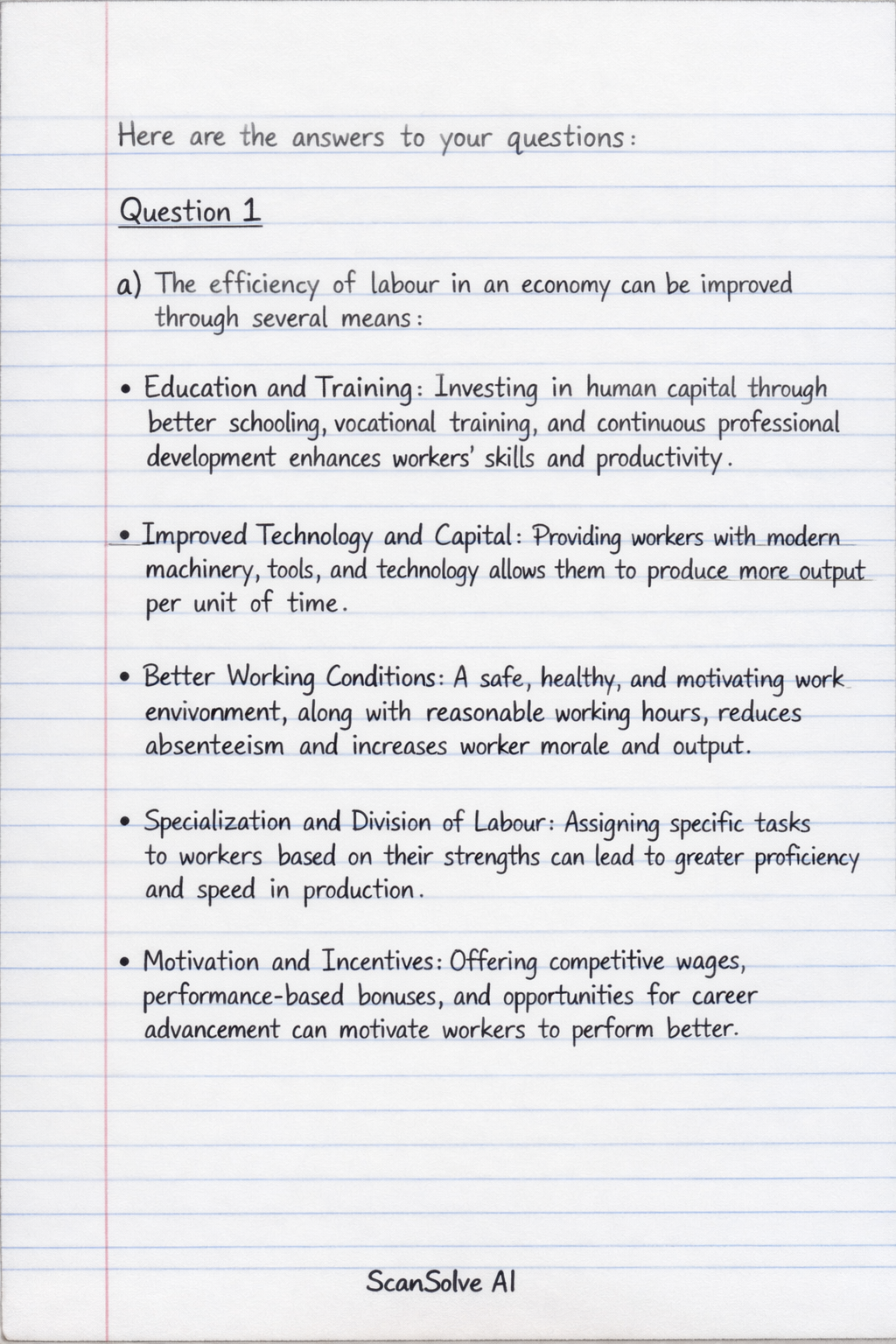
Here are the answers to your questions:
Question 1
a) The efficiency of labour in an economy can be improved through several means:
- Education and Training: Investing in human capital through better schooling, vocational training, and continuous professional development enhances workers' skills and productivity.
- Improved Technology and Capital: Providing workers with modern machinery, tools, and technology allows them to produce more output per unit of time.
- Better Working Conditions: A safe, healthy, and motivating work environment, along with reasonable working hours, reduces absenteeism and increases worker morale and output.
- Specialization and Division of Labour: Assigning specific tasks to workers based on their strengths can lead to greater proficiency and speed in production.
- Motivation and Incentives: Offering competitive wages, performance-based bonuses, and opportunities for career advancement can motivate workers to perform better.
b) The government can improve the geographical mobility of labour in the following ways:
- Relocation Subsidies: Providing financial assistance to workers and their families to cover moving expenses, housing costs, and job search costs when relocating for work.
- Affordable Housing Policies: Investing in affordable housing projects in areas with labour shortages or providing housing subsidies to make these regions more accessible for workers.
- Improved Information Dissemination: Establishing job centers and online platforms that provide comprehensive information about job vacancies and living conditions in different regions.
- Infrastructure Development: Improving transport links, public services, and amenities in various regions to make them more attractive places for workers to live and work.
- Reducing Regional Disparities: Implementing policies that aim to reduce significant differences in living costs, wages, and quality of life between regions, making relocation less daunting.
Question 3
i) A firm might experience several difficulties when practicing price discrimination:
- Preventing Resale (Arbitrage): It can be challenging to stop consumers who purchase the product at a lower price from reselling it to those who would otherwise pay a higher price.
- Identifying Market Segments: The firm must be able to accurately identify and separate different groups of consumers with varying price elasticities of demand.
- Market Power: The firm needs to possess some degree of monopoly power to set prices; in perfectly competitive markets, price discrimination is not possible.
- Information Costs: Gathering sufficient information about each consumer's willingness to pay can be costly and time-consuming.
- Consumer Resistance: Consumers may react negatively or perceive the pricing as unfair if they discover that others are paying less for the same product.
ii) The advantages of price discrimination include:
- Increased Revenue and Profits: By charging different prices to different customer segments, a firm can capture more consumer surplus, leading to higher total revenue and profits.
- Increased Output: Price discrimination can allow a firm to sell to a wider range of customers, including those with lower willingness to pay, potentially leading to a higher overall output than under a single-price strategy.
- Economies of Scale: Higher output levels achieved through price discrimination can enable the firm to benefit from economies of scale, potentially lowering average production costs.
- Provision of Goods/Services: In some cases, price discrimination may be necessary for a firm to cover its costs and provide a good or service that would otherwise not be offered, especially for products with high fixed costs.
- Cross-Subsidization: Profits generated from high-price segments can be used to subsidize the provision of goods or services to lower-income segments or to fund research and development.
Question 4
a) Trade unions are desired in modern industries for several reasons:
- Collective Bargaining Power: They provide a unified voice for workers, giving them significantly more bargaining power in negotiations with employers regarding wages, benefits, and working conditions than individual workers would have.
- Protection Against Exploitation: Unions act as a safeguard against unfair labor practices, arbitrary dismissals, and discrimination, ensuring that workers' rights are protected.
- Improved Working Conditions: They advocate for safer workplaces, reasonable working hours, and better overall working environments, which can lead to increased worker satisfaction and productivity.
- Legal Representation and Support: Unions often provide legal advice and representation for members in disputes with employers, ensuring due process and fair treatment.
- Voice and Participation: They enable workers to have a say in decisions that affect their jobs, livelihoods, and the overall direction of the company, fostering a sense of ownership and engagement.
b) A trade union might secure increased earnings for its members under the following circumstances:
- Strong Bargaining Power: This is enhanced by a high percentage of union membership in the industry, the union's ability to organize effective strikes, and the employer's reliance on the unionized workforce.
- Inelastic Demand for Labour: If the demand for the specific type of labour represented by the union is inelastic (e.g., highly skilled, specialized workers), employers are less likely to reduce employment significantly in response to higher wages.
- Inelastic Demand for the Product: If the demand for the firm's product is inelastic, the firm can more easily pass on higher labour costs to consumers through price increases without a substantial drop in sales.
- High Profitability of the Firm/Industry: When firms or industries are experiencing high profits, they have a greater capacity and willingness to grant wage increases to avoid industrial action.
- Favorable Economic Conditions: During periods of economic growth, low unemployment, and labour shortages, employers are more inclined to offer higher wages to attract and retain workers.
- Effective Leadership and Strategy: Strong union leadership, clear objectives, and well-executed negotiation strategies can significantly influence the outcome of wage discussions.
Was this helpful?
Still stuck on this one?
Ask a follow-up, and the answer starts from this question.
Got a different question?Ask your own question
More Economics Questions
QHow can efficiency for labour be improved in an economy? (b) In what ways can the government improve…QSECTION A: How can efficiency of labour be improved in an economy? SECTION B: When will an increase…QThe movement of workers from one geographical area to another is A. efficiency of labour. B. labour…QECONOMICS questions Define ECONOMIC growth Economic system Labour Capital Economic development…QWhat is efficiency of labour
Handwritten Step-by-Step Solution
Get this as a handwritten image on WhatsApp — like a tutor wrote it for you.
Try on WhatsApp