This biology question covers important biological concepts and processes. The step-by-step explanation below helps you understand the underlying mechanisms and reasoning.
Summarize the relationship between Cardiac Output, Peripheral Resistance, Blood Volume, and Vessel Elasticity on blood pressure, including the key mechanisms involved.
Biology

ScanSolve AI Answer
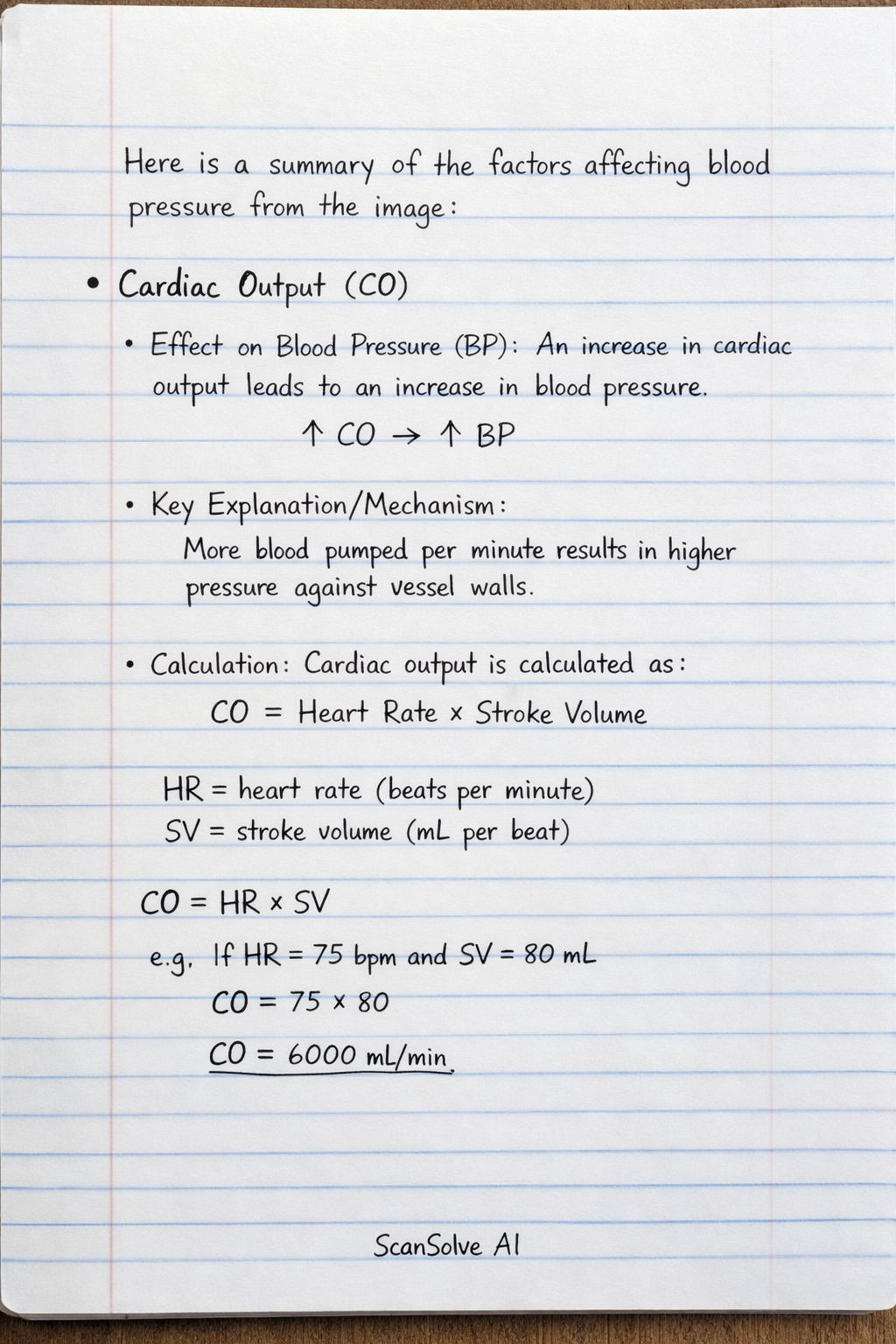
Here is a summary of the factors affecting blood pressure from the image:
-
Cardiac Output (CO)
- Effect on Blood Pressure (BP): An increase in cardiac output leads to an increase in blood pressure.
- Key Explanation/Mechanism: More blood pumped per minute results in higher pressure against vessel walls. Cardiac output is calculated as Heart Rate Stroke Volume.
-
Peripheral Resistance (TPR)
- Effect on Blood Pressure (BP): An increase in resistance leads to an increase in blood pressure, and a decrease in resistance leads to a decrease in blood pressure.
- Key Explanation/Mechanism: Primarily controlled by arteriole diameter.
- Vasoconstriction: Narrows blood vessels, increasing resistance and thus increasing blood pressure.
- Vasodilation: Widens blood vessels, decreasing resistance and thus decreasing blood pressure.
-
Blood Volume
- Effect on Blood Pressure (BP): An increase in blood volume leads to an increase in blood pressure.
- Key Explanation/Mechanism: More circulating fluid (e.g., from fluid retention, high salt intake) increases pressure in the vessels.
-
Vessel Elasticity
- Effect on Blood Pressure (BP): A decrease in vessel elasticity leads to an increase in systolic blood pressure, especially.
- Key Explanation/Mechanism: Stiff arteries (due to aging or atherosclerosis) have a low ability to stretch, leading to higher peak pressure during systole.
Was this helpful?
Need help with your own homework?
Get instant step-by-step solutions to any question. Free to start.
Ask Your Question
Handwritten Step-by-Step Solution
Get this as a handwritten image on WhatsApp — like a tutor wrote it for you.
Try on WhatsAppMore Biology Questions
QFeature Prokaryotic Eukaryotic Nucleus No true nucleus True nucleus Nuclear membrane Absent Present…QWhy do we drink waterQIn a food chain study, learners discussed energy transfer. State two ways energy is lost.QHow many chromosomes were present in the cell at the beginning of meiosis?QName the organelle that is found in plant cells only, where the nucleic acid named in QUESTION 1.4.1…
Still have questions?
Quick Answer
Cardiac Output (CO) Effect on Blood Pressure (BP)*: An increase in cardiac output leads to an increase in blood pressure.
ScanSolve AI Answer
Here is a summary of the factors affecting blood pressure from the image: Cardiac Output (CO) Effect on Blood Pressure (BP)*: An increase in cardiac output leads to an increase in blood pressure. CO BP Key Explanation/Mechanism*: More blood pumped per minute results in higher pressure against vessel walls. Cardiac output is calculated as Heart Rate × Stroke Volume. Peripheral Resistance (TPR) Effect on Blood Pressure (BP)*: An increase in resistance leads to an increase in blood pressure, and a decrease in resistance leads to a decrease in blood pressure. Resistance BP Resistance BP Key Explanation/Mechanism*: Primarily controlled by arteriole diameter. Vasoconstriction*: Narrows blood vessels, increasing resistance and thus increasing blood pressure. Vasoconstriction Resistance BP Vasodilation*: Widens blood vessels, decreasing resistance and thus decreasing blood pressure. Vasodilation Resistance BP Blood Volume Effect on Blood Pressure (BP)*: An increase in blood volume leads to an increase in blood pressure. Volume BP Key Explanation/Mechanism*: More circulating fluid (e.g., from fluid retention, high salt intake) increases pressure in the vessels. Vessel Elasticity Effect on Blood Pressure (BP)*: A decrease in vessel elasticity leads to an increase in systolic blood pressure, especially. Elasticity Systolic BP (especially) Key Explanation/Mechanism*: Stiff arteries (due to aging or atherosclerosis) have a low ability to stretch, leading to higher peak pressure during systole.