
We read your photo as:
Explain the concepts of price ceilings, shortages, and surpluses in economics, and calculate the monetary value of a surplus at a given price.
ScanSolve AI Answer
Step-by-step solution
7 stepsHere are the solutions to your questions.
QUESTION 1
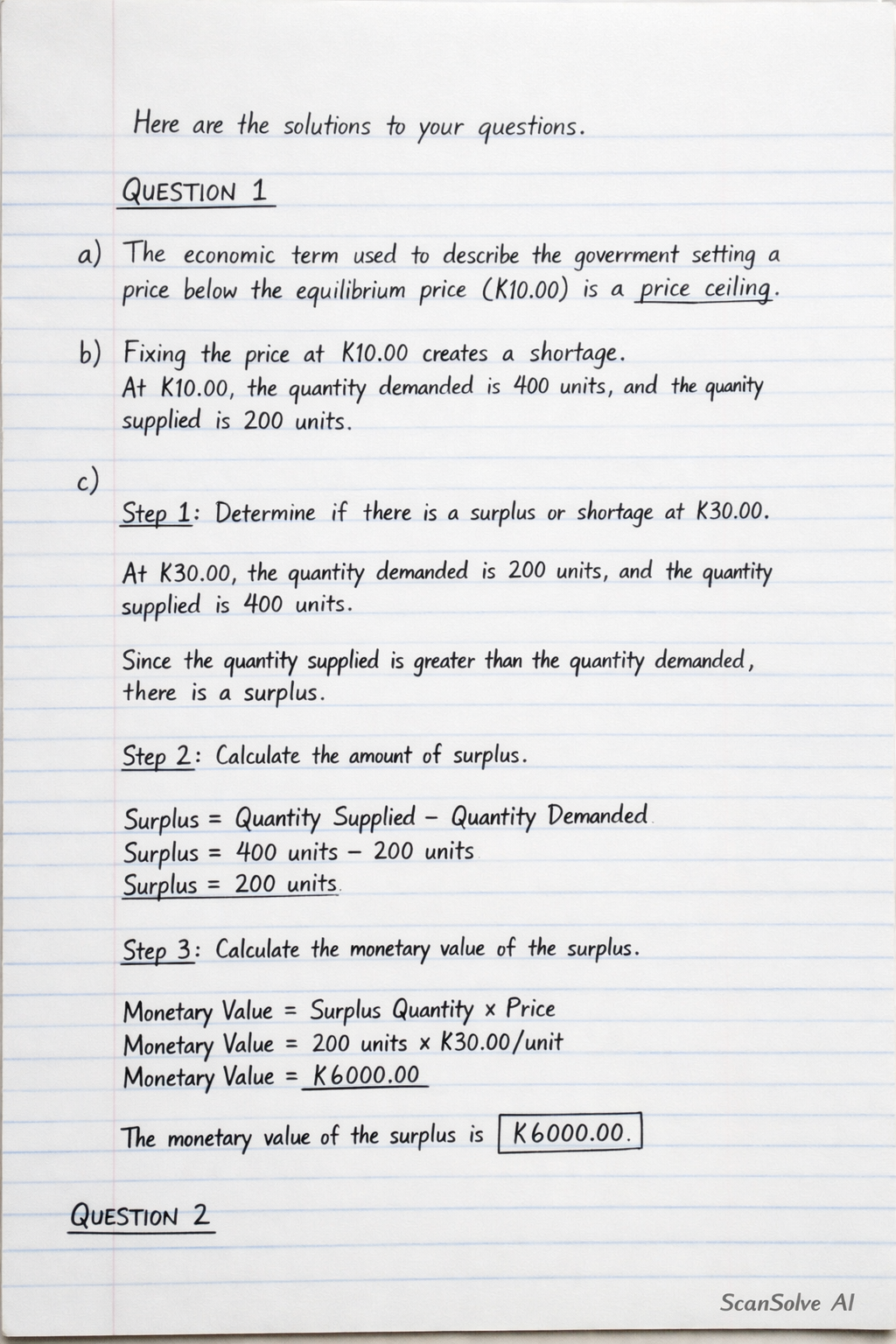
a) The economic term used to describe the government setting a price below the equilibrium price (K10.00) is a price ceiling.
b) Fixing the price at K10.00 creates a shortage. At K10.00, the quantity demanded is 400 units, and the quantity supplied is 200 units.
c)
Determine if there is a surplus or shortage at K30.00.
From the graph, at K30.00, the quantity demanded is 200 units, and the quantity supplied is 400 units.
Since the quantity supplied is greater than the quantity demanded, there is a surplus.Calculate the amount of surplus.
Calculate the monetary value of the surplus.
The monetary value of the surplus is .
QUESTION 2
A)
- Absolute Advantage theory: A country has an absolute advantage in producing a good if it can produce that good more efficiently (using fewer resources or producing more output with the same resources) than another country.
- Comparative Advantage theory: A country has a comparative advantage in producing a good if it can produce that good at a lower opportunity cost (giving up less of another good) than another country.
B)
a)
Compare production for oranges.
PNG produces 450 oranges, while Vanuatu produces 300 oranges. PNG produces more oranges.
Compare production for coffee.
PNG produces 200 coffee, while Vanuatu produces 150 coffee. PNG produces more coffee.
PNG has an absolute advantage in the production of both oranges and coffee.b) From absolute theory point of view, which country should be specialized in producing:
(i) Oranges:
(ii) Coffee:
d) From comparative advantage theory point of view, which country should be specialized in producing:
Calculate the opportunity cost for each country for both goods.
For PNG:
Opportunity cost of 1 Orange =
Opportunity cost of 1 Coffee =For Vanuatu:
Opportunity cost of 1 Orange =
Opportunity cost of 1 Coffee =Compare opportunity costs to determine comparative advantage and specialization.
(i) For Oranges: PNG's opportunity cost (0.44 Coffee) is lower than Vanuatu's (0.5 Coffee). Therefore, PNG has a comparative advantage in oranges.
(ii) For Coffee: Vanuatu's opportunity cost (2 Oranges) is lower than PNG's (2.25 Oranges). Therefore, Vanuatu has a comparative advantage in coffee.
(i) Oranges:
(ii) Coffee:
Still stuck on this one?
Ask a follow-up, and the answer starts from this question.
More Economics Questions
Handwritten Step-by-Step Solution
Get this as a handwritten image on WhatsApp — like a tutor wrote it for you.
Try on WhatsApp